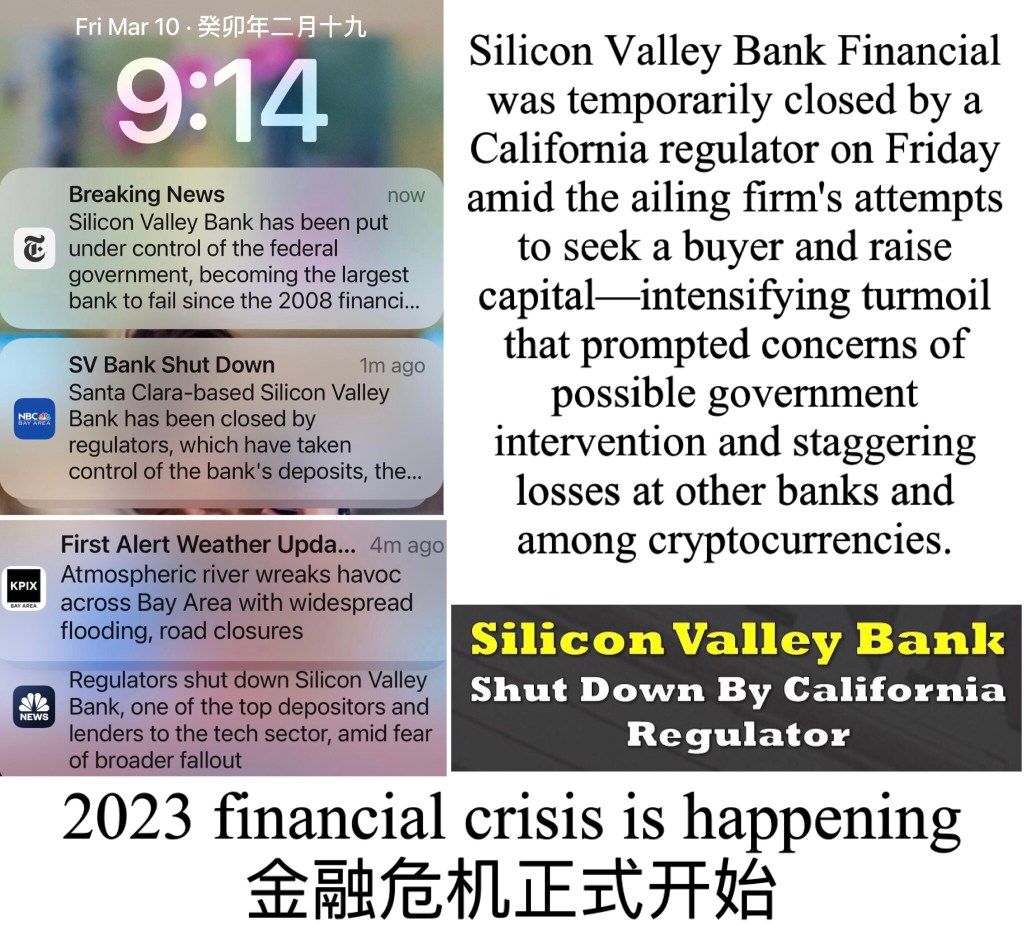
High paying job cuts especially in high tech skyrocket across US – report. Silicon Valley Bank just went busted. Layoffs jumped more than five times in February from a year earlier, an outplacement firm reports.

High paying job cuts especially in high tech skyrocket across US – report. Silicon Valley Bank just went busted. Layoffs jumped more than five times in February from a year earlier, an outplacement firm reports.
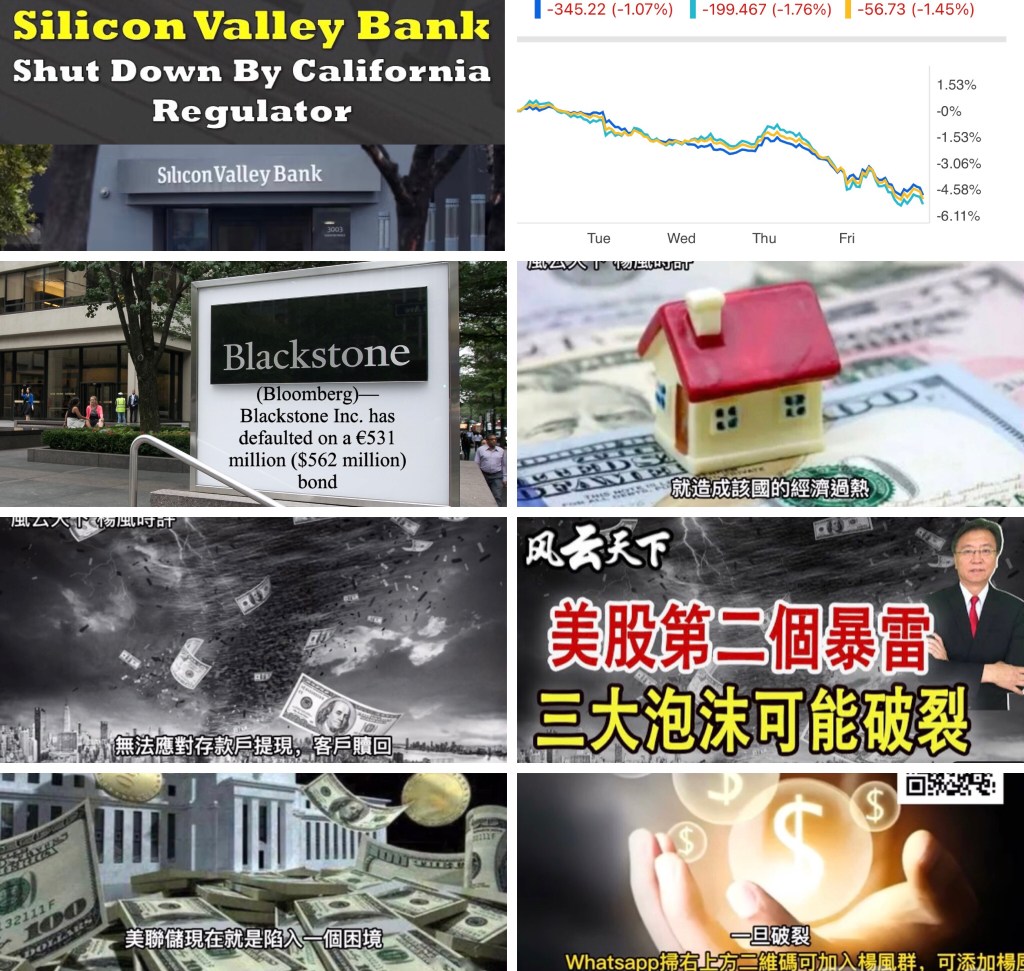
Taiwan US-China Expert video: The second thunderstorm in the US stock market, US three major bubbles may burst 台灣中美專家視頻: 美股第二個暴雷 三大泡沫可能破裂
https://rumble.com/v2cn488-us-three-major-bubbles-may-burst.html
https://m.facebook.com/story.php?story_fbid=908929780330348&id=100036400039778&mibextid=qC1gEa
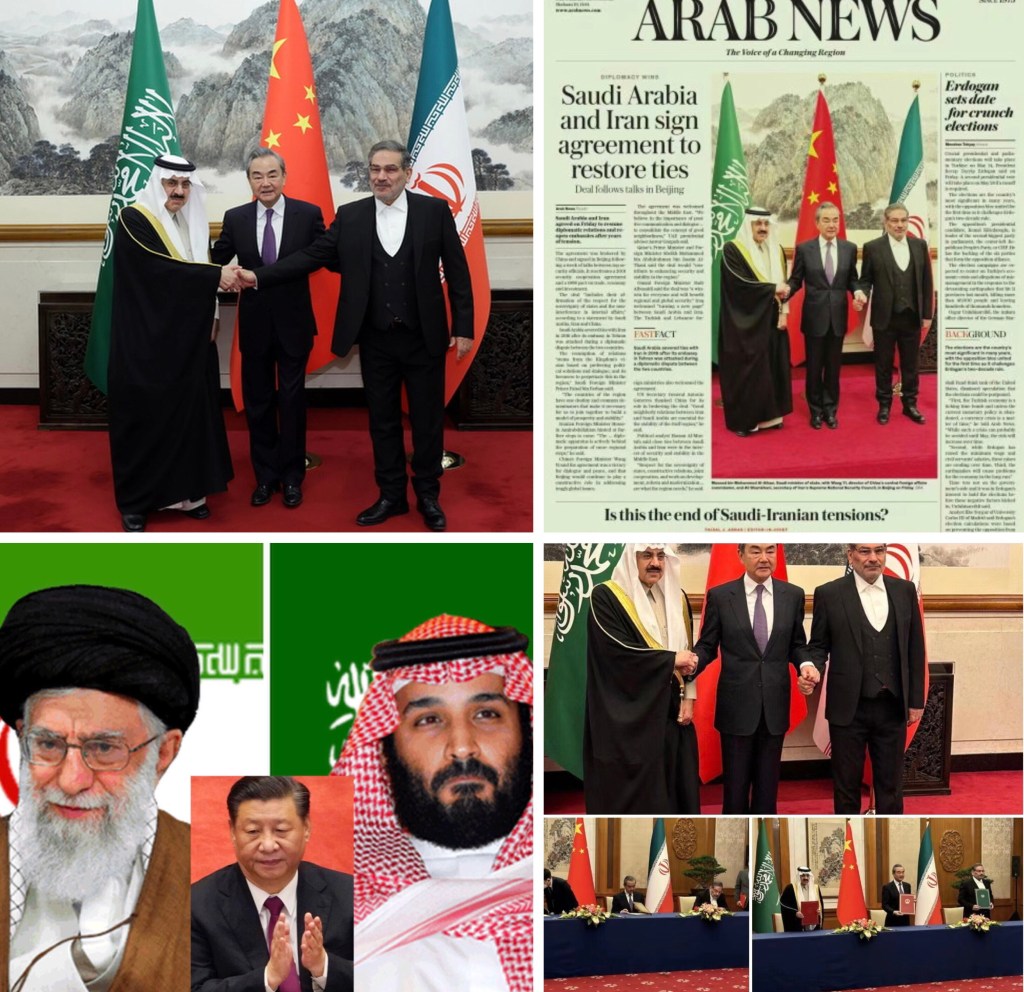
Analysis: China role in Saudi, Iran deal a tricky test for US War Machines, the Military Industrial Complex 分析:中國在沙特、伊朗的角色對美國戰爭機器、軍事工業園區構成嚴峻考驗 By Phil Stewart and Michelle Nichols March 11, 2023
Wang Yi, a member of the Political Bureau of the Communist Party of China (CPC) Central Committee and director of the Office of the Central Foreign Affairs Commission, Ali Shamkhani, the secretary of Iran’s Supreme National Security Council, and Minister of State and national security adviser of Saudi Arabia Musaad bin Mohammed Al Aiban pose for pictures during a meeting in Beijing, China March 10, 2023. China Daily via REUTERS
NEW YORK/WASHINGTON, March 10 (Reuters) – The surprise deal between Iran and Saudi Arabia to restore diplomatic ties offers much for the United States to be intrigued about, including a possible path to rein in Tehran’s nuclear program and a chance to cement a ceasefire in Yemen.
It also contains an element sure to make officials in Washington deeply uneasy – the role of China as peace broker in a region where the U.S. has long wielded influence.
The deal was announced after four days of previously undisclosed talks in Beijing between the Middle East rivals. White House spokesperson John Kirby said on Friday that while Washington was not directly involved, Saudi Arabia kept U.S. officials informed of the talks with Iran.
Relations between the U.S. and China have become highly contentious over issues ranging from trade to espionage and increasingly the two powers compete for influence in parts of the world far from their own borders.
Kirby appeared to downplay China’s involvement in Friday’s development, saying the White House believes internal and external pressure, including effective Saudi deterrence against attacks from Iran or its proxies, ultimately brought Tehran to the table.
But former senior U.S. and U.N. official Jeffrey Feltman said China’s role, rather than the re-opening of embassies after six years, was the most significant aspect of the agreement.
“This will be interpreted – probably accurately – as a slap at the Biden administration and as evidence that China is the rising power,” said Feltman, a fellow at the Brookings Institution.
NUCLEAR TALKS
The agreement comes as Iran accelerates its nuclear program after two years of failed U.S. attempts to revive a 2015 deal that aimed to stop Tehran producing a nuclear bomb.
Those efforts have been complicated by a violent crackdown by Iranian authorities on protests and tough U.S. sanctions on Tehran over accusations of human rights abuses.
Brian Katulis, of the Middle East Institute, said that for the U.S. and Israel the agreement offers a “new possible pathway” for reviving stalled talks on the Iran nuclear issue, with a potential partner in Riyadh.
“Saudi Arabia is deeply concerned about Iran’s nuclear program,” he said. “If this new opening between Iran and Saudi Arabia is going to be meaningful and impactful, it will have to address the concerns about Iran’s nuclear program – otherwise the opening is just optics.”
Friday’s agreement also offers hope for more durable peace in Yemen, where a conflict sparked in 2014 has widely been seen as a proxy war between Saudi Arabia and Iran.
A U.N.-brokered truce agreed last April has largely held despite expiring in October without agreement between the parties to extend it.
Gerald Fierestein, a former U.S. ambassador to Yemen, said Riyadh would “not have gone along with this without getting something, whether that something is Yemen or something else is harder to see.”
GROWING ROLE FOR CHINA
China’s involvement in brokering the deal could have “significant implications” for Washington, said Daniel Russel, the top U.S. diplomat for East Asia under former President Barack Obama.
Russel said it was unusual for China to act on its own to help broker a diplomatic deal in a dispute to which it was not a party.
“The question is, whether this is the shape of things to come?” he said. “Could it be a precursor to a Chinese mediation effort between Russia and Ukraine when Xi visits Moscow?”
When it comes to Iran, it is not clear that the results will be good for the U.S., said Naysan Rafati, senior Iran analyst at International Crisis Group.
“The drawback is that at a time when Washington and Western partners are increasing pressure against the Islamic Republic … Tehran will believe it can break its isolation and, given the Chinese role, draw on major-power cover,” said Rafati.
China’s involvement has already drawn skepticism in Washington about Beijing’s motives.
Republican Representative Michael McCaul, chairman of the U.S. House of Representatives Foreign Affairs Committee, rejected China’s portrayal of itself as peace-broker, saying it “is not a responsible stakeholder and cannot be trusted as a fair or impartial mediator.”
Kirby said the U.S. was closely monitoring Beijing’s behavior in the Middle East and elsewhere.
“As for Chinese influence there or in Africa or Latin America, it’s not like we have blinders on,” he said. “We certainly continue to watch China as they try to gain influence and footholds elsewhere around the world in their own selfish interests.”
Still, Beijing’s involvement adds to a perception of growing Chinese power and influence that contributes to a narrative of a shrinking U.S. global presence, said Jon Alterman, of Washington’s Center for Strategic and International Studies.
“The not-so-subtle message that China is sending is that while the United States is the preponderant military power in the Gulf, China is a powerful and arguably rising diplomatic presence,” he said.
Additional reporting by Patricia Zengerle, Jonathan Landay and David Brunnstrom; Writing by Michelle Nichols; Editing by Don Durfee and Daniel Wallis
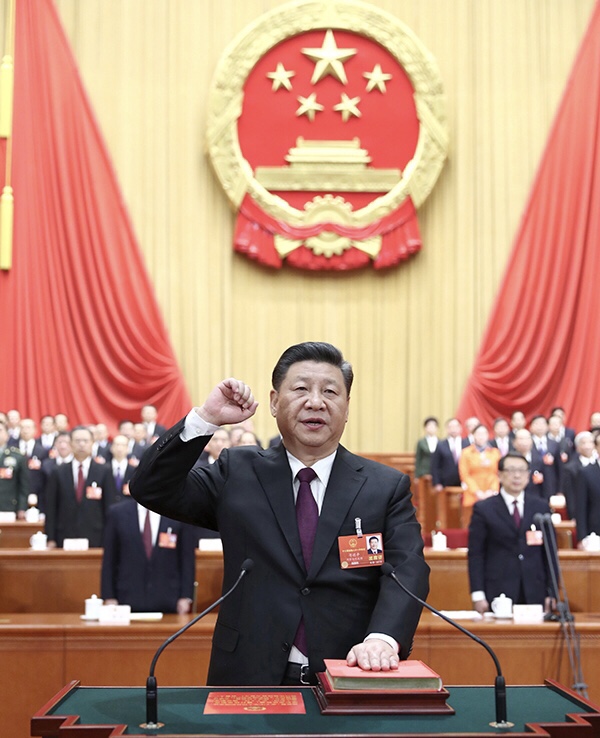
Video: Newly elected President and Chairman of the Central Military Commission Xi Jinping took the constitutional oath. 新當選的國家主席、中央軍委主席習近平進行憲法宣誓.
“I swear: to be loyal to the Constitution of the People’s Republic of China, to uphold the authority of the Constitution, to perform statutory duties, to be loyal to the motherland and to the people, to fulfill our duties, to be honest and honest, to accept the supervision of the people, and to work hard to build a prosperous, strong, democratic, civilized, harmonious and beautiful modern socialist country! Xi Jinping.”
「我宣誓:忠於中華人民共和國憲法,維護憲法權威,履行法定職責,忠於祖國、忠於人民,恪盡職守、廉潔奉公,接受人民監督,為建設富強民主文明和諧美麗的社會主義現代化強國努力奮鬥!宣誓人習近平。」
https://rumble.com/v2cki9g-xi-jinping-took-the-constitutional-oath.html
https://m.facebook.com/story.php?story_fbid=908638957026097&id=100036400039778&mibextid=qC1gEa
Video: Why China stopped Ants Group IPO in US? 為何中國阻止螞蟻集團赴美上市?
https://rumble.com/v2ckcs8-why-china-stopped-ants-group-ipo-in-us.html
https://m.facebook.com/story.php?story_fbid=908628807027112&id=100036400039778&mibextid=qC1gEa
How US financial games are played, the winner is always the banker who invests very little money but wins the most, and the investor who invests most of the money may lose everything CHINA SAY NO 美國金融遊戲是怎樣玩的, 贏家總是莊家投入極少的錢但贏最多, 投資者投入最多的錢但可能輸得一干二淨 中國不容許這種無本生意
2023 financial crisis is happening, mass layoffs at Silicon Valley will continue 金融危机正式开始, 矽谷大規模裁員將繼續
Silicon Valley Bank Financial was temporarily closed by a California regulator on Friday amid the ailing firm’s attempts to seek a buyer and raise capital—intensifying turmoil that prompted concerns of possible government intervention and staggering losses at other banks and among cryptocurrencies.
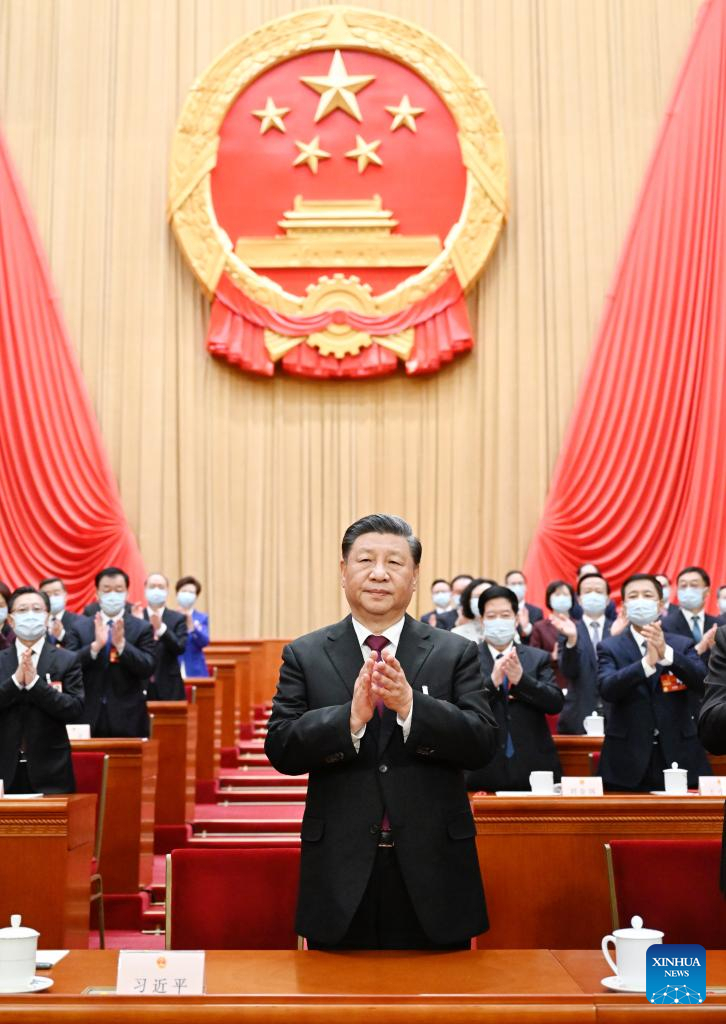
One of China best CEO in China’s 5000 years history: Xi unanimously elected Chinese president, PRC Central Military Command chairman, leads China on new journey in unity, confidence 中國5000年歷吏最佳行政總裁之一: 習近平全票當選中國國家主席、中華人民共和國中央軍事司令部主席,帶領中國團結自信踏上新征程.
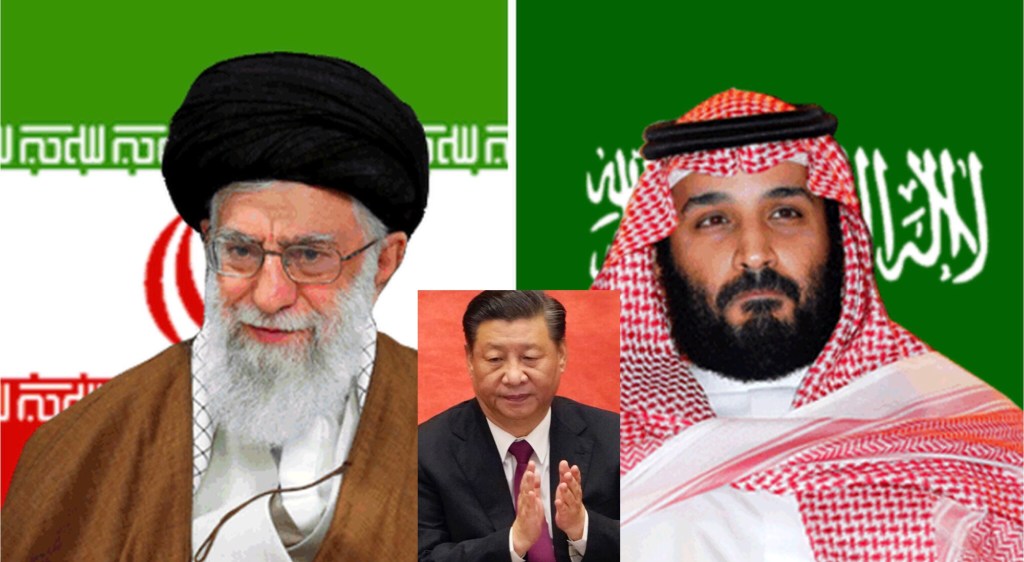
NYT: With the help of China, Saudi Arabia and Iran agree to re-establish ties in major regional shift, a huge blow to US hegemony in the Middle East 紐約時報:在中國的幫助下,沙特阿拉伯和伊朗同意在重大地區轉移中重建關係,對美國在中東的霸權造成巨大打擊
当地时间3月10日,沙特阿拉伯政府发布沙特、伊朗、中国三方联合声明。声明宣布,通过中国主办主持的会谈,沙特和伊朗达成协议,同意恢复两国外交关系,并在两个月内重新开放大使馆,通过对话和外交解决两国之间的分歧。伊朗官方媒体伊通社(IRNA)也报道了这一消息。
DUBAI, United Arab Emirates — Longtime regional foes Iran and Saudi Arabia agreed to resume diplomatic relations and reopen embassies in each other’s countries following China-led negotiations in Beijing, both governments announced via their respective state media agencies.
“As a result of the talks, Iran and Saudi Arabia agreed to resume diplomatic relations and re-open embassies …within two months,” Iran’s news agency IRNA reported Friday.
Saudi Arabia’s state Saudi Press Agency confirmed the announcement in its own statement.
The Saudi statement profusely thanked Beijing for its leadership in the talks.
“In response to the noble initiative of His Excellency President Xi Jinping, President of the People’s Republic of China, of China’s support for developing good neighborly relations between the Kingdom of Saudi Arabia and the Islamic Republic of Iran... The delegations from the two countries held talks during the period 6-10 March 2023 in Beijing,” the SPA statement said.
It emphasized the Chinese leader’s role in hosting and sponsoring talks between the Saudi Kingdom and Iran, a process that Riyadh described as “proceeding from their shared desire to resolve the disagreements between them through dialogue and diplomacy, and in light of their brotherly ties.”
The Saudi statement also expressed thanks to Riyadh’s neighbors Iraq and Oman, which it said had hosted “rounds of dialogue that took place between both sides during the years 2021-2022.”
Oman’s foreign ministry welcomed the Friday development on Twitter, expressing hope that it will “contribute to strengthening the pillars of security and stability in the region and consolidating positive and constructive cooperation that benefits all peoples of the region and the world,” according to a Google translation.
Iran and Saudi Arabia have long accused each other of destabilizing the region and regarded one another as grave security threats, often on opposite sides of regional conflicts such as those in Yemen, Lebanon and Syria.
Saudi Arabia cut diplomatic ties with Iran in 2016, after Iranian protesters stormed the Saudi embassy in Tehran in response to Saudi authorities executing 47 dissidents, including a leading Shia cleric.
The breakthrough is very positive news for the region, said Anna Jacobs, senior Gulf analyst at the International Crisis Group.
“It’s hugely positive news,” she said, which signals that there has been enough dialogue “to start some serious confidence building measures and agree to this roadmap to restore full diplomatic relations. The news also suggests we are likely to some positive movement on the Yemen ceasefire.”
The development “shows that Saudi-Iran dialogue has succeeded after many years, and it’s succeeded with support from regional powers like Iraq and Oman, but also global powers like China,” Jacobs told CNBC.
The agreement also illustrates that China has stepped up its role in the region in new ways, particularly in mediation,Jacobs added. “For China, this is a huge win.”
This breakthrough signals even further momentum towards an Asia-centered multipolar world, with its trade-and-development focused multilateralism. It also signals the weakening of Empire-driven “divide and conquer”–where the West has colonized, balkanized & fanned conflict–in particular weaponizing Wahhabism/Salafism (and other sectarian divides) against its enemies–, China is now mediating and reconnecting.
This has to do with China’s strong relations with Iran–historically China has always had good relations with Persia/Iran–for millenia–, and Iran had just recently joined the SCO and signed a 25 year comprehensive strategic partnership with China.
At the same time, China had been strengthening relations with the Gulf Cooperation Countries–as demonstrated in the recent visit of XJP to Saudia Arabia, which is seeking to join the BRICS, and the signing of multiple agreements with the GCC. This dual relationship with both Iran and Saudia Arabia0GCC had looked like a highly unstable dynamic, but behind the scenes, Chinese diplomats had been working to resolve the contradictions.
Note that where Saudi Arabia goes, the other Gulf Cooperation Countries/Western Asian countries are likely to follow. Note also that this also puts real wind into the drive towards dedollarization–as the lifeblood of the global economy shifts to the 7 R’s (The Brics’ Real, Rouble, Rupee, RMB, Rand, and now Saudi Rial), and now the Iranian Rial.
This weakens & undermines the petro-dollar bourse which was the foundation of the unlimited credit card that the US has used to fund its endless wars in Asia and elsewhere.
Syria, Iraq, Lebanon, Bahrain, Yemen, which have functioned as proxy conflicts, now may have conditions to create positive shifts.
This is just the first of many steps, but I believe it is an important opening towards a more peaceful world.
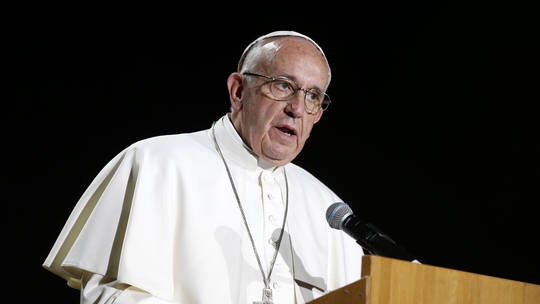
The Pope is speaking out against US, UK & NATO: Ukraine conflict being fueled by empires. The interests of several countries, not just Russia, are driving the hostilities – Pope Francis 教皇公開反對美國、英國和北約:帝國助長了烏克蘭衝突。幾個國家的利益,不僅僅是俄羅斯,正在推動敵對行動 – 教宗方濟各
Russia is not the only “empire” whose interests are driving the conflict in Ukraine, Pope Francis said in an interview with Swiss television RSI, set to be released on Sunday. Excerpts from the interview were published on Friday by several Italian outlets.
Asked about the ongoing conflict between Moscow and Kiev, the Pope noted that it had grown into a “world war” where “the great powers are all entangled.”
“The battlefield is Ukraine. Everyone is fighting there. This makes industry think of weapons,” the Pontiff commented.
He mentioned that on the second day after Russia launched its military offensive against Ukraine, he went to the Russian embassy and offered to travel to Moscow to personally negotiate with President Vladimir Putin. However, he said he was told by Foreign Minister Sergey Lavrov that it was “not the time.”
The pontiff stated that Putin knows that the option to negotiate peace is always available, but acknowledged that there are “imperial interests” at play in the Ukrainian conflict, and “not only of the Russian empire, but of empires elsewhere.”
“It is the empire’s business to put nations second,” proclaimed the Pope.
Francis has repeatedly called for a peaceful end to the hostilities that have gripped Ukraine over the past year. However, after suggesting that the conflict was “perhaps somehow either provoked or not-prevented” and that there is an “interest in testing and selling weapons” at play, the Pope did point out that he is not a supporter of Putin.
It would be simplistic and erroneous to say such a thing,” insisted the Pontiff in an interview in June, adding “I am simply against turning a complex situation into a distinction between good guys and bad guys, without considering the roots and self-interests, which are very complex.”
The Pope made similar remarks in an interview with Spanish paper ABC in December, where he also suggested that “war is being waged when an empire begins to weaken. And when there are weapons to be used, tested and sold. The stakes are high.”
Moscow, meanwhile, has repeatedly described the conflict in Ukraine as a “proxy war” being waged against it by the US and its allies. Putin has pointed out that the West is now seeking a global conflict, with some NATO officials openly calling for the “strategic defeat of Russia.”
He has also pinned the blame for the Ukraine conflict on Kiev and its Western backers who started the war against the people of Donbass in 2014. He noted, however, that although Russia “did not start the military activities,” it is now trying to end them.
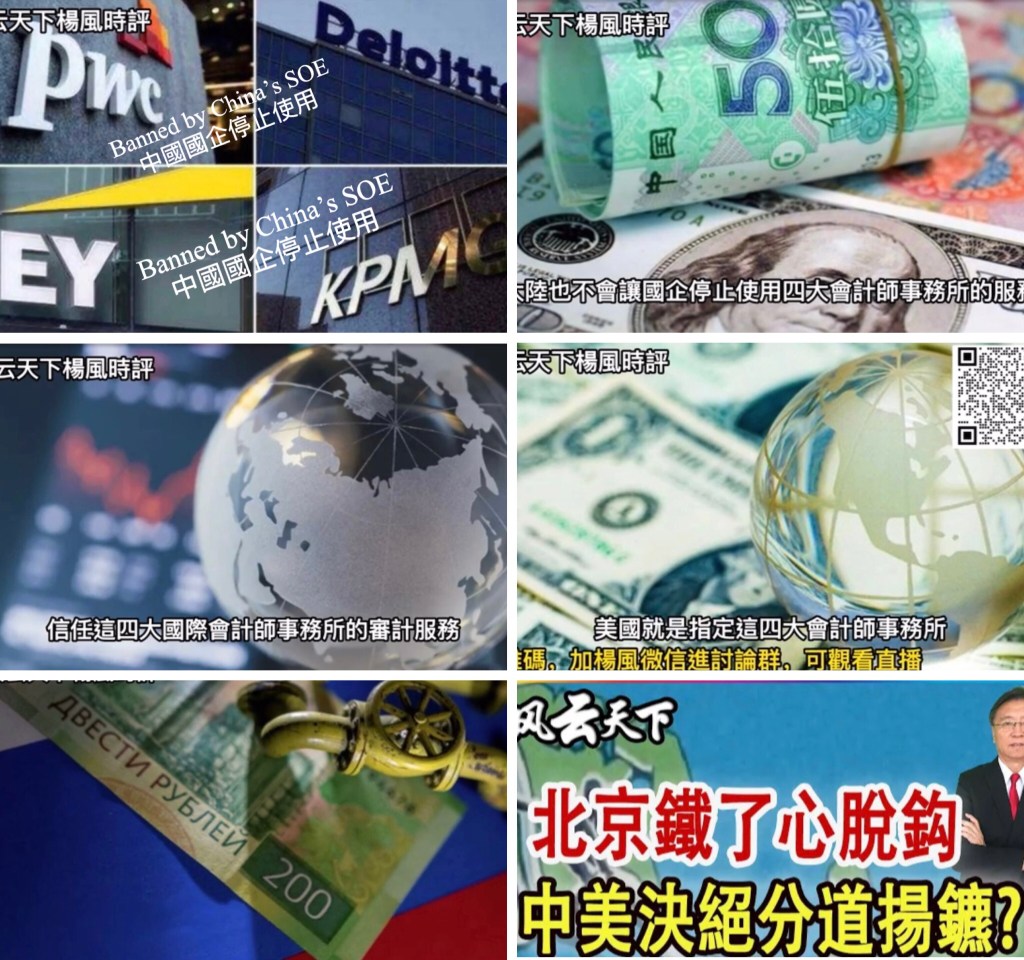
Taiwan US-China expert video: Beijing determined to decouple with US & there is no turning back 台灣中美尊家視頻: 北京鐵了心和美國脫鈎 中美決絕分道揚鑣?
https://rumble.com/v2chvw8-beijing-determined-to-decouple-with-us.html
https://m.facebook.com/story.php?story_fbid=908391983717461&id=100036400039778&mibextid=qC1gEa
 Business Blog