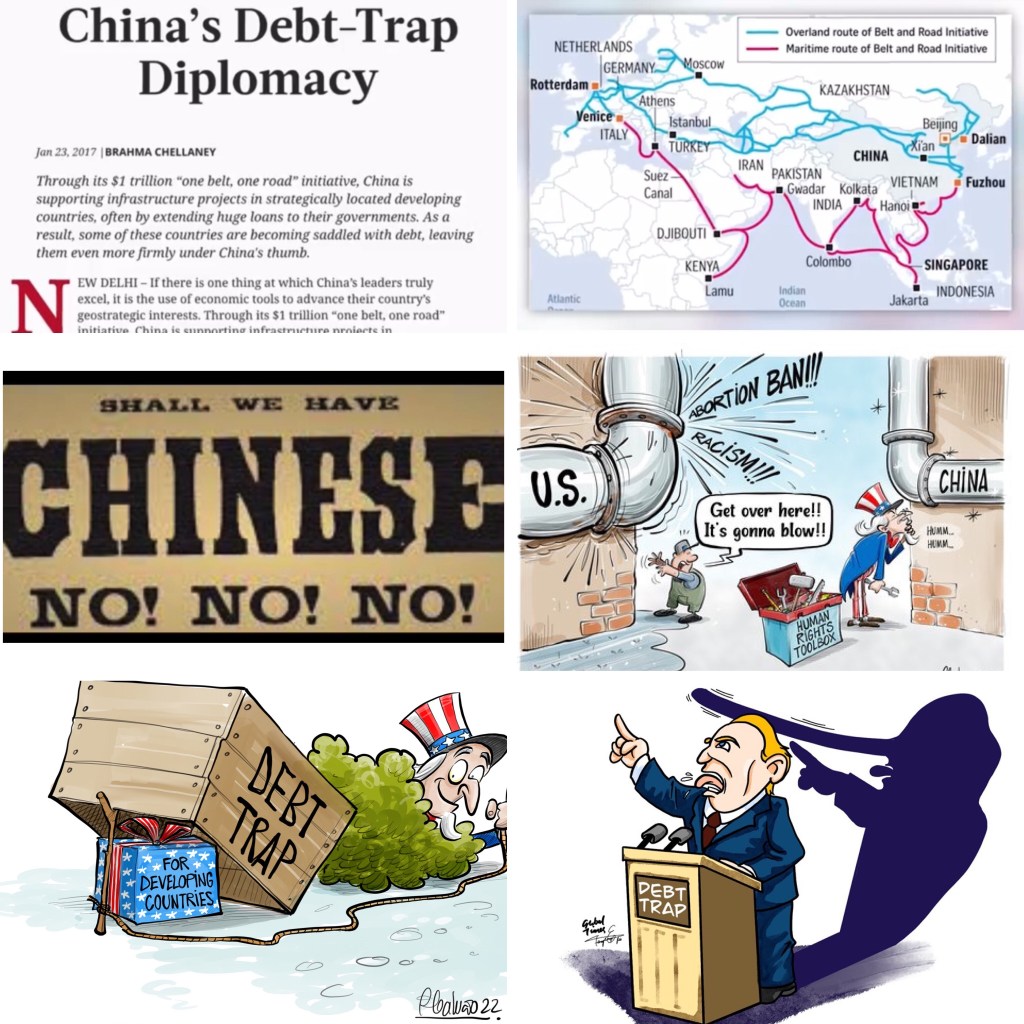
Anti-China Protests in Thailand video: Who is Behind them & Why? US Searching for Asia’s “Zelensky” “The Comedian”. Let’s look back at US racist history and crimes against humanity since before 1776: eliminated 90% of Native Americans populations through ethnic cleansing, brought in African Slaves, 1882 Chinese Exclusion Acts (till today), African-American US President Obama (supported by all latter US Presidents) said Chinese does not deserve a good life want to send China back to the Stone Age. All of the above is supported and legitimized by the US Constitution in the name of (fake) Freedom Democracy Human Rights and Rules of Law, the US rule based order that if you want to live must follow otherwise ends up like Iran, Iraq, Libya, Afghanistan, Syria, Yemen, Palestine…sent 10s of millions of refugees to Europe…ongoing regime change attempts at Thailand, Myanmar, Russia, China…destroying Europe through proxy war against Russia in Ukraine by cutting off cheap Russia energy supplies forcing them to buy it 4x more from US to make America Great Again…and the list goes on. When you have a friend like US, who needs enemies https://youtu.be/eGTD6308loY 泰國反華抗議活動視頻:誰在背後支持?為什麼?美國尋找亞洲的“澤倫斯基”“喜劇演員”。讓我們回顧一下美國自1776年以來的種族主義歷史和反人類罪 1)通過種族清洗消滅了90%的美洲原住民人口,引進非洲奴隸,1882年的排華法案(至今),非裔美國總統奧巴馬(所有後來的美國總統也支持) 都說中國人不配過上好日子想把中國送回石器時代。以上所有內容都得到美國憲法的支持並以(假)自由民主人權和法治的名義合法化,美國基於規則的秩序如果你想生存就必須遵守,否則最終會像伊朗、伊拉克、利比亞, 阿富汗,敘利亞,也門,巴勒斯坦的下場……將數以百萬計的難民送往歐洲的禮物……泰國,緬甸,俄羅斯,中國正在進行政權更迭……通過切斷廉價的俄羅斯能源供應迫使歐盟從美國購買石油天然氣高達四倍的價錢, 讓美國再次偉大……這樣的例子不勝枚舉。當你有像美國這樣的朋友你還需要敵人嗎?
Professor Ling-Chi Wang of UC Berkeley: I think the only way to describe what is happening to TSMC 台積电 in Hsinchu, Taiwan is to call it the biggest international heist, in broad daylight, of Taiwan’s biggest and most valuable manufacturing facility and intellectual property theft, estimated to be worth 4% of Taiwan’s GNP, considered by the people of Taiwan to be their 护国神山, ever undertaken in human history by the U.S. government. The people of Taiwan are stunned by the magnitude and speed of the heist and the massive airlifting of the manufacturing facility, its most advance know-hows, and top scientists and engineers and their families to Phoenix, Arizona, commencing in December. The U.S. is paying billions to relocate and transport the company to the U.S. The scale of intellectual robbery is unmatched by other large-scale international robberies I know of. The U.S. justified the robbery by declaring it a matter of “national security” of the U.S., based on the assumption that China will sooner or later seize Taiwan, thus depriving the U.S. and the world of its indispensable products. What is even more stunning and insulting to the people of Taiwan is the conspicuous absence of any meaningful protest by the Taiwan government of Tsai Ing-wen. In fact, the government is aid and abetting the robbery.
Professor John V Walsh, MD, in San Francisco: First the US frightens them with threats of war and turning Taiwan into a porcupine bristling with American weapons. No one wants to live in Ukraine 2.0.
Then the US offers an “escape hatch” to Arizona where these Taiwanese may find the US anti-China rhetoric a bit much to stomach – and no distinctions made between Taiwanese and Chinese by street toughs.
Bloomberg: Europe has been taken to the cleaners by US Reasserts Middle Path on China, Pushing Back on Biden 彭博社:歐洲在中國問題上重申中間路線,反擊拜登,歐洲已成為美國殖民地!?
President Xi Jinping started his week overseas mending ties with the US, and ended it with European leaders making the case for resisting the Biden administration’s sweeping chip curbs on China.
The shift in sentiment amounts to a victory for Xi on just his second foray outside of China since the pandemic began — a span that had seen Beijing’s relations with the US and its allies go from bad to worse. In October, President Joe Biden restricted the sale of semiconductors and chipmaking equipment to China in a bid to stem its economic development, and asked key allies to comply — raising fears of a split in the global economy.
On Friday, French President Emmanuel Macron called for engagement with Beijing and resisting efforts to divide the world into competing blocs. That followed similar appeals from German Chancellor Olaf Scholz, who visited China earlier this month, and efforts by Dutch Prime Minister Mark Rutte to coordinate with other key chipmaking nations in resisting US pressure.
“Now, progressively, a lot of people would like to see that there are two orders in this world,” Macron said in a speech to business executives at the Asia-Pacific Economic Cooperation CEO summit in Bangkok. “This is a huge mistake, even for both the US and China.”
“We need a single global order,” he added, a line that drew extended applause.
The French leader’s comments in particular show Europe is finding its footing in carving out a middle ground when it comes to China. While calls have grown in some European capitals to get tougher with Beijing on issues related to human rights and democracy, the sweeping US export controls on chips — which may soon be extended to other strategic technologies — have shifted the conversation from fears about China to concern about American overreach.
With Germany heading toward recession and Europe facing a harsh winter without cheap Russian oil and gas, “there is little appetite for confrontation with Beijing,” said Noah Barkin, managing editor of the Rhodium Group’s China practice.
“For all the rhetoric about standing up to Xi, forging a common European front and mitigating the risks of economic engagement with China, the actions over the past month have fallen short,” he said. “The risk, if this continues, is more cracks in the transatlantic relationship. We are already seeing some of these cracks in Europe’s reaction to recent US technology controls aimed at China.”
Xi sought to exploit the divisions on his six-day trip to attend the Group of 20 summit in Bali and APEC in Thailand, during which he met with roughly 20 leaders — many of whom he hadn’t seen face-to-face in at least three years. In a meeting with Rutte in Bali, Xi urged the Dutch leader to avoid “decoupling” as the US piles pressure on ASML Holding NV, which has a virtual monopoly on a type of machine needed to make the most advanced chips.
trade issues and maintain the stability of the global industrial chain and supply chain,” Xi told Rutte on Tuesday. The Chinese leader also called for increased cooperation in high-tech manufacturing with South Korea in a meeting with President Yoon Suk Yeol, whose nation is home to chip giants Samsung Electronics Co. and SK Hynix Inc.
Later in the week on Thursday, Rutte met with Yoon during a visit to Seoul, where the two leaders pledged greater cooperation. A day later, Dutch Foreign Trade Minister Liesje Schreinemacher said the US shouldn’t expect the Netherlands to unquestionably adopt its approach to China export restrictions.
“The Netherlands will not copy the American measures one to one,” Schreinemacher said in an interview with Dutch newspaper NRC published on Friday. “We make our own assessment — and we do this in consultation with partner countries such as Japan and the US.”
The Biden-Xi summit showed that the world’s largest economies understand their responsibility to overcome divisions, but risks remain of a greater bifurcation without follow through in subsequent discussions, according to International Monetary Fund Managing Director Kristalina Georgieva.
“We are in a world that is going from one shock to another — pandemic, war, inflation, cost of living crisis,” the Bulgarian economist told Bloomberg Television on Saturday. “And if we add on top of it the fragmentation in the world economy, it would be throwing gasoline on a fire. Nobody benefits from it.”
The US moves to restrict trade with China have also come under criticism in Asia, where nations like Singapore have warned against cutting off Beijing economically. Many governments in the region also viewed US House Speaker Nancy Pelosi’s trip to Taiwan earlier this year as unnecessarily provocative.
Biden appeared to address those concerns after his meeting with Xi, telling reporters he didn’t see “any imminent attempt” by China to invade Taiwan and made clear the US policy toward the self-governed island “has not changed at all.” He said Xi was “straightforward,” adding that “I think that we understand one another.”
Though major European leaders are increasingly resistant to rising pressure from Washington, they are far from reaching a consensus on how to deal with an increasingly assertive China. While the European Union has labeled China a systemic rival, policy across the continent remains fragmented.
Former Soviet bloc countries in particular are coming to view Beijing’s economic influence over the continent with suspicion. Finnish Prime Minister Sanna Marin on Thursday warned of Europe’s technological dependency on China, noting the risks of becoming too reliant on an authoritarian regime.
Xi’s diplomatic support for Vladimir Putin, who invaded Ukraine shortly after declaring a “no limits” friendship with the Chinese leader, has also helped strengthen US-Europe bonds. The Chinese leader has recently moved to alleviate some concerns about his relationship with Putin by drawing a red line on the use of nuclear weapons, a line he mentioned during a meeting with Scholz and later repeated with Biden.
Altogether, Xi’s actions at least have Europe thinking about a middle path. In an extended metaphor during his APEC speech, Macron likened the US and China to “two big elephants” in a jungle.
“If they become very nervous and start a war, it will be a big problem for the rest of the jungle,” he said. “You need the cooperation of a lot of other animals.”
Singtao Newspaper SF Live Webcast 11-22-2022 9:00am
The Shrinking Influence of Chinese-Americans in US Politics despite the song and dance by some to fool us, facts and results cannot lie! https://youtu.be/pr0WtqIbcqI 時事觀察集結號:美國華人政治力量在萎縮
Chinese scientists are leaving America and moving to China. Why is this happening? In today’s video I examine this interesting trend and reveal how Donald Trump’s policy has caused much fear amongst Chinese professors and students, and why the America China university battle is only just beginning. 中國科學家正離開美國前往中國。為什麼會這樣?在今天的視頻中,我研究了這一有趣的趨勢,並揭示了唐納德特朗普的政策如何在中國教授和學生中引起了極大的恐懼,以及為什麼美中大學之戰才剛剛開始。
Poland, Bulgaria, Lithuania and More: Here are the Biggest Losers of Europe’s Energy Crisis. Eastern Europe is home to many countries. Albania, Bosnia and Herzegovina, Bulgaria, Croatia, the Czech Republic, Estonia, Hungary, Kosovo, Latvia, Lithuania, the Republic of North Macedonia, Moldova, Montenegro, Poland, Romania, Serbia, Slovakia, Slovenia and Ukraine. Not one of the 19 countries in Eastern Europe is in the list of the biggest economies of the bloc. That list is comprised of the likes of Germany, France, Italy, Spain, UK and Russia. 波蘭、保加利亞、立陶宛等:這是歐洲能源危機的最大輸家。東歐是許多國家的家園。阿爾巴尼亞、波斯尼亞和黑塞哥維那、保加利亞、克羅地亞、捷克共和國、愛沙尼亞、匈牙利、科索沃、拉脫維亞、立陶宛、北馬其頓共和國、摩爾多瓦、黑山、波蘭、羅馬尼亞、塞爾維亞、斯洛伐克、斯洛文尼亞和烏克蘭。東歐 19 個國家中沒有一個國家在該集團最大經濟體的名單中。該名單包括德國、法國、意大利、西班牙、英國和俄羅斯等國家。