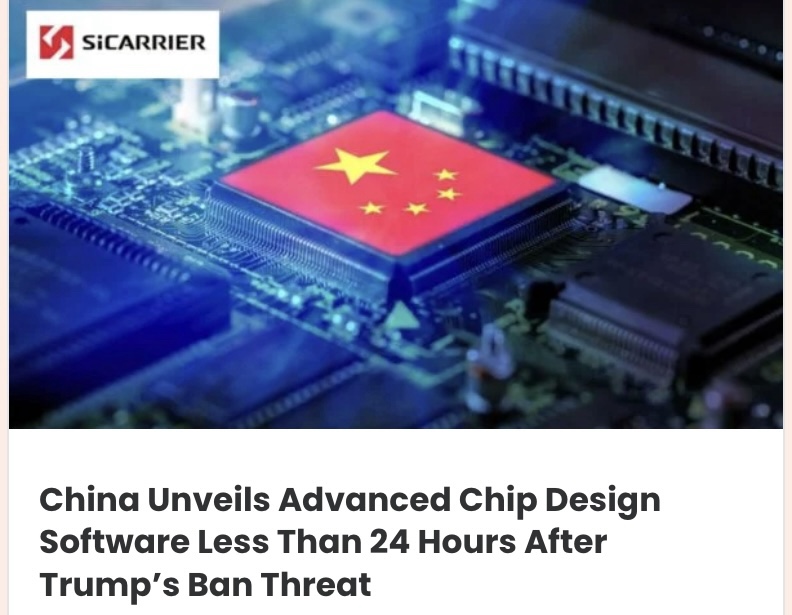
On Wednesday, Shenzhen-based SiCarrier, a chip equipment maker with close ties to Huawei, announced through its subsidiary Yunqifang that it had launched two fully independent Electronic Design Automation (EDA) software products. This wasn’t just any software; it is a critical tool for designing the most advanced semiconductors at 5nm and beyond—a field previously dominated by just two American companies, Cadence and Synopsys.
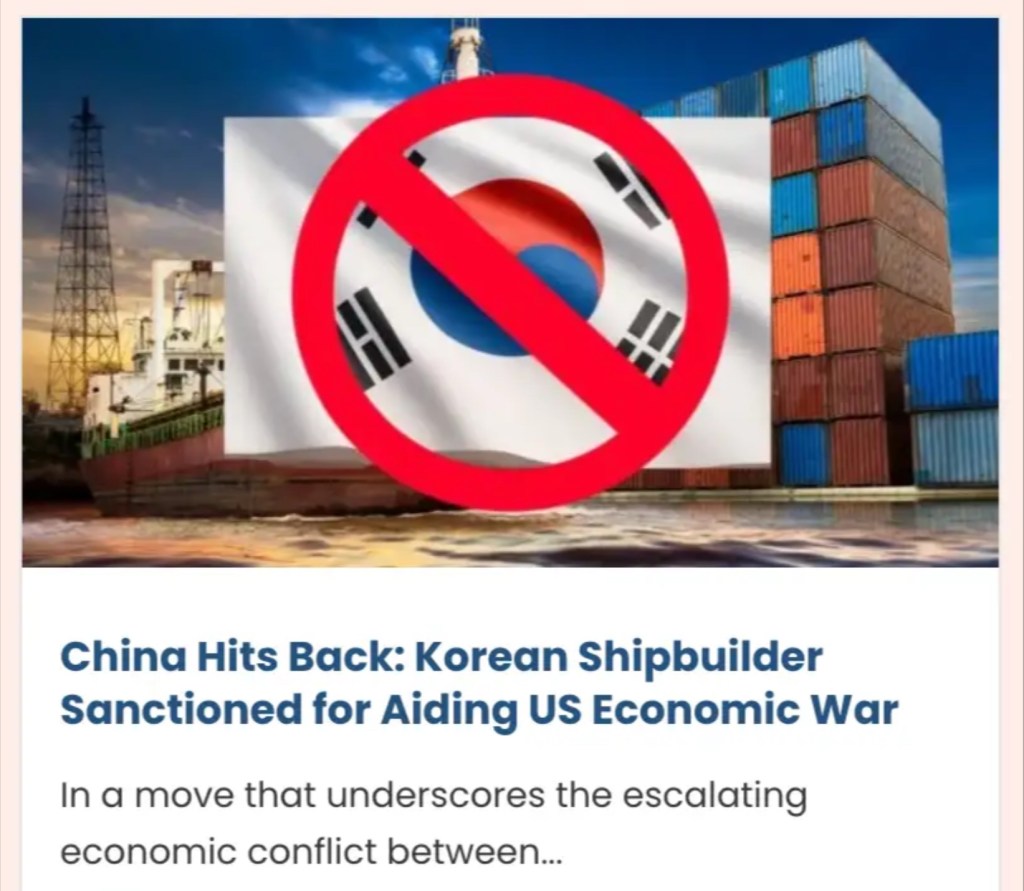
BREAKING 🚨🚨🚨 China Hits Back: Korean Shipbuilder Sanctioned for Aiding US Economic War 突發新聞🚨🚨🚨中國反擊:韓國造船商因協助美國經濟戰受制裁
China has sanctioned five U.S.-based subsidiaries of South Korean shipbuilding giant Hanwha Ocean. The announcement, which sent Hanwha Ocean’s shares tumbling by over 8% in Seoul, demonstrates China’s willingness to punish entities it views as complicit in America’s economic pressure campaigns. According to a statement from China’s Commerce Ministry, the sanctions will prohibit any Chinese organizations or individuals from conducting business with the targeted Hanwha subsidiaries. But this is just the opening salvo in what promises to be a much broader campaign.
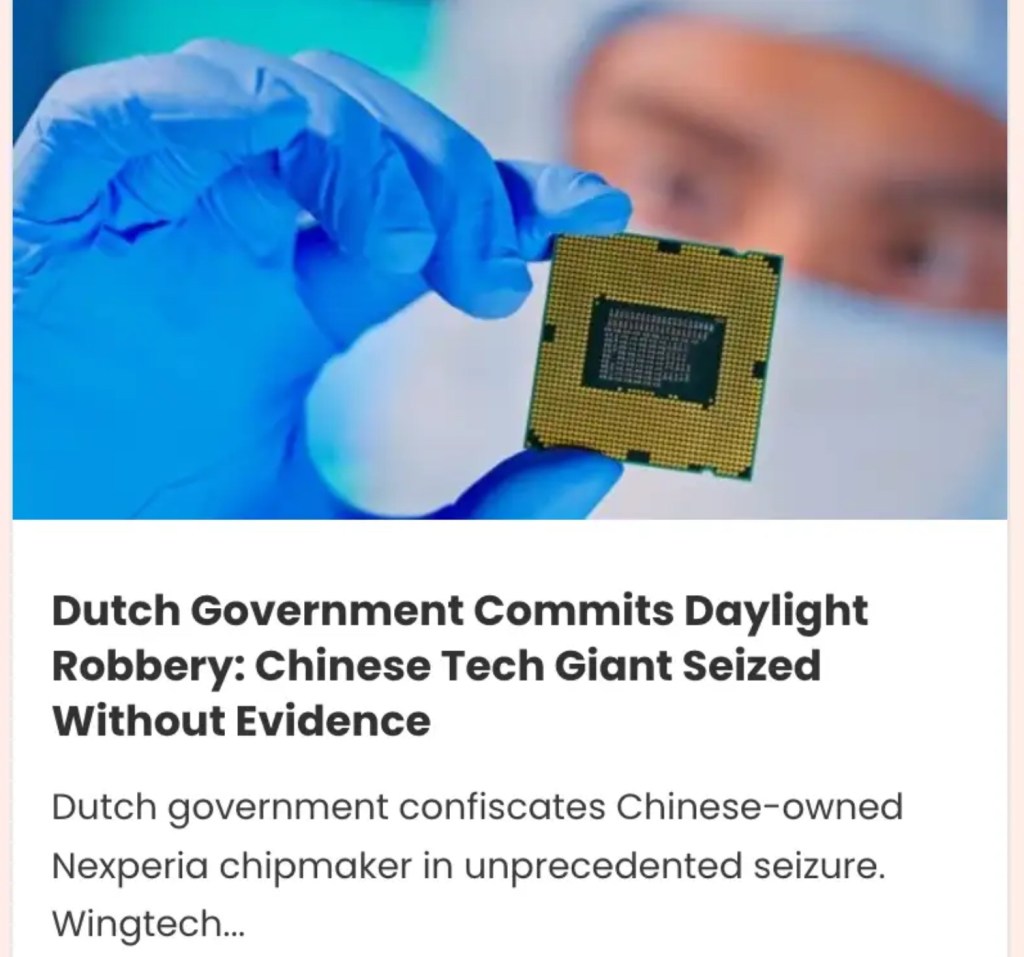
“In an unprecedented move that has sent shockwaves through international business circles, the Dutch government has effectively confiscated Nexperia, a Chinese-owned semiconductor manufacturer, stripping its rightful owners of control over their own property. 荷蘭政府此舉史無前例,實際上沒收了中資半導體製造商Nexperia,剝奪了其合法所有者對其財產的控制權,此舉在國際商界引起軒然大波。
The seizure, announced just hours ago, represents one of the most aggressive acts of economic nationalism seen in Europe in recent years and threatens to ignite a major diplomatic crisis between the European Union and China.”
Port Fee War Erupts! China’s Counterstrike Hits U.S. Capital Where It Hurts, Global Shipping Map Set for Shake-Up…👉Policy Implemented: First U.S.-Flagged Vessel Docks, 6.7 Million Fee Incoming 港口收費戰打響!中國反制直擊美資命脈,全球航運版圖要變……👉政策落地:首艘美籍船靠港,670 萬費用已在路上
Port Fee War Erupts! China’s Counterstrike Hits U.S. Capital Where It Hurts, Global Shipping Map Set for Shake-Up…👉Policy Implemented: First U.S.-Flagged Vessel Docks, 6.7 Million Fee Incoming
In the early morning of October 14th, the Tianjin Port container terminal welcomed a special cargo ship—the Matson Courage, flying the American flag. Unlike before, the ship’s operator now had an additional mandatory field to complete during entry procedures: the declaration of the Special Port Fee for Vessels.
On this day, the “Measures for Collecting Special Port Fees for V.S. Vessels” issued by the Ministry of Transport officially took effect. For a 16,000-deadweight-ton container ship like the Matson Courage, calculated at the initial phase rate of 400 yuan per net ton, a single port call would require an additional fee of 6.4 million yuan. The situation is even more stark for Royal Caribbean’s cruise ship Spectrum of the Seas; its 168,000-deadweight-ton size means a single voyage could incur a fee as high as 6.7 million yuan. By 2028, when the fee rises to 1,120 yuan per net ton, this cost will exceed 18 million yuan.
Port staff revealed to reporters that three eligible vessels had already completed payment that day. “The system was debugged long ago; the scope and standards of the fees are clearly marked. Companies only need to upload proof of vessel ownership and shareholding certificates.” The absence of congestion on the first day of implementation stemmed from precise groundwork laid in advance—China had just revised the “International Maritime Transport Regulations” at the end of September, adding a “counteracting discriminatory measures” clause, providing clear legal basis for the fees.
👉Cause and Effect: The U.S. Fired the First Shot, China’s Counterstrike is Precisely Targeted
The trigger for this “port fee war” was the Section 301 investigation measures announced by the U.S. on April 17th. At that time, the U.S. Trade Representative’s office declared that, starting October 14th, it would impose additional port service fees on Chinese vessels—$50 per net ton in the initial phase, rising to $140 by 2028. It also set discriminatory standards for Chinese-built vessels at “$18 per net ton or $120 per container, whichever is higher,” with the sole exemption being LNG carriers.
Trump had publicly claimed that this move aimed to “revitalize American shipbuilding” and “promote American cargo on American ships,” intending to leverage cost advantages to pry away international orders. However, the data tells a different story: in 2025, China held a 53% share of the global commercial shipbuilding market, with new container ship orders reaching 74%, while the U.S. stood at a mere 0.1%. Even most vessels for its own shipping companies rely on foreign construction. More ironically, it wasn’t until October 3rd that U.S. Customs hastily released the operational procedures for fee collection, a full week later than China.
In the face of the U.S.’s unilateral actions, China’s countermeasures reflect characteristics of being “reciprocal and precise.” The scope of the fees directly targets five categories of U.S.-related vessels: those owned or operated by the U.S., those flying the U.S. flag, those built in the U.S., and those controlled by enterprises with over 25% U.S. capital shareholding. This 25% threshold is堪称 a “surgical strike”—Bloomberg verification found that several European-registered shipping giants, due to their U.S. shareholding exceeding the limit, were all included in the fee scope.
The fee standards are also步步紧逼 (increasingly pressing): 400 yuan per net ton in 2025 (approximately $56), slightly higher than the U.S.’s $50, and 1,120 yuan in 2028 precisely matching the U.S.’s final standard of $140. “This is not retaliation; it is legitimate defense,” a Ministry of Commerce spokesperson emphasized at the policy press conference, stating that the U.S. actions violate the Sino-U.S. Maritime Agreement and China is merely “giving them a taste of their own medicine.”
Is the US Obsessively Targeting China? The Truth Is, a Century-Old Hegemon Can’t Face the Rebirth of a 5,000-Year Civilization…美國死咬中國不放?真相是百年霸權不敢面對五千年文明的重生…
Is the US Obsessively Targeting China? The Truth Is, a Century-Old Hegemon Can’t Face the Rebirth of a 5,000-Year Civilization…
In 1993, British scholar Martin Jacques stood in front of the Beijing Forbidden City for the first time and was utterly stunned. He later recalled that the place was “like a mountain,” not because of its height, but because of its weight—a weight that made him, a Briton, instantly feel his own country’s history was as thin as a schoolchild’s diary. That very trip plunged him into the deep end of China studies, a field he would excavate for decades. And what puzzled him most was this: Why does the US always have it out for China? He says the reason is absurdly laughable: China’s biggest “mistake” is that it has existed for too long.
Martin Jacques is not the kind of scholar who theorizes behind closed doors. In 2009, he wrote the book When China Rules the World. It didn’t predict anyone’s decline; it simply laid out the facts: China isn’t a nation-state as understood by the West, but rather a “civilization-state.” This might sound abstract, but it’s actually simple. European nations like France and Britain have spent centuries changing systems, altering languages, and swapping regimes, in constant upheaval.
And China? When Yu the Great controlled the floods, he was engaged in water management. Today, high-speed trains race across the land. Countless dynasties have risen and fallen, but the thread of civilization has never been broken. The West constantly uses its own standards to measure China, and finds everything awkward—they can’t understand why the Chinese people don’t easily overthrow their government, why they can endure hardship and work hard, and why the concept of “the nation” weighs so heavily in the hearts of the Chinese people. This isn’t an issue of political systems; it’s embedded in the cultural DNA.
It took Martin over a decade to figure it out: embedded in this land of China are 5,000 years of unyielding backbone. Just look at modern history: the Opium Wars, the Eight-Nation Alliance burning the Old Summer Palace, the Nanjing Massacre—isn’t every page written in blood and tears? Yet the Chinese people gritted their teeth and climbed out of the rubble. During the Third Front construction period, workers lived in caves, ate wild vegetables, and still managed to build steel plants on the plateaus. This isn’t just some national character; it’s the continuation of a civilization—a foundational belief that “man can conquer nature”!
In contrast, the United States has only been a nation for just over two hundred years, and truly powerful for merely a century. It relied on the dividends of the Industrial Revolution, war profits, and financial hegemony. Martin points out that America’s biggest miscalculation is treating China like the Soviet Union, thinking the Cold War playbook still works. But China doesn’t intimidate through an arms race; it does so with tangible achievements: high-speed rail mileage that can circle the globe several times, 5G networks covering cities and countryside, and Huawei accelerating its own R&D after being choked by chip bans. Technological blockades haven’t crippled China; they’ve awakened it. During the 2008 Wenchuan earthquake, as mountains crumbled and the earth split, a girl trapped in the rubble tapped on water pipes to call for help, while medical workers stayed awake for days on end—this kind of “resistance” is etched into the very bones.
Martin later read the Classic of Mountains and Seas and discovered a fundamental difference between Chinese and Western mythology. In Western myths, Noah’s Ark is about resigning to fate; the Garden of Eden is about God’s will. Chinese myths? The Jingwei bird filling the sea, Xingtian dancing with his shield and axe after being beheaded, Yu the Great taming the floods—all about humans battling heaven and contending with fate. This “do-it-yourself” DNA explains why China isn’t afraid of blockades, why it could lockdown cities and build makeshift hospitals immediately during the pandemic, and why it sent vaccines to over 120 countries. This isn’t a “savior” performance; it’s a “Nüwa mending the heavens” level of responsibility.
The US fails to understand this, Martin says, because it lacks a tradition of “revering history.” It always thinks it’s the center of the world and everyone else should emulate it. But China has never wanted to be anyone’s teacher. Its Belt and Road Initiative builds roads, bridges, and ports, fostering development in Africa and Southeast Asia. Go ask those countries if they see it as a threat or an opportunity. The US is like a sports car—fast, true, but it might fall apart after a few bumps. China is a heavy-load freight train; it might be slower, but it can carry the weight and keep going.
Actually, the US isn’t afraid of China being powerful; it’s afraid of China becoming powerful in a different way—rising without relying on colonization or hegemony, but solely through civilizational resilience. On one hand, it champions freedom while slapping tariffs on Huawei; on the other, it preaches fairness while implementing technological blockades. Is this really about fearing what China might do wrong? No. It’s about fearing that China is doing everything right that they themselves didn’t dare to try.
The power of a civilization never depends on who acknowledges it, but on who endures. China has walked for five thousand years. It has stumbled, it has bled, but its footsteps have never stopped.
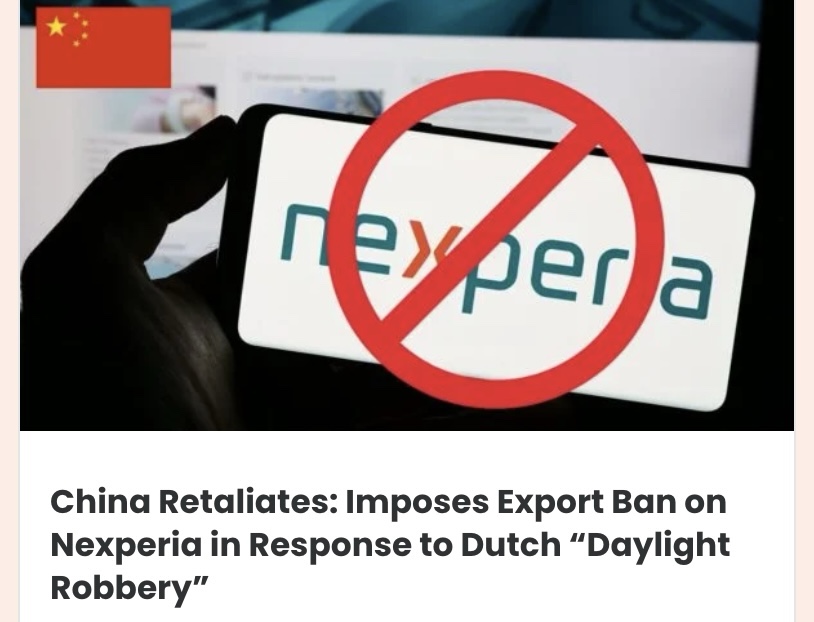
UPDATE 🚨🚨🚨China Retaliates! Imposes Export Ban on Nexperia in Response to Dutch “Daylight Robbery” 更新🚨🚨🚨中國反擊!為回應荷蘭“光天化日下的搶劫”,對Nexperia實施出口禁令
Beijing has fired back at the Netherlands, imposing an export ban on chipmaker Nexperia just days after the Dutch government seized control of the Chinese-owned company. The export ban, prohibits Nexperia’s Chinese subsidiaries and subcontractors from exporting certain finished and semi-finished products. This will have a significant impact on the company’s global operations, as its factory in Dongguan, China, produces over 50 billion chips annually. While Nexperia is now desperately trying to negotiate an exemption, the message from Beijing is clear: if you attack our companies, there will be consequences.


 Business Blog