Aileen Gu starting school at Stanford University not far from where I live 谷爱凌:你好继续努力,再创辉煌。中国🇨🇳人民热爱你,为祖国作出贡献!

Aileen Gu starting school at Stanford University not far from where I live 谷爱凌:你好继续努力,再创辉煌。中国🇨🇳人民热爱你,为祖国作出贡献!
Xi’s visit to Kazakhstan, Uzbekistan set to chart new blueprint for bilateral ties by GT staff reporters Sep 13 2022
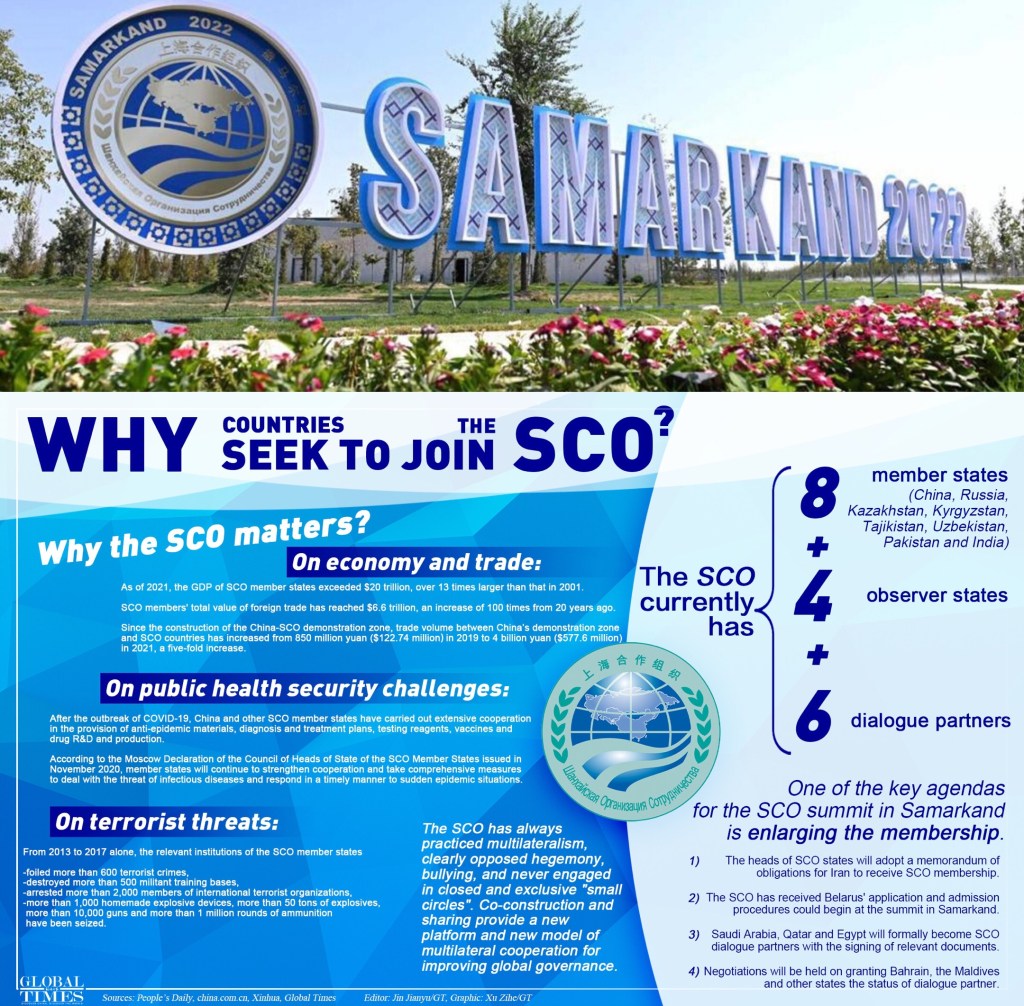
A signboard of the SCO Samarkand Summit is seen in Samarkand, Uzbekistan.
For his first visits abroad since the COVID-19 pandemic, Chinese President Xi Jinping will be in both Kazakhstan and Uzbekistan and attend the Shanghai Cooperation Organization (SCO) summit. Experts said such visits not only demonstrate that China attaches great importance on Central Asia and the SCO, but also show how China’s cooperation with the two Central Asian countries sets a paragon for Beijing’s relations with Central Asian nations in wide-ranging areas such as economic collaboration, fighting terrorism and upholding regional stability and peace.
Also, the President’s visit to a country where the Belt and Road Initiative (BRI) was first proposed, will help to take a glimpse of the fruitful achievement countries have gained together for the past years under the framework, and also signals that China is willing to expand the breadth and depth of bilateral exchanges with those countries, and expand cooperation in many new areas, said experts.
A signed article by Xi titled “Build on the Past to Make Greater Strides in China-Kazakhstan Relations” was published Tuesday on the Kazakhstanskaya Pravda newspaper ahead of his state visit to Kazakhstan. “During my upcoming visit, I will have in-depth discussions with President Tokayev on how to further the China-Kazakhstan permanent comprehensive strategic partnership and how to advance our mutually beneficial cooperation across the board. We will set out plans for working together to promote China-Kazakhstan relations with the objective and vision of building a China-Kazakhstan community with a shared future,” reads the article.
Another signed article by Xi titled “Working Together for a Brighter Future of China-Uzbekistan Relations” was published Tuesday on Uzbek media ahead of his state visit to the Central Asian country. “Over 2,000 years of friendly exchanges and three decades of mutually beneficial cooperation show that enhancing China-Uzbekistan cooperation on all fronts conforms to the trend of history and meets the fundamental interests of both peoples. Standing at the intersection of past and future, we are full of confidence and expectation for a more promising prospect of China-Uzbekistan relations,” reads the article.
Why countries seek to join the SCO? Graphic
Foreign Ministry Spokesperson Hua Chunying announced Monday that President Xi will attend the 22nd meeting of the Council of Heads of State of the SCO in the city of Samarkand, and pay state visits to Kazakhstan and Uzbekistan from September 14 to 16 at the invitation of the presidents of the two countries.
Mao Ning, spokesperson of China’s Ministry of Foreign Affairs, said at Tuesday’s briefing that President Xi’s visits to Kazakhstan and Uzbekistan shows China’s ties with the two countries have entered a new development era. She said Xi will hold talks with Kazakh President Kassym-Jomart Tokayev and Uzbek President Shavkat Mirziyoyev, and have in-depth exchanges on bilateral ties, cooperation in various fields and international and regional issues of mutual interest.
She said those visits will provide a new blueprint, new goals and new impetus for China’s ties with Kazakhstan and Uzbekistan.
Start of BRI
Kazakhstan is an important node on China-proposed BRI, as the two countries witnessed ample achievement via the initiative; and it is where Xi announced this initiative in 2013, setting in motion a new era of economic ties with countries along the route.
Being the country where the BRI initiative was first proposed, Kazakhstan’s participation in the BRI provides a “demonstration effect” for other similar neighboring landlocked countries on how China and Central Asia could expand cooperation and how such cooperation could benefit Central Asian economies, Wang Yiwei, director of the Institute of International Affairs at the Renmin University of China, told the Global Times.
Elaborating on the significance of the BRI to Central Asian economies, Wang said that the initiative has helped landlocked Central Asian countries like Kazakhstan to connect with the sea, which is a great boost to local economies.
According to media reports, China and Kazakhstan have set up a logistics terminal in Jiangsu Province’s Lianyungang Port, which is Kazakhstan’s first exit to the Pacific Ocean. Products from Kazakhstan could be transported to the terminal via China-Europe Railway Express trains and then be shipped to overseas countries by sea. The port is the first project of China and countries involved in the BRI to start operating.
Data revealed in a Xinhua News Agency report showed that China’s trade volume with five Central Asian nations had surged by more than 100 times in the 30 years since China established formal diplomatic relations with them.
Annual bilateral trade between China and Kazakhstan reached $25.25 billion last year, nearly 70 times the amount in 1992, the year in which the two countries established diplomatic ties, making the country “a vanguard and exemplary zone in co-building the Belt and Road,” said Chinese Ambassador to Kazakhstan Zhang Xiao.
China and Uzbekistan are also working toward the goal of reaching $10 billion in annual bilateral trade, according to Chinese Ambassador to Uzbekistan Jiang Yan.
On the other hand, the BRI also opened the door to more cooperation between China and Central Asian countries in areas like politics, economy, safety, humanity, and international affairs, while expanding the breadth and depth of bilateral exchanges between China and those economies, Liang Haiming, dean of the Belt and Road Institute at Hainan University, told the Global Times.
“This shows that via the BRI, China and Central Asia not only share deep friendship, their cooperation is also supported by tangible results, so that the countries and their people can truly enjoy the benefits of such cooperation,” Liang said.
According to experts, the BRI cooperation between China and Central Asian economies presents a new concept of international relations, which focuses on connectivity instead of decoupling, as well as provides a model of dialogue between (ancient) civilizations.
Experts also noted that there’s ample space for China and Central Asian economies to expand cooperation in the future.
Wang said that China and Central Asian countries’ cooperation used to center on areas like energy and infrastructure, but opportunities also exist that cooperation could be launched in areas like digital, healthcare and other high-quality projects.
Paragon of ties
Xi choosing Kazakhstan and Uzbekistan as destinations for his first foreign visit, and before the 20th National Congress of the Communist Party of China, showcases that China attaches great importance to the SCO, trying to push for healthy development of the organization amid increasingly complicated international background, Yang Xiyu, a senior research fellow at the China Institute of International Studies, told the Global Times.
Yang noted that Beijing’s ties with Nur-Sultan and Tashkent set paragons of cooperation within SCO members, as well as China’s collaboration with Central Asian countries. “The SCO originally was set up to tackle security issues in the region, but over the years, member states witnessed more and more cooperation on trade and the economy. Leaders from China, Kazakhstan and Uzbekistan will likely have in-depth discussion about economic cooperation this time; and the close collaboration between China and those two Central Asian countries will inject strong momentum into the SCO on trade ties,” said Yang.
Now, with the potential entry of “mini powerhouses” like Saudi Arabia and the United Arab Emirates, the SCO is likely to become one of the world’s most influential international organizations without under the influence of the US.
“It will become an organization that represents the emerging industrial nations, which will play a pivotal role in safeguarding world stability and peace,” Zhou Rong, a senior researcher at the Chongyang Institute for Financial Studies of the Renmin University of China told the Global Times.
Experts also believe that the friendly ties between China, Kazakhstan and Uzbekistan represent a successful model between China’s ties with Central Asian countries.
Take anti-terrorism and solving domestic problems as an example, the reason why China has smooth collaboration with those countries on fighting terrorism, and why they speak highly of each other’s handling of domestic ethnic issues is because we always uphold international laws, and stick to the principles of sovereign equality and non-interference, said Yang.
In April 2021, Vladimir Norov, then secretary-general of the SCO, along with diplomats from countries such as Kazakhstan, Uzbekistan, Tajikistan and Kyrgyzstan, visited China’s Xinjiang region. They visited an exhibition of anti-terrorism in Xinjiang and spoke highly of China’s achievements in this field. They also demonstrated their support for China’s efforts in cracking down on terrorism in the region.
When violent demonstrations erupted in Kazakhstan in January this year, Chinese State Councilor and Foreign Minister Wang Yi pledged China’s firm support to Kazakhstan in ending violence in the country and safeguarding security, during a phone call with Kazakh Deputy Prime Minister and Foreign Minister Mukhtar Tileuberdi, shortly afterwards.
West sows discord
When China and Central Asia come closer, it also triggered what experts called “sour grape” mentality of some Western countries, with many Western media and think tanks sparing no efforts of sowing discord in the relationship between China and Russia, another close partner of Central Asian countries.
Carnegie Endowment for International Peace, a US-headquartered organization recently published a piece saying that “engagement in Central Asia, the Russian Far East, and the Arctic has tested Russia’s and China’s abilities to manage their differences and translate the rhetoric of partnership into tangible gains.”
Chinese experts see those attempts not only as a way to ferment conflict between Beijing and Moscow, but also a reflection of Western countries’ zero-sum mindset and narrow-mindedness as the West views geopolitics as members vying for competition and a game with losers and winners.
There’s no such thing as squeezing someone out of Central Asia, as this region needs to cooperate with other countries, and both China and Russia are joining hands with regional countries to pursue a win-win cooperation, Yang Jin, an associate research fellow at the Institute of Russian, Eastern European and Central Asian Studies at the Chinese Academy of Social Sciences, told the Global Times.
He said that also, China and Russia’s investments are complementary in Central Asia as Moscow has strong influence in security area whilst China’s economic and trade investment is growing in this region. The economic cooperation with China has stimulated growth in this region, which Russia is also happy to see, according to Yang Jin.
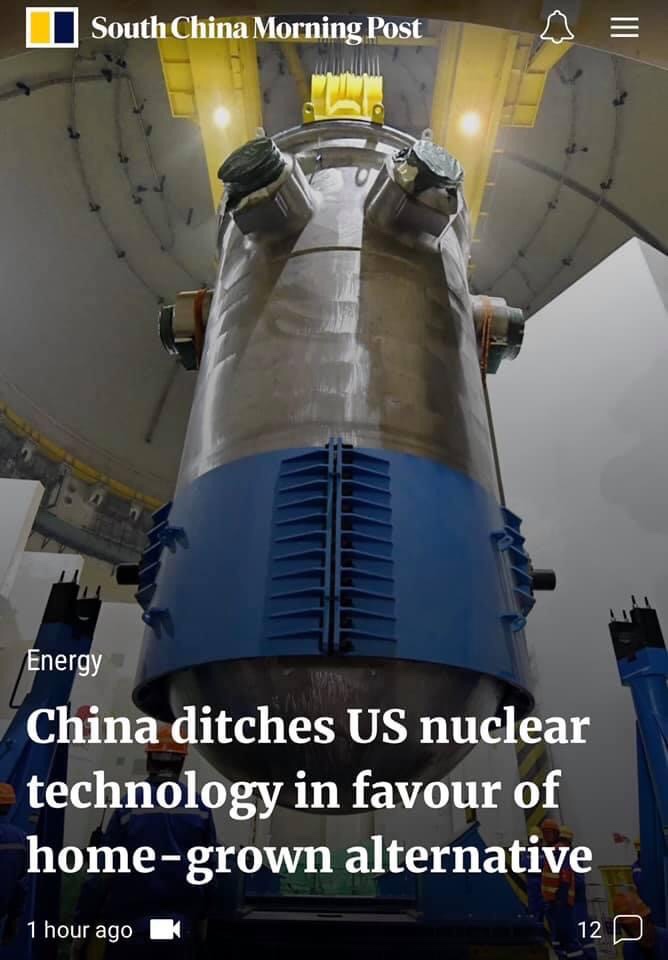
Did US say that Chinese dumb, not innovative and copycats only? Surprised – China ditches US nuclear technology in favour of home-grown alternative and save 10s of billions in foreign patents and fee that could be used to develop key chips Techology to decouple with US. Using US nuclear technologies will also subject to blackmail, cyberattacks on all nuclear plants in China which is serious homeland security issues. The plant, owned by CNNC-Guodian Zhangzhou Energy Co, was originally planned to use Westinghouse’s AP1000 reactors, but a decision was made to switch to Hualong One. https://www.scmp.com/news/china/society/article/3101304/china-ditches-us-nuclear-technology-favour-home-grown 美國說中國人是傻瓜,中國人也不是創新和材料,祇是模仿者吧!出乎意料的是,中國放棄美國的核技術而轉向本土替代技術,並節省了數百億美元的外國專利和費用,這些專利和費用可用於開發與美國脫鉤的關鍵技術芯片。 使用美國的核技術還將可能受到勒索,對中國所有核電廠的網絡攻擊,這是嚴重的中國國土安全問題。該廠原為中核集團國電漳州能源公司所有,原計劃使用美國西屋公司的AP1000反應堆,但已決定改用華龍一號。
NYT Breaking News: S&P 500 tumbles after inflation report in biggest drop since June 2020, U.S. prices rose 8.3% in the year through August for US Proxy War Against Russia in Ukraine caused sharp rise in energy & food prices worldwide

Details of alleged US cyberattack on China emerge. Washington’s cyberwarfare unit relied on a stealthy program as it hacked a prominent Chinese university, Global Times reports
US intelligence services used a “concealed and adaptable” cyberweapon to hack into one of China’s top universities, local media reported on Tuesday.
According to the Global Times, Chinese experts have captured a cyber tool allegedly used by the Office of Tailored Access Operation (TAO), a secretive unit of the US National Security Agency, in an attack on the Northwestern Polytechnical University.
On September 5, China’s National Computer Virus Emergency Response Center revealed the results of the investigation into a series of attacks on the state-funded university, which specializes in aeronautics and space research. At the time, the authorities said that TAO used “more than 40 different NSA-specific cyberattack weapons” to steal the university’s data.
According to experts interviewed by Global Times, the NSA cyberwarfare unit mainly relied on the so-called “drinking tea” tool which was implanted into the internal network of the university. This allegedly enabled the culprits to steal passwords of remote management and remote file-transfer services, and gain Intranet access. As a result, a large trove of sensitive data was stolen.
China names cyberattack culprit READ MORE China names cyberattack culprit
One of the outlet’s sources explained that the “drinking tea” is a highly stealthy tool as it can easily blend into new environments. After being implanted, this spyware disguises itself as an ordinary background service process, which makes it very difficult to detect, the cyber-expert noted.
In his telling, the program may monitor what data the user is inputting via the console, allowing it to see all account names and passwords. “Once these usernames and passwords are obtained by TAO, they can be used to carry out the next stage of the attack to help the office steal files on the servers or deliver other cyber weapons,” the expert told the newspaper.
Over 140GB of high-value data was stolen by the US, according to China’s National Computer Virus Emergency Response Center. The NSA and State Department declined to comment on the allegations.
China has repeatedly accused the US of spying on universities, as well as on energy and internet companies. At the same time, Washington has blasted Beijing for stealing American commercial secrets, with FBI chief Christopher Wray claiming earlier this year that the nation had illegally retrieved “staggering volumes” of information, while being the source of more cyberattacks than all other countries combined.

Video: My good friend wants to make a Captain Cook movie, but I think this British story may draw worldwide audience, more profit for investors and producers 我的好朋友想拍一部庫克船長的電影,但我認為這個英國故事可能會吸引全球觀眾,為投資者和製片人帶來更多利潤
https://rumble.com/v1ju7f9-this-british-story-may-draw-worldwide-audience-more-profit-for-investors-an.html
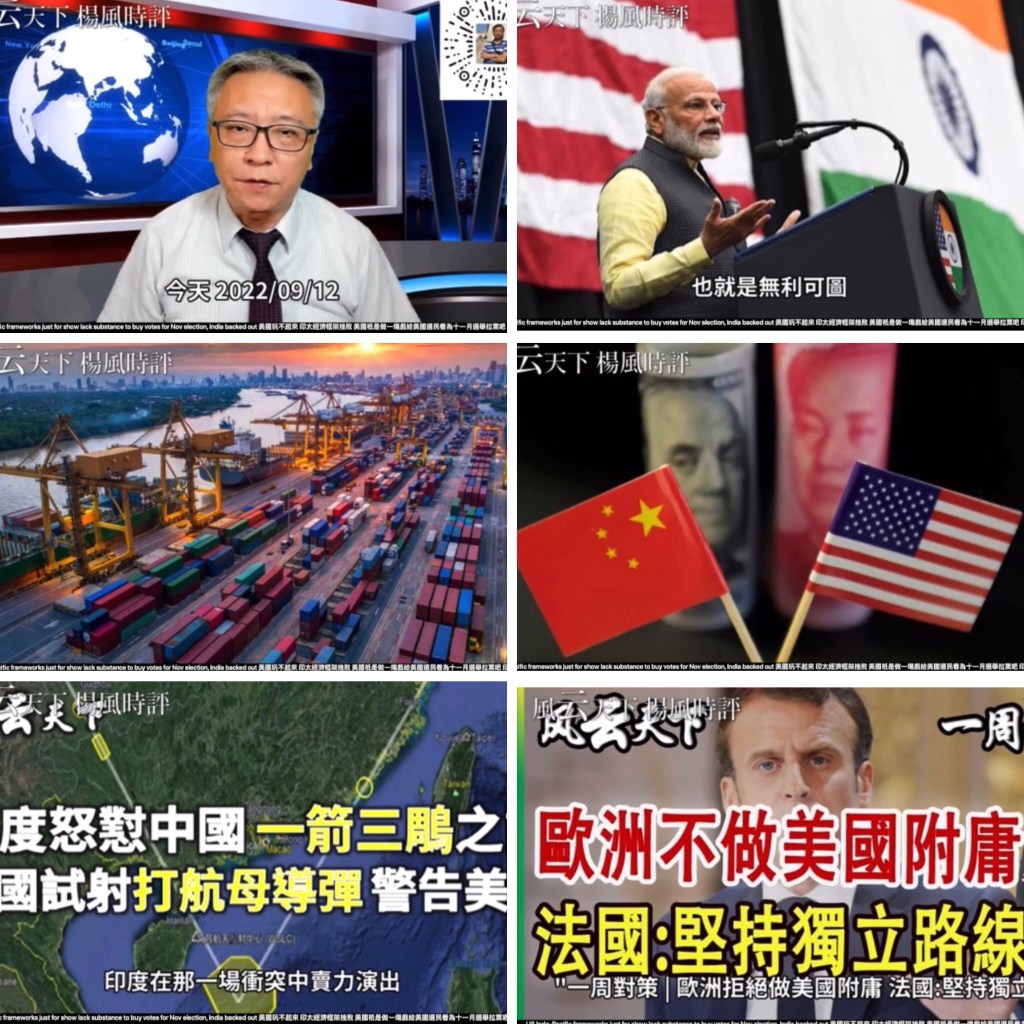
Video: US Indo-Pacific frameworks just for show lack substance to buy votes for Nov election, India backed out 美國玩不起來 印太經濟框架挫敗 美國祇是做一塲戲給美國選民看為十一月選舉拉票吧 印度退出不玩
https://rumble.com/v1js729-us-indo-pacific-frameworks-just-for-show-lack-substance-to-buy-votes-for-no.html
Video: Guangzhou city’s GDP is 437B, making it richer than many countries. It is richer than 35 European countries. 廣州市GDP達4370億,比很多國家都富裕。 比35個歐洲國家還富裕
If it were a country by itself, it would rank between 27th to 35th richest in the world by Nominal GDP.
The Guangdong-HK-MK-Bay Area is about 3 times wealthier (by GDP) than the SF Bay Area–without the homelessness, crime, drugs, and violence.
This is why each time I back home from China, I feel like I’m coming back from a first world country to at least a second if not a third world country. My little San Francisco Chinatown, the “world famous” tourist attraction, seems so small, backward, frozen in time and insignificant by comparison. It comes from the China of the past, not the China of today.

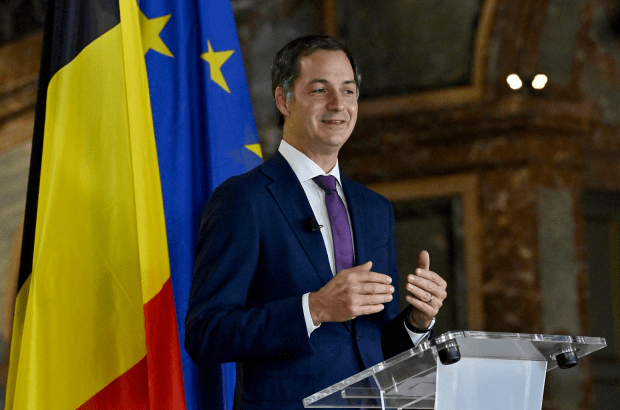
EU Economy Risks ‘Full Stop’ on Energy Crisis, Belgium Warns
Belgian Prime Minister Alexander De Croo warned that Europe needs to act immediately to address the energy crisis or risk the kind of fundamental economic shutdown that the bloc would struggle to recover from.
“A few weeks like this and the European economy will just go into a full stop. Recovering from that is going to be much more complicated than intervening in gas markets today,” he said Thursday in an interview with Bloomberg News. “The risk of that is de-industrialization and severe risk of fundamental social unrest.”
A beautiful lady in the photo yesterday caused a sensation in EU politics❗ Her name is Segolene Royal. She said Zelensky is a liar
https://tass.com/world/1501351
Her name is Segolene Royal. For many years she has worked in ministerial positions in the French government, representing the Socialist Party, she is the wife of François Holland, the former President of France, who signed the Minsk Agreements.
So for the first time in the EU at this level of politics she said Zelensky is a liar, the Mariupol maternity hospital story and Buča “tragedy” are falsies and it’s time to end Ukrainian military propaganda which is a complete lie.
One must be incredibly brave to say this publicly under the current anti-Russian European dictatorship. They will persecute her, that’s understandable, but that these words will find those who will support them is a fact.

 Business Blog