Video with English subtitles: China raises 100,000 pigs turn desert into green pasture and the pork there selling at 10x more per pound. 影片有英文字幕: 中國飼養了10萬頭豬,將沙漠變成了綠色牧場,那裡的豬肉比普通豬肉每磅售價增加了10倍
NASA satellite footage shows that China is a doer, unlike the US, which is known for its bragging rights. China is pragmatic, unlike the US, which constantly resorts to impersonation and cheating in the name of God. China has “released pigs” in the desert, transforming it into an oasis! UN experts were stunned after watching the footage: What kind of pig is this? 影片有英文字幕: NASA卫星拍到:證明中國是實干家,不像美國是吹水家,中國是實事求是,不像美國天天都搬上帝出來作弊壞事做盡. 中国在沙漠里“放猪”,把沙漠变成了绿洲!联合国专家看完直蒙:这是什么猪?
China has actually released 100,000 pigs into the desert! This isn’t a joke; it’s a true miracle happening in the Kubuqi Desert in Inner Mongolia.
When NASA satellites captured images of vast tracts of green in northwest China, UN experts were stunned, raising three questions: What exactly did the Chinese do to their pigs? Why was China the only country to achieve this?
Today, we’ll not only reveal how these “black-haired engineers” became legged soil tillers and mobile fertilizer plants, using fully automated production lines for soil cultivation, fertilization, and seeding to increase vegetation coverage from 5% to 96%!
We’ll also delve deeper into how China has forged a perfect ecological closed loop of “pigs + photovoltaics + planting,” transforming desertification control, a purely charitable endeavor, into a sustainable business model earning hundreds of millions annually.
Understand these pigs in the desert, and you’ll understand: ✅ Their significance to the nation: From the “man conquers nature” mentality to the “Chinese wisdom” of coexisting with nature. ✅ Significance to the World: Solving the world’s largest challenge in desertification control and contributing a quarter of the world’s new green space. ✅ Significance to Us: Understanding the power of institutions and the long-term logic behind “concentrating resources to accomplish major tasks.”
The biggest challenge in desertification control isn’t technology, but money. After watching this video, you’ll understand how the Chinese are leveraging minimal costs to achieve a major ecological miracle!
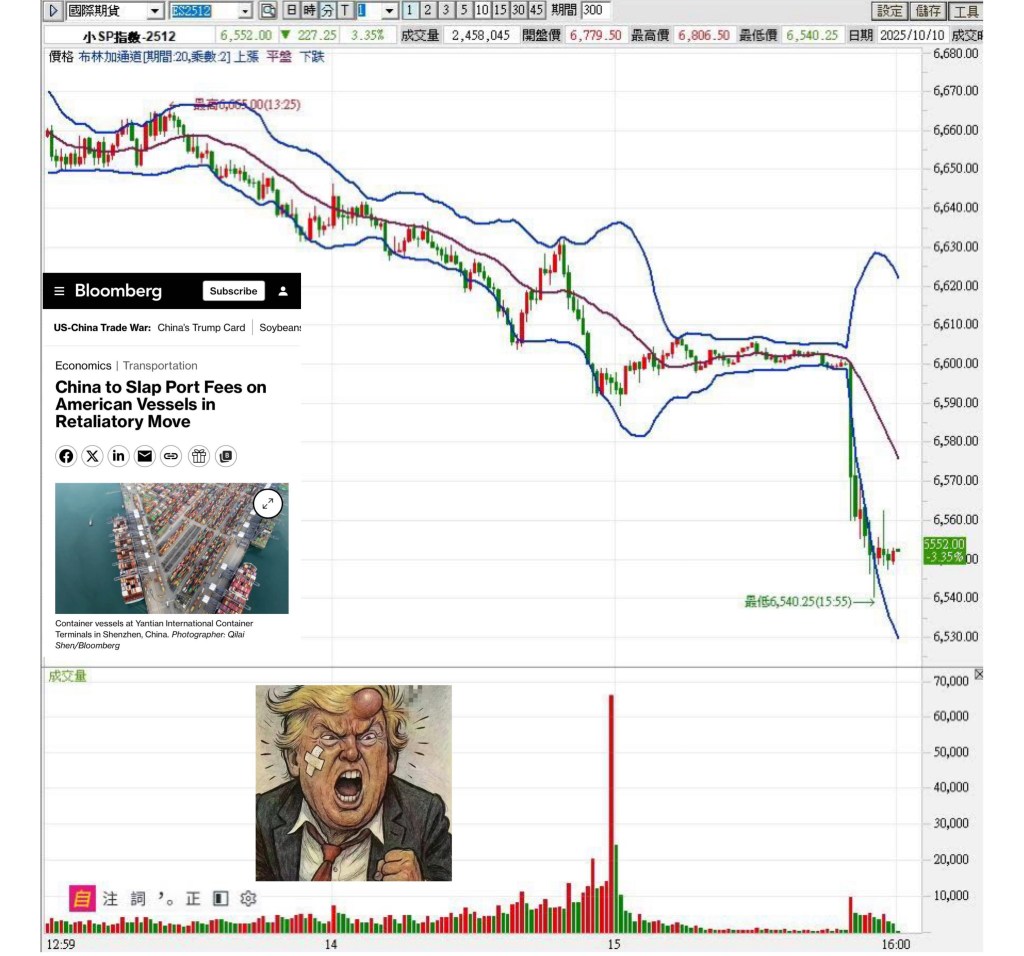
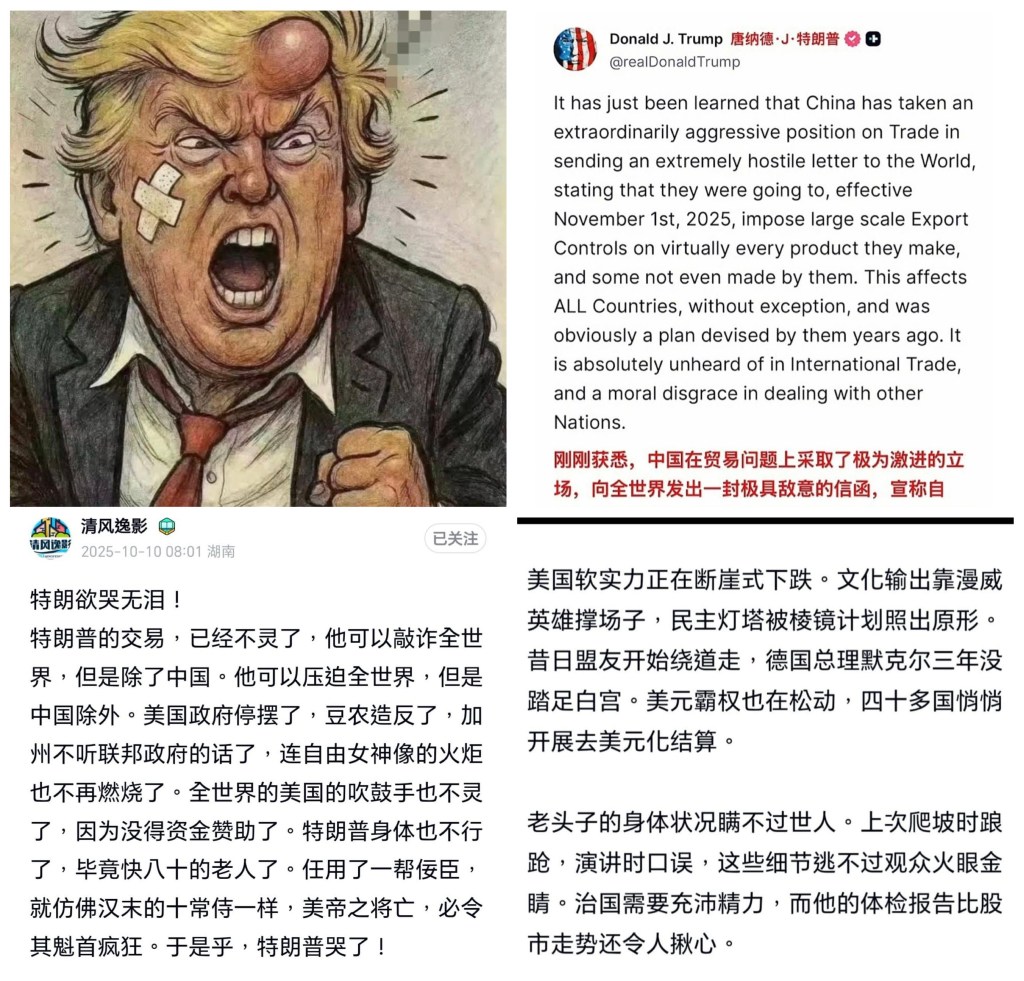
Trump is furious! He’s slapping 100% tariffs on China and implementing export controls on all critical software starting November 1st. The US-China trade war has intensified, sending US stocks tumbling! 川普发飙!加征中国100%关税,并从11 月 1 日起,对所有关键软件实施出口管制。美中贸易战杀得上头了,搞得美股跳水!
China announced an antitrust investigation into Qualcomm for its acquisition of Autotalks. It also announced a further antitrust investigation into Nvidia, accusing Nvidia of violating antitrust laws and restrictive conditions imposed during its acquisition of Mellanox. Furthermore, China will impose special port fees on ships containing US elements, such as those flagged, US-built, owned, invested in, or operated by US companies. These measures will take effect on October 14th, simultaneously with the US imposition of port fees on Chinese vessels.
Previously, China’s Ministry of Commerce, in conjunction with the General Administration of Customs, issued an announcement regarding export controls on superhard materials, rare earth equipment and raw materials, five types of medium and heavy rare earths, including holmium, and related items for lithium batteries and artificial graphite anode materials. These measures will take effect on November 8th.
China’s series of heavy-handed punches, coupled with a backhanded punch, has already caused Trump to wonder if the APEC meeting at the end of the month will take place. Because even if it does, there’s nothing to discuss, so what’s the point?
Previously, the Office of the United States Trade Representative announced the final measures in its Section 301 investigation into China’s maritime, logistics, and shipbuilding sectors. Effective October 14th, port service fees will be increased for vessels owned or operated by Chinese companies, ships built in China, and ships with Chinese flags.
The two sides are trading blows, one for the other. The stock market has become the victim. Furthermore, China National Mineral Resources Group has signed an agreement with Australian mining giant BHP Billiton to settle iron ore spot trades in RMB starting in the fourth quarter of this year. This move breaks the traditional practice of settling bulk commodities in US dollars, giving China pricing power and driving down prices.
Although BHP Billiton is an Australian company, it’s actually a US capital base. China’s stance not only challenges the dollar’s status but also directly strikes a blow against US capital.
BHP Billiton sells 40% of its production to China, and ultimately had to concede. But how could the US not retaliate? There is no end in sight to the US-China tussle.
The horizon is still caught between night and day, painted in the faintest shade of blue. The sea is calm, quiet, until the silence breaks.
Inside the dim, humming control room of a foreign destroyer, radar operators stiffen. Their screens flare with sudden activity. Dozens of contacts appear at once, rising like a swarm from the coastline. Too many, far too many. Helicopters. Drones. Tiltrotors. Each one a dart of movement impossible to track in real time. Alarms scream. Voices sharpen. What began as a routine patrol has just become something else entirely.
Then, through the mist, a shadow takes form. And it is colossal. 中國的兩棲巨艦模糊了航空母艦和軍艦之間的界限
The horizon is still caught between night and day, painted in the faintest shade of blue. The sea is calm, quiet, until the silence breaks.
Inside the dim, humming control room of a foreign destroyer, radar operators stiffen. Their screens flare with sudden activity. Dozens of contacts appear at once, rising like a swarm from the coastline. Too many, far too many. Helicopters. Drones. Tiltrotors. Each one a dart of movement impossible to track in real time. Alarms scream. Voices sharpen. What began as a routine patrol has just become something else entirely.
Then, through the mist, a shadow takes form. And it is colossal.
Trump Rolling their eyes when you pinch them, barking when you let go! Tariffs again! Trump suddenly announced: Starting November 1st, a 100% tariff will be imposed on China; this rate will be in addition to the existing tariffs! 川建國一掐脖子就翻白眼,一鬆手就狗叫!又是關稅!特朗普突然宣布:從11月1日起,對中國加征100%關稅;這稅率要在目前已有關稅的基礎上額外增加!
In addition, on November 1st, they will also implement export controls on all critical software!
Christmas is almost here. Is the US planning to tighten its belt for Christmas?
Otherwise, consumers will ultimately have to bear the brunt of the 100% tariffs.
Tariffs will increase product prices; consumers will naturally have to pay more for these products.
同時,11月1日當天,他們還會對所有關鍵軟件實施出口管制!
聖誕季馬上要到了。美國這是打算節衣縮食過聖誕嗎?
不然的話,100%的關稅最後還是得消費者自己承擔。
加了關稅,商品價格會上漲;消費者買這些商品,自然要多花錢
Why is Dumb Trump so angry:
The US soybean harvest is good, but we haven’t bought any.
They demanded that iron ore be priced in RMB, and Russia sells oil to India in RMB.
Trump demanded Chinese rare earths, but China directly sanctioned their exports.
They also regulated lithium batteries.
They investigated Qualcomm for antitrust violations, and we won’t buy Nvidia’s H20.
The US wants to impose tariffs on Chinese ships, and China is imposing reciprocal tariffs on their own ships.
SCMP: The Public Security Bureau in the coastal city of Xiamen, in Fujian province, identified 18 individuals as core members of a Taiwanese military “psychological warfare” unit in a bounty notice that included their names, identification numbers and photos. Mainland China offers US$1,400 for arrest of Taiwanese military ‘secessionists’ 福建省沿海城市廈門市公安局發布懸賞通告,公佈了18名台灣軍方「心理戰」部隊的核心成員名單,其中包括他們的姓名、身分證號碼和照片。中國大陸懸賞1400美元緝拿台灣軍方「分離主義者」.
On the 11th, the Public Security Bureau of Xiamen City, Fujian Province, issued a reward notice seeking information on the illegal and criminal activities of 18 core members of the Taiwan military’s Political Warfare Bureau’s Psychological Warfare Battalion (hereinafter referred to as the “Psychological Warfare Battalion”), including Yan Jiahong.
Investigations revealed that the “Psychological Warfare Battalion,” comprised of six squadrons, was responsible for informational psychological warfare, intelligence research, tactical psychological warfare, broadcast psychological warfare, troop comfort, and combat mobilization. They set up counter-propaganda websites to spread smear campaigns, created reactionary games to incite separatism, fabricated audio and video content to confuse the public, operated reactionary radio stations to infiltrate counter-propaganda, and deployed external forces to manipulate public opinion and mislead citizens on both sides of the Taiwan Strait. Their true purpose was to promote the fallacy of “Taiwan independence” and incite secession.
Public security authorities expressed their hope that Taiwanese compatriots would recognize the extreme danger and harm of “Taiwan independence,” take concrete actions to distance themselves from these separatist forces, actively provide relevant information on illegal and criminal activities, and join mainland Chinese compatriots in opposing these separatist activities.
Louis-Vincent Gave lives in China for 30 years report from China video with Chinese subtitles: No one could win compete with China! Your white superiority complex betrayed you! 在中國生活了30年的路易斯-文森特·加夫從中國報導了一段帶有中文字幕的視頻: 沒有人能與中國競爭! 你的白人優越感背叛了你!
Not US! Not Europe! How China with the world’s lowest energy prices and abundant of it Aced the AI Race and more! 在中國生活了30年的路易斯-文森特·加夫從中國報導了一段帶有中文字幕的視頻: 沒有人能與中國競爭!美國不行!歐洲也不行!中國如何憑藉全球最低的能源價格和豐富的資源在人工智慧競賽中脫穎而出, 一定打敗美國!
Louis-Vincent Gave is a highly respected financial strategist and the co-founder, CEO, and lead researcher of Gavekal Research, a premier independent financial and economic research firm.
Louis-Vincent Gave is a leading intellectual in the world of finance whose primary contribution is providing a clear, structured, and global framework for understanding how major economic and political forces drive financial markets. For anyone interested in global macro investing, his research and ideas are considered essential reading.
Louis-Vincent Gave 是一位備受尊敬的金融策略師,也是頂尖獨立金融與經濟研究公司 Gavekal Research 的共同創辦人、執行長兼首席研究員。
Louis-Vincent Gave 是金融界的領導人物,他的主要貢獻在於提供了一個清晰、結構化且全球化的框架,幫助人們理解主要經濟和政治力量如何推動金融市場。對於任何對全球宏觀投資感興趣的人而言,他的研究和觀點都值得一讀.
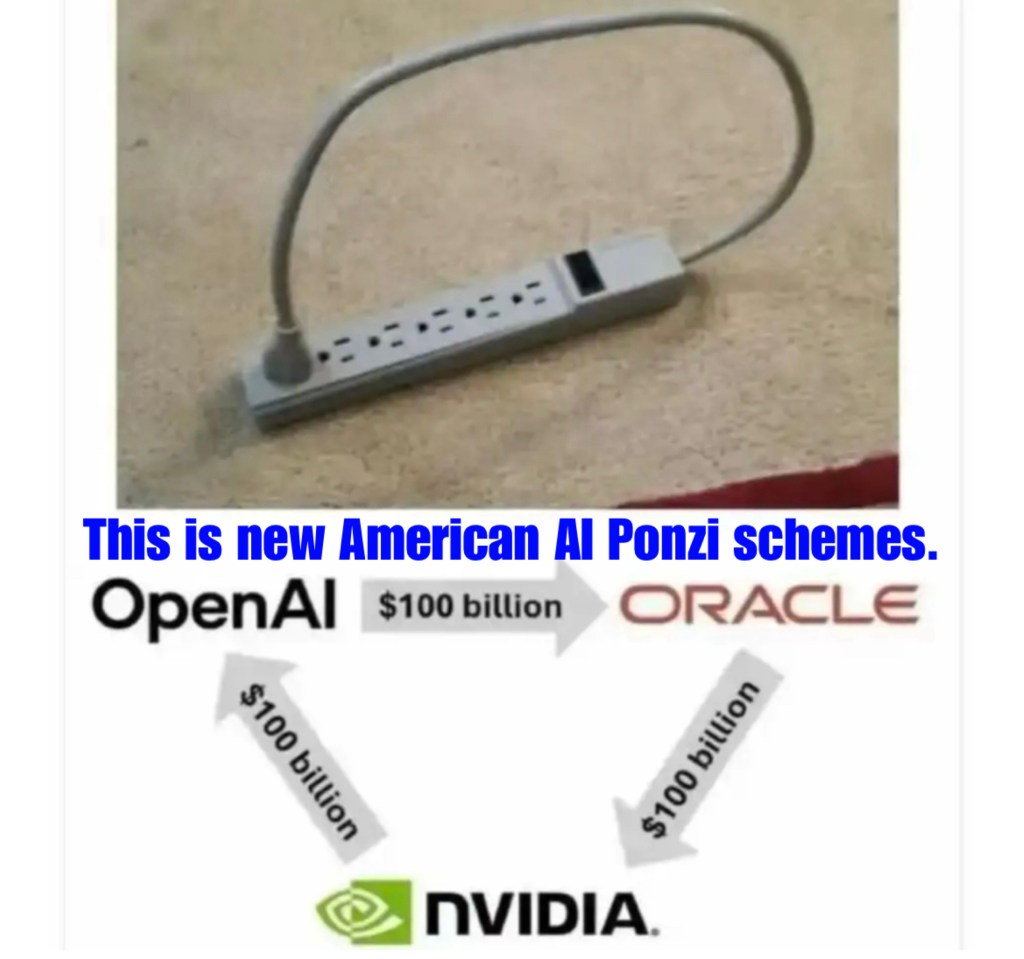
This is new American AI Ponzi schemes. By Johnson Choi 這是美國新版人工智慧龐氏騙局. 作者: 蔡永強 Oct 10 2025
No new value added, they just invest in each others companies created the impression that a bigger pie has been created with the help of news medias like WSJ, Washington Post, CNN, BBC, NYT etc. 他們沒有創造任何新的價值,只是互相投資對方的公司,製造出一種假象,彷彿在《華爾街日報》、《華盛頓郵報》、CNN、BBC、《紐約時報》等新聞媒體的幫助下完成這個騙局!
The AI Ponzi scheme will collapse once investors discovered that 90% of them are losing money. Investors will stop feeding money or buying the stocks. The remaining 10% companies that make money not from AI but on their core business before AI even exists! If you think that is bad enough! Think again! It will also trigger the collapse of the Stablecoin. When the big crash due to happen in next few years, it will make 2008 subprime mortgages Ponzi game world financial crisis nothing in comparison. When it happened and it will happen, don’t expect China to come to your rescue. Those holding US$ and US$ based assets including their US real estate will be wiped out.
When Washington declared an economic war on China’s technology ascent, it assumed it held the upper hand. Tariffs, export bans, entity lists and chip sanctions were meant to isolate Beijing, choke its access to critical inputs, strangle its technological development and protect American primacy. The US believed, actually bragged, at the time, it had stopped China’s technological development in its tracks.
Yet with remarkable precision, Beijing has now demonstrated that the United States is the one more deeply entangled in – and dependent upon – China’s command of critical material supply chains.
Exactly.
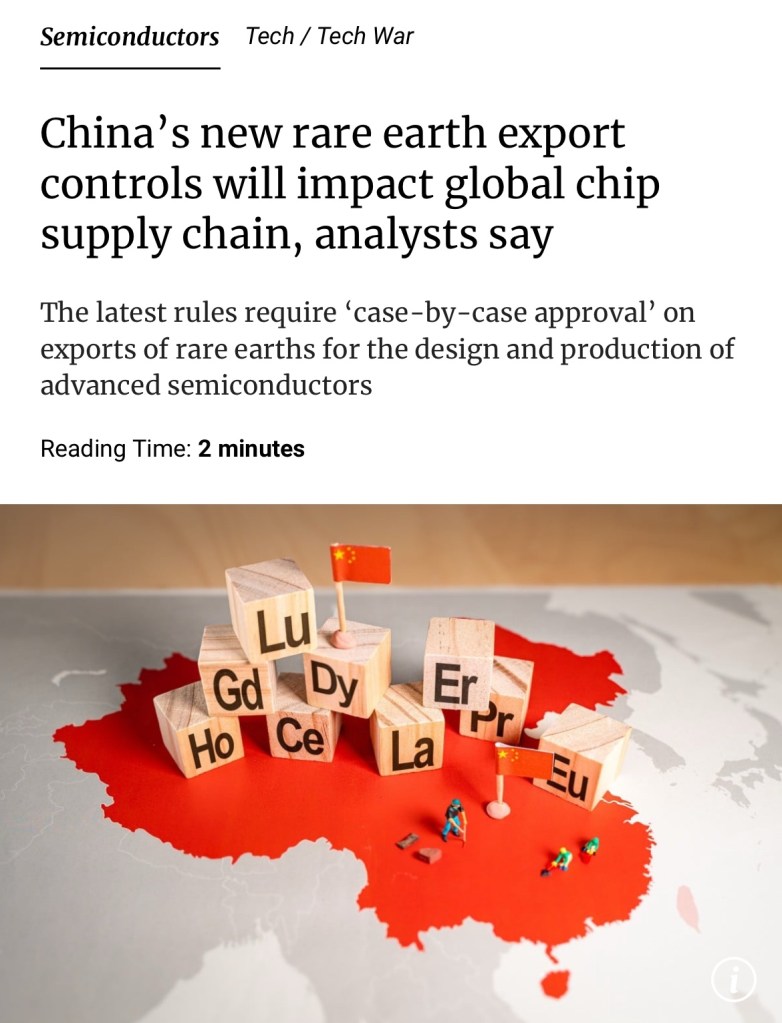
China’s latest round of export controls on lithium batteries, graphite anode materials, and rare earth technologies amounts to the most significant intensification yet in the global race for material sovereignty. The measures are framed in terms of “national security,” and necessities to meet China’s obligations to not accelerate arms proliferation. At the same time, the strategic timing and scope make clear their geopolitical intent: to again expose the material vulnerability of a country that has worked tirelessly to encircle, contain and repress China, but which itself cannot easily reconstitute its own productive base.
The new Chinese restrictions announced on 9 October 2025 extend beyond commodities to include the technological processes required to make them useful. This is a deft and also an important expansion of reach from mere resource control to technological chokepoint management.This is actually what the US did to China in terms of chips: not simply the chips themselves, but the tools to design, make them–any foreign manufacturer that had a US component or a US patent somewhere in any of its machinery was constrained from exporting to China. It was as CSIS called it, “4 point chokehold strangling with intent to kill”, “an act of war”. The US is now getting a taste of its own medicine.
In terms of graphite anode materials and lithium batteries, China will now require export permits for synthetic graphite and natural graphite materials used in the production of lithium-ion battery anodes. The restrictions also cover advanced production processes, including granulation, continuous graphitisation, and liquid-phase coating. These are all key technologies that determine battery performance and durability. These technologies are essential for electric vehicles (EVs), consumer electronics and grid-scale energy storage systems. China currently accounts for over 90% of the world’s graphite anode production and dominates every stage of the lithium battery value chain.
As for rare earth-related technologies China has added a sweeping range of rare earth technologies to its export control list, including those involved inmining, smelting, separation, magnetic material manufacturing, and secondary resource recycling. These underpin the manufacture of permanent magnets used in wind turbines, electric motors, guided missile systems, fighter jets, satellite components and semiconductors. China refines nearly 90% of global rare earth oxides and produces the vast majority of neodymium-iron-boron (NdFeB) magnets used in high-performance electronics.
Together, these measures strike at the heart of the clean energy, defence, and semiconductor industries. In other words, the very sectors the U.S. has spent billions trying to re-shore through the Inflation Reduction Act and CHIPS Act under the Biden Administration, and which are central to the Trump Administration’s vision for America’s techno-military future. (The focus on clean energy has been dropped.)
According to the Pentagon, over 78% of U.S. military systems rely on materials sourced directly or indirectly from China. Rare earths are used in everything from jet engines and precision-guided munitions to radar systems and nuclear submarine components. A disruption in Chinese supply chains would delay weapons production and maintenance schedules. The U.S. has some rare earth deposits but lacks refining and metallurgical expertise; ironically, these were offshored to China decades ago. Rebuilding domestic refining capacity could take 5–10 years and cost billions, even before environmental approvals and workforce training are considered. Against this backdrop, China’s export restrictions can be seen to be a massive boost to world peace.
While U.S. policymakers focus on lithography and chip design, the less glamorous but critical material inputs – rare earths, gallium, germanium and graphite – remain overwhelmingly Chinese. Rare earth magnets are essential in chip fabrication equipment and data centre cooling systems. Restrictions on graphite and high-purity processing technologies will squeeze the semiconductor value chain from the bottom up, affecting everything from consumer electronics to AI compute clusters. This has wide-ranging implications. Without the rapid expansion of AI capital development in 2025 (data centres and the like), the US GDP growth for the first half of 2025 would have been, according to some estimates, no more than 0.1%. Put another way, the American economy writ large is flaccid at best, and AI-related capex is keeping its head above water. Disruptions to the input supply chains needed by the AI sector will jeopardise the sector’s expansion; it will also increase costs due to supply side disruptions. The impacts of China’s restrictions are double-barrelled: they go to the resources needed for augmenting the US electricity supply sector on the one hand, while also creating bottleneck risks in the supply of semiconductors. The Wall Street AI bubble may well be exposed to the sharp needle of Chinese export restrictions.
The EV revolution in the U.S., if indeed one could even call it that, depends on a Chinese battery ecosystem that dominates both upstream materials and midstream processing. China processes two-thirds of the world’s lithium and over 90% of the world’s graphite. U.S. automakers have only recently begun investing in local cathode and anode production, but the know-how and equipment still come largely from Chinese firms. Supply disruptions will increase EV costs, reduce availability, and slow decarbonisation timelines.
In short, America’s green and digital transitions are built on Chinese foundations. Now those foundations are shifting, or perhaps worse, those foundations have simply been removed.
It is one thing to announce subsidies and grand industrial acts; it is another to rebuild entire production ecosystems hollowed out over 40 years of offshoring. The United States faces a threefold constraint: time, resources, and knowledge. In terms of time developing new mining, refining, and magnet manufacturing capacity is not a matter of quarters or even years; it’s a decade-long process. Environmental permitting alone can stall U.S. projects for years, while Chinese firms are already vertically integrated and continuously upgrading. As for material resources, even if the U.S. opened every known domestic deposit tomorrow, it still lacks the refining and separation facilities to make those materials usable. Mining without refining simply shifts the bottleneck. Lastly, the US facesknowledge and equipment constraints. China’s near-monopoly on rare earth processing equipment and graphite treatment technology means that even friendly suppliers – Australia, Canada or Brazil – depend on Chinese machinery and expertise. The U.S. does not have the skilled labour force or capital goods base to replicate these processes quickly.
The result is a structural dilemma. No amount of rhetoric or subsidy can compress industrial time. The U.S. can print money, but it cannot print metallurgists, engineers, or processing plants. As I argued in May, the US can keep its dollars; China has the dysprosium.
Ironically, the U.S. has engineered its own isolation. By attempting to exclude China from global technology networks, Washington has incentivised Beijing to constrain the very supply chains the U.S. once took for granted. China, for its part, has pursued a measured escalation strategy; first restricting gallium and germanium exports in 2023, now broadening to rare earth technologies and graphite. Each move demonstrates both restraint and capability: China can choose when, where, and how to tighten the tap.
For the U.S., this is more than an economic inconvenience. It is ageostrategic humiliation. The self-declared arsenal of democracy is now dependent on the industrial capacity of the very nation it sought to cripple.
China’s new controls have revealed the underlying asymmetry of the global economy: one side makes things; the other makes narratives. The real economy of thermodynamics and materials trumps the economy of fictitious capital and simulacra. The U.S. may still dominate finance, media and military power projection, but without access to the materials that make advanced technologies possible, these advantages are increasingly performative.





 Business Blog