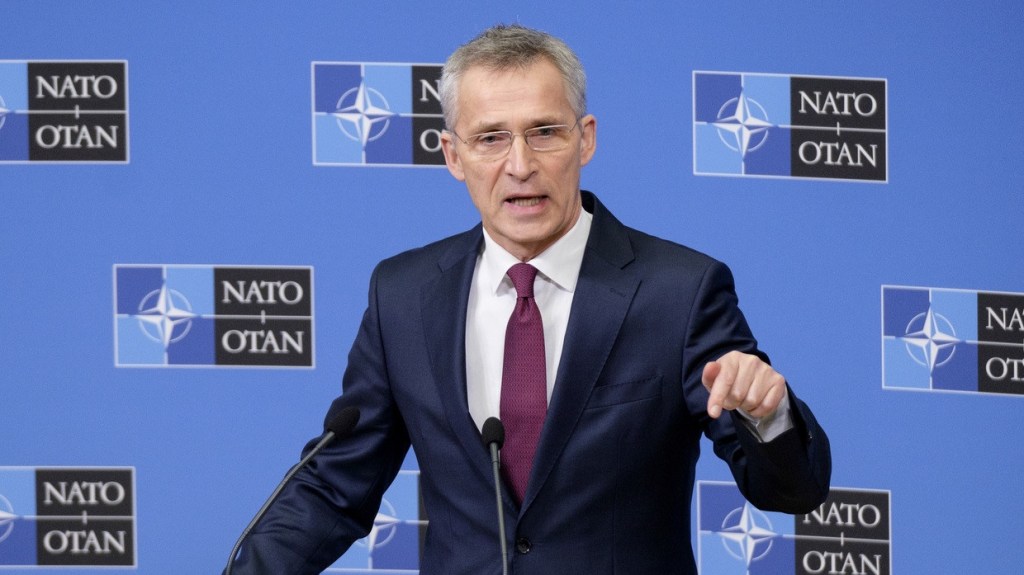
NATO’s arsonist-in-chief Jens Stoltenberg wants the Western public to pay for a Ukrainian fire he helped to ignite. by Scott Ritter
EU members should ‘stop complaining’ and ‘pay the price’ for the Russia-Ukraine conflict, says leader of the bloc which started it all
Scott Ritter is a former US Marine Corps intelligence officer and author of ‘Disarmament in the Time of Perestroika: Arms Control and the End of the Soviet Union.’ He served in the Soviet Union as an inspector implementing the INF Treaty, in General Schwarzkopf’s staff during the Gulf War, and from 1991-1998 as a UN weapons inspector.
The General Secretary of NATO, Jens Stoltenberg, took it upon himself recently to lecture the members of the European Parliament about the need to “pay the price” necessary to keep Ukraine able to function and fight in its ongoing conflict with Russia. What he failed to admit was the major role he himself played in bringing about this conflict.
The Norwegian has an important role. In many ways, one can liken it to that of a fire commissioner whose job is to bring together various neighborhood fire departments into a large mutual aid pact, where a fire in one district automatically causes the resources of the neighboring districts to be dispatched in response. That’s Article 5 of NATO’s Charter in a nutshell.
Like any membership-based bureaucracy, joining a fire district, like joining NATO, involves a process which requires specific undertakings by all parties involved. The mutual aid pact, like Article 5, can’t be triggered unless the involved party is a member.
Now imagine a scenario where a fire commissioner was pushing for the membership of a questionable fire district, and in the middle of the processes involved in making this district a member, a giant fire breaks out. The fire commissioner encourages his constituent districts to turn over equipment and resources (but not manpower) to the non-member district to fight the fire. The fire is big. The fire commissioner asks for more resources.
And now imagine that it turns out that the fire commissioner is an arsonist who helped set the fire in the first place.
That’s pretty much the scenario which faces NATO today, where the US-led bloc is struggling to deal with the consequences of 14 years of fundamentally flawed policy which saw it promise Ukraine eventual membership, despite knowing that Russia was adamantly opposed to such a move. NATO then watched as its constituent members helped conduct a coup in Ukraine in February 2014, replacing a duly elected president with a cohort of politicians hand-picked by Washington.
The coup in question was made possible only with the involvement of radical Ukrainian right-wing nationalists whose lineage can be traced back to Nazi Germany and, post-World War Two, covert CIA backing which lasted from 1945 through the present. The involvement of these neo-Nazi elements can be likened to the fire commissioner dispatching a team of fellow arsonists to ostensibly help prepare the prospective member for joining the fire district, only to have them secretly conspire amongst themselves to instead burn down entire neighborhoods within the territory of the candidate district.
For eight years Jens Stoltenberg oversaw a system which pretended to pursue peace in Ukraine post-coup through the Minsk Accords, only to secretly conspire with Ukraine, France, and Germany to prevent closure on the accords for the purpose of buying time for Ukraine to build a NATO-standard military capable of delivering a massive knockout blow to the breakaway Donbass region, and perhaps even Crimea.
Stoltenberg helped light the match that set Ukraine ablaze. And now it turns out, during a meeting with members of the European Parliament, the secretary general of NATO chastised the parliamentarians to “stop complaining and step up and provide support to Ukraine”.
The arsonist-in-chief was lecturing the insurance underwriters of Europe to suck it up and pay the price of his handiwork.
His hypocrisy was sickening. “The price we pay as the European Union, as NATO,” he declared, “is the price we can measure in currency, in money. The price they [Ukrainians] pay is measured in lives lost every day. We should stop complaining and step up and provide support, full stop.”
Left unsaid was the fact that Stoltenberg and NATO were responsible for the conflagration which has swept over Ukraine. With Kiev gearing up for an offensive against the Donbass, only Russia’s decision to launch its own special military operation prevented the NATO/Ukrainian plan from reaching fruition.
But the arsonist cannot admit that he started the fire. Instead, Stoltenberg not only shifted responsibility for the Ukraine conflict onto Russia, but then had the audacity to state that the fire he started posed a threat to all of NATO. “It is in our interest to help Ukraine,” Stoltenberg declared to the European parliamentarians, “because you have to understand that if Ukraine loses this, that’s a danger for us.”
Ignoring the fact that he was largely responsible for the disaster that struck Ukraine when Russia initiated its military operation, Stoltenberg planted his banner firmly onto a hill of hypocrisy, proclaiming: “If you don’t care about the moral aspect of this, supporting the people of Ukraine, you should care about your own security interests. Pay for the support, pay for the humanitarian aid, pay the consequences of the economic sanctions, because the alternative is to pay a much higher price later on.”
What Stoltenberg was really saying was: “pay for my mistakes, your mistakes, our mistakes.”
But admitting a mistake is not part of the moral fiber of an arsonist.
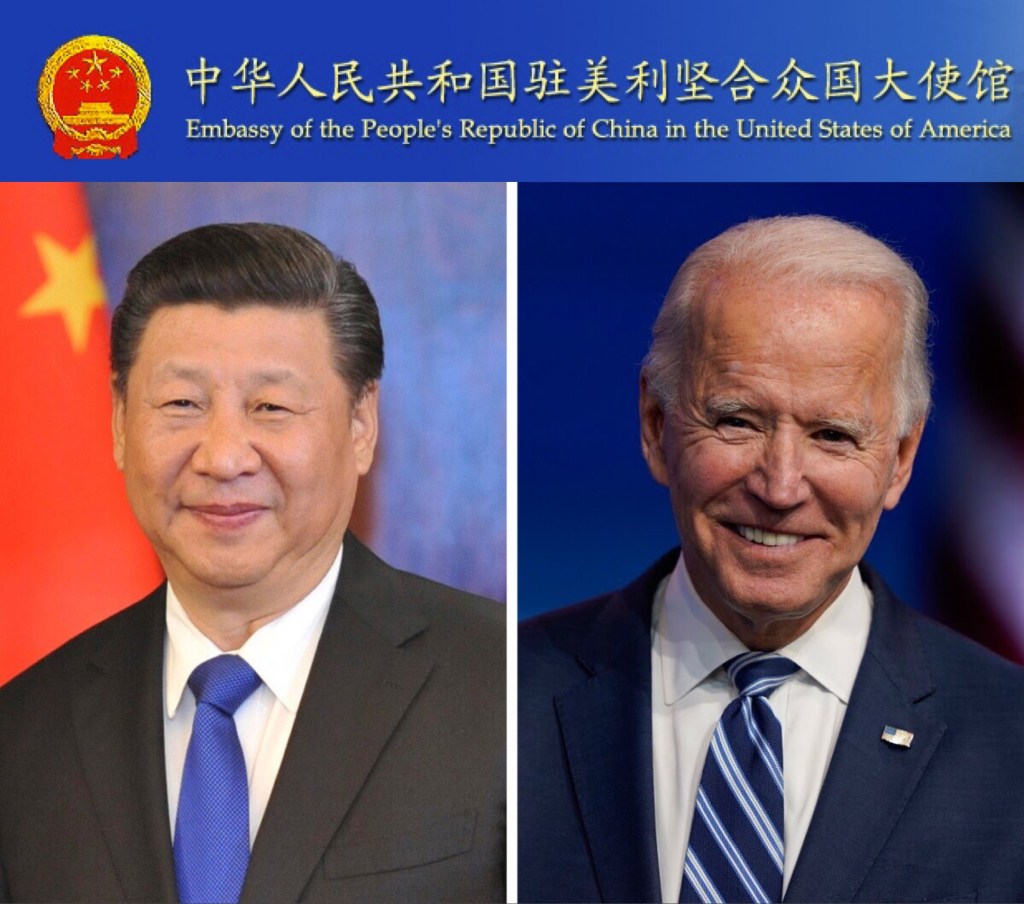
President Xi Jinping Speaks with US President Joe Biden on the Phone 中國國家主席習近平同美國總統拜登通電話 28 July 2022
On the evening of 28 July, President Xi Jinping spoke with US President Joe Biden on the phone at the request of the latter. The two Presidents had a candid communication and exchange on China-US relations and issues of mutual interest.
President Xi pointed out that in the world today, the trends of turbulence and transformation are evolving, and deficits in development and security are looming large. Faced with a world of change and disorder, the international community and the people around the world expect China and the US to take the lead in upholding world peace and security and in promoting global development and prosperity. This is the responsibility of China and the US as two major countries.
President Xi underscored that to approach and define China-US relations in terms of strategic competition and view China as the primary rival and the most serious long-term challenge would be misperceiving China-US relations and misreading China’s development, and would mislead the people of the two countries and the international community. The two sides need to maintain communication at all levels and make good use of existing channels to promote bilateral cooperation. Recognizing the many challenges facing the global economy, President Xi underscored the need for China and the US to maintain communication on such important issues as coordinating macroeconomic policies, keeping global industrial and supply chains stable, and protecting global energy and food security. Attempts at decoupling or severing supply chains in defiance of underlying laws would not help boost the US economy. They would only make the world economy more vulnerable. The two sides need to work for deescalation of regional hotspots, help rid the world of COVID-19 as early as possible, reduce the risk of stagflation and recession, and uphold the international system centering on the UN and the international order underpinned by international law.
President Xi elaborated on China’s principled position on the Taiwan question. President Xi highlighted that the historical ins and outs of the Taiwan question are crystal clear, and so are the fact and status quo that both sides of the Taiwan Strait belong to one and the same China. The three Sino-US joint communiqués embody the political commitments made by the two sides, and the one-China principle is the political foundation for China-US relations. China firmly opposes separatist moves toward “Taiwan independence” and interference by external forces, and never allows any room for “Taiwan independence” forces in whatever form. The position of the Chinese government and people on the Taiwan question is consistent, and resolutely safeguarding China’s national sovereignty and territorial integrity is the firm will of the more than 1.4 billion Chinese people. The public opinion cannot be defied. Those who play with fire will perish by it. It is hoped that the US will be clear-eyed about this. The US should honor the one-China principle and implement the three joint communiqués both in word and in deed.
President Biden said that the world is at a critical moment. US-China cooperation benefits not only the two peoples but also people of all countries. The US hopes to keep an open line of communication with China to enhance mutual understanding and avoid misperception and miscalculation, and will work with China where the interests of the two countries align and, at the same time, properly manage differences. He reiterated that the one-China policy of the US has not changed and will not change, and that the US does not support “Taiwan independence”.
The two Presidents exchanged views on issues including the Ukraine crisis. President Xi reiterated China’s principled position.
Both Presidents viewed their call as candid, in-depth and constructive. They agreed to stay in touch and instructed the two teams to keep up communication and cooperation.
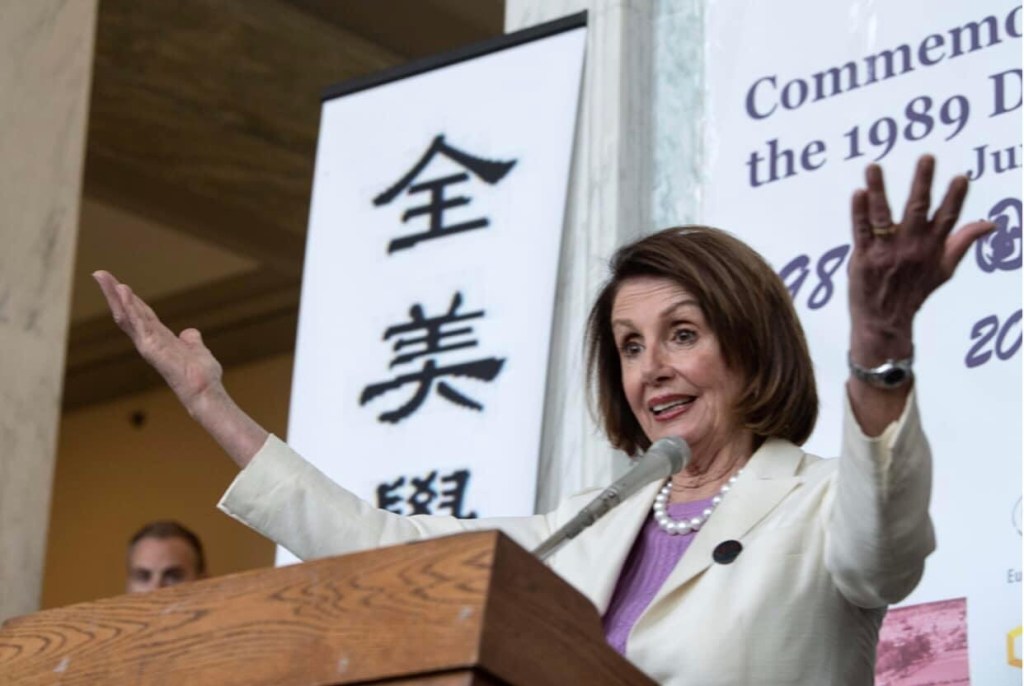
Biden claimed that Pelosi was a separate branch of government and that he did not have control over her travel plans completely false. The supreme court decided in Haig vs Agee that the US State Department could definitely prevent travel of any US citizen if it was a threat to national security or foreign policy. 拜登聲稱佩洛西是政府的一個獨立部門,他無法控制她的旅行計劃,這完全是錯誤的。 最高法院在黑格訴阿吉案中裁定,如果任何美國公民的旅行對國家安全或外交政策構成威脅,美國國務院絕對可以阻止其旅行
“In a 7-to-2 decision, the Court held that Passport Act of 1926 and other congressional statutes implicitly granted the Secretary of State the power to revoke passports. The Court noted Congress’s historical recognition of “Executive authority to withhold passports on the basis of substantial reasons of national security and foreign policy.” The Court further held that because the regulations were limited to cases in which there was a likelihood of “serious damage” to foreign policy, Agee’s claims concerning the First Amendment, the Fifth Amendment, and the right to travel were “without merit.”
If Biden does not seek to invoke Haig vs Agee–as any reasonable leader would–we can infer that the Biden WH does not see Pelosi’s trip as causing damage to foreign policy, i.e. Pelosi may be carrying out foreign policy.
WASHINGTON, July 28 (Reuters) – U.S. President Joe Biden and China’s Xi Jinping held a fifth call as leaders on Thursday, speaking for more than two hours, as concerns mounted over a possible visit to Chinese-claimed Taiwan by U.S. House of Representatives Speaker Nancy Pelosi.
The White House said the call began at 8:33 a.m. (1233 GMT) and ended at 10:50 a.m. (1450 GMT). U.S. officials had said it would have a broad agenda, including discussion of Russia’s invasion of Ukraine, which China has yet to condemn.
At its core, U.S. officials see the exchange as another chance to manage competition between the world’s two largest economies, whose ties have been increasingly clouded by tensions over democratically governed Taiwan, which Xi has vowed to reunite with the mainland, by force if necessary.
Beijing has issued escalating warnings about repercussions should Pelosi visit Taiwan, a move that would be a dramatic, though not unprecedented, show of U.S. support for the island, which says it is facing increasing Chinese military and economic threats.
Washington does not have official relations with Taiwan and follows a “one-China” policy that recognizes Beijing, not Taipei, diplomatically. But it is obliged by U.S. law to provide the island with the means to defend itself, and pressure has been mounting in Congress for more explicit support.
“This is about keeping the lines of communication open with the president of China, one of the most consequential bilateral relationships that we have, not just in that region, but around the world, because it touches so much,” White House national security spokesman John Kirby told reporters on Wednesday.
One person briefed on planning for the call said the Biden administration thinks leader-to-leader engagement is the best way to lower tensions over Taiwan.
Some analysts believe Xi also has an interest in avoiding escalation as he seeks an unprecedented third term in office at a congress of China’s ruling Communist Party expected in the fall.
Biden also wanted to discuss climate and economic competition issues, the person briefed said, as well as the idea of placing a price cap on Russian oil to punish Moscow for its war in Ukraine, an issue Treasury Secretary Janet Yellen raised with Chinese counterparts earlier in July. read more
The Biden administration has been debating whether to lift some tariffs on Chinese goods as a way to ease soaring inflation, but U.S. officials have said a decision was not expected ahead of the call. read more
When Biden last spoke to Xi in March, he warned of “consequences” if Beijing gave material support for Russia’s war, and the U.S. government believes that that red line has not been crossed in the months since.
Taiwan has complained of stepped-up Chinese military manoeuvres over the past two years to try and force it to accept Beijing’s sovereignty. Just ahead of Thursday’s call, Taiwan’s military said it fired flares to warn away a drone that “glanced by” a strategically located and heavily fortified island close to the Chinese coast that was possibly probing its defences. read more
TOXIC TIES The White House has reiterated that its “one-China” policy has not changed despite speculation over a possible trip by Pelosi, which the speaker has yet to confirm.
The last time a speaker of the U.S. House visited Taiwan was in 1997, and as a co-equal branch of government, the U.S. executive has little control over congressional travel.
China has grown more powerful militarily and economically since, and some analysts worry such a visit at a time of fraught ties, could spur a crisis across the 100-mile (160-km) wide Taiwan Strait waterway separating China and Taiwan.
“The relationship is in such a toxic state. Mutual distrust is really at an all-time high. I think people don’t realize how dangerous this particular moment is,” said Bonnie Glaser, a China expert at the German Marshall Fund of the United States.
She said Biden and Xi needed to focus their call on de-escalation, including possible mechanisms to reduce the risk of mishaps.
Kirby said the administration has been in touch with Pelosi’s office to make sure she has “all the context” she needs to make decisions about her travel.
China has given few clues to specific responses it might take if Pelosi, a long time critic of China, particularly on human rights issues, does go to Taiwan.
Martin Chorzempa, a senior research fellow at the Peterson Institute for International Economics, said playing up the Taiwan issue could serve Xi as a domestic distraction from China’s slowing economy, but “any reaction strong enough to trigger U.S. sanctions would create massive damage to China and the world economy.” read more
China’s state media said on Thursday the country will try hard to achieve the best possible results for the economy this year, dropping previous calls that it will strive to meet its 2022 growth target. This followed a high-level Communist Party meeting chaired by Xi. read more
Scott Kennedy of Washington’s Center for Strategic and International Studies think tank, said he did not believe the two sides were on the edge of a crisis, but “the risk of a major crisis is well above zero” and a Biden-Xi call was important to avoid an unwanted clash.
“Beijing, Taipei and Washington are full of people steeped in how to send and interpret signals conveying threats and reassurance, and I’m sure no one wants a war right now.”
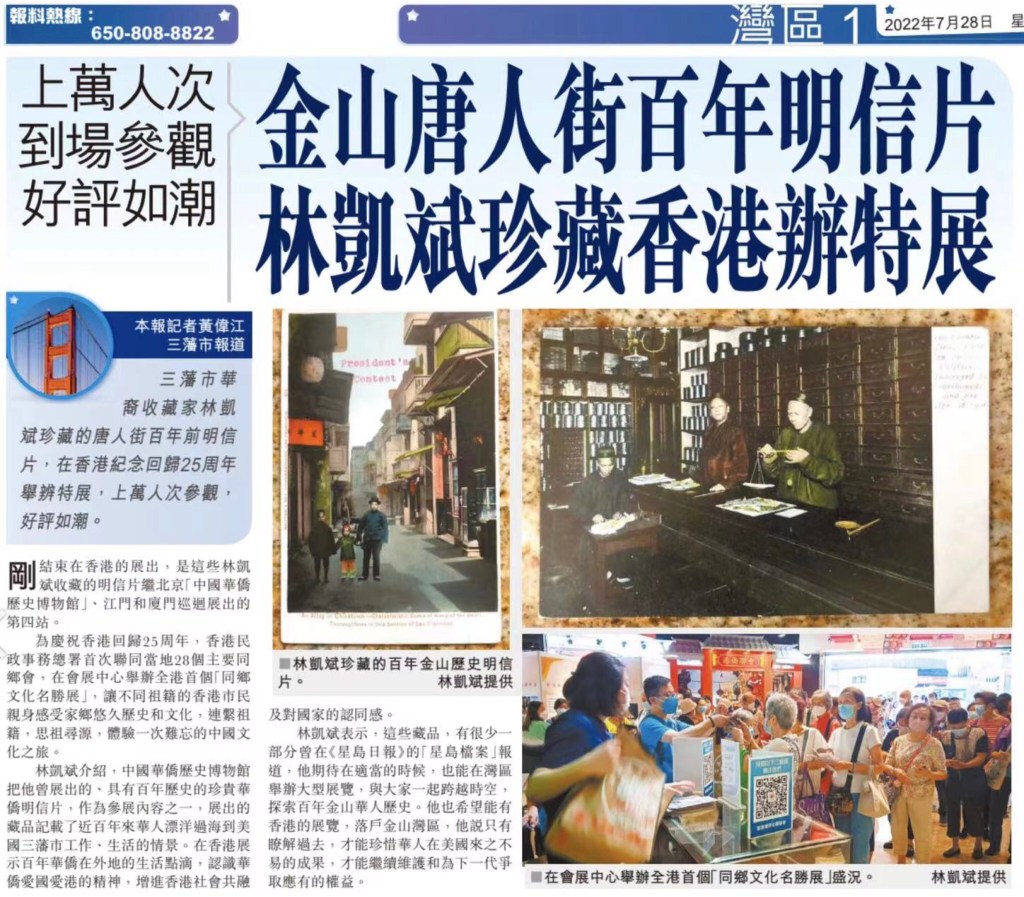
San Francisco collections send to Hong Kong for exhibition 為纪念香港回歸祖國25 周年纪念,林凱斌 Herbert Lam個人藏品百年前舊金山華人為主题的明信片很榮幸被《中國華僑歷史博物馆》和香港🇭🇰特区民政事務處選中,代表海外華僑文物在香港展出。十分感謝本地華文報纸《星島日報》及記者黄偉江先生在今天7月28日用宝貴的版面報導盛事。
As we all know, China is known for its infrastructure, including the Forbidden City in Beijing, the Mausoleum of Emperor Qin Shiguang, the Beijing-Hangzhou Grand Canal and the Yangtze River, the Three Gorges Dam, the North-south Water Diversion Project, and the Hong Kong-Zhuhai-Macao Bridge. And China, an infrastructure fiend, will never be content with the present. But recently, China has surprised the world again, with five super projects on the horizon that will make western countries worry. So, what are these five super projects?
Scott Ritter, a military analyst and CN contributor, was among those blacklisted by a Ukrainian government agency that appears to be funded by the United States. Ritter has written the following letter to his representatives in Congress.
Senator Charles Schumer Leo W. O’Brien Federal Office Building 11A Clinton Avenue, Room 827 Albany, NY 12207
Senator Christine Gillibrand Leo W. O’Brien Federal Office Building 11A Clinton Avenue, Room 821 Albany, NY 12207
Representative Paul Tonko 19 Dove Street, Unit 302 Albany, NY 12210 July 27, 2022
Dear Senators Schumer and Gillibrand, and Congressman Tonko,
My name is Scott Ritter. I am a New York State resident, currently residing in the Town of Bethlehem, in Albany County. My family and I have lived at our current address since July 2000.
I am writing to you in your collective role as my elected representatives in the United States Congress, specifically regarding H.R. 7691, the Additional Supplemental Appropriations Act of 2022, which became Public Law 117-128 on May 21, 2022, which each of you voted in favor of.
I draw your attention to the First Amendment of the United States Constitution, specifically the following language: “Congress shall make no law…abridging the freedom of speech, or of the press.”
By enacting Public Law 117-128, you appear to have abrogated your Constitutional responsibilities in so far as you may have, in fact, made a law which both abridges the freedom of speech and a free press by enabling the Government of Ukraine, through the use of US taxpayer dollars appropriated under Public Law 117-128, to publish a “blacklist” singling out US citizens as “Russian propagandists” for exercising their Constitutional rights pertaining to free speech and a free press.
The “blacklist” in question was published on July 14, 2022, by the Ukrainian Center for Countering Disinformation, and consists of a list of politicians, academics, and activists who the Center claims promote “Russian propaganda.” Many on this list are citizens of the United States, some of whom, like me, have taken an oath to uphold and defend the Constitution of the United States.
While the specific criterion used by the Ukrainian Center for Countering Disinformation for selecting persons for inclusion on this “blacklist” is not known, in my case the Ukrainian government appears to have taken umbrage against my articulation of Ukraine as a NATO base of operations, my analysis of the Bucha Massacre in early March which assigns responsibility to Ukrainian security services, and my description of the current Ukraine-Russian conflict as a “proxy conflict” being waged on behalf of the United States.
Whether one agrees with my positions on these and other matters pertaining to Ukraine is not the point; by articulating my views, I am exercising my rights under the Constitution of the United States. While the Government of Ukraine is free to express its opinions regarding my viewpoints as it sees fit, the Government of the United States, by using funds appropriated by the United States Congress, should not facilitate the actions of the Government of Ukraine in this regard.
I draw your attention to Section 507(a) of Public Law 117-128, which directs that “[f]unds made available by this title under the heading Economic Support Fund may be made available for direct financial support for the Government of Ukraine.”
Public Law 117-128 makes available $8,766,000,000 for assistance for Ukraine under the heading “Economic Support Fund.”
On July 12, 2022, the United States Agency for International Development (USAID) issued a press release in which it announced that $1.7 billion in direct budgetary aid was provided to Ukraine under Public Law 117-128, which allowed the Government of Ukraine, among other things, to pay the salaries of Ukrainian civil servants. This would logically include the salaries of the employees of the Ukrainian Center for Countering Disinformation.
As a constituent whose name has appeared on a so-called “blacklist” published by the Ukrainian Center for Countering Disinformation, my personal and professional life has been, and continues to be, detrimentally impacted by the chilling effect of being labeled a “Russian propagandist” for simply exercising the right to free speech guaranteed by the United States Constitution. Moreover, Ukraine has a history of converting “blacklists” of this nature into “kill lists”, where those who speak out against the policies of the Ukrainian government are being murdered or threatened with violence. I am certain you agree with me that Congress cannot be in a position where, through its actions, foreign governments are provided the means to intimidate citizens of the United States from exercising their Constitutionally protected rights regarding free speech.
As such, I respectfully request that each of you investigate what role, if any, funds authorized by you under Public Law 117-128, have been used to underwrite the actions of the Ukrainian Center for Countering Disinformation, and more specifically, if any funds appropriated under Public Law 117-128 have been used to pay the salaries of Ukrainian civil servants employed by the Ukrainian Center for Countering Disinformation involved in the preparation and dissemination of this so-called “blacklist”.
Under Section 507(d) of Public Law 117-128, Congress directs that “[t]he Secretary of State or the Administrator of the United States Agency for International Development, as appropriate, shall report to the appropriate congressional committees on the uses of any funds provided for direct financial support to the Government of Ukraine pursuant to subsection (a) and the results achieved, not later than 90 days after the date of enactment of this Act and every 90 days thereafter until September 30, 2025,” and that such a report “shall also include the metrics established to measure such results.”
I request that each of you become personally involved in preparing the appropriate questions to be asked of either the Secretary of State or the Administrator of USAID when they next appear before Congress to carry out their mandated reports regarding the use of funds provided for the direct financial support of the Government of Ukraine. The specific metric of interest here is whether any of these funds were used to pay the salaries of civil servants employed by the Ukrainian Center for Countering Disinformation involved in the preparation and dissemination of the aforementioned “blacklist”.
If funds were, in fact, used in this manner, I would respectfully request that you, in your status as my elected representatives to the United States Congress, take the appropriate action necessary to ensure that funds appropriated by the United States Congress are not used to suppress the free speech rights afforded to citizens of the United States, including myself, by the First Amendment of the United States Constitution. Moreover, I would insist that you take the appropriate action to guarantee that the Government of Ukraine immediately cease and desist in all activity designed to threaten and intimidate citizens of the United States. You are duty bound to protect the interests of the United States and its citizens rather than facilitate the actions of a foreign power that are, by design, intended to accomplish just the opposite.
Congress cannot be allowed to bypass Constitutionally imposed constraints on its actions by allowing a foreign government to do that which would not be permitted here in the United States. By paying the salaries of the civil servants employed by the Ukrainian Center for Countering Disinformation, who have prepared and disseminated the so-called “blacklist”, you and your fellow Senators and Representatives appear to be doing just that—allowing the Government of Ukraine to suppress the right of free speech guaranteed to United States citizens under the Constitution.
I look forward to hearing back from each of you as to how you propose to proceed in this matter.

 Business Blog