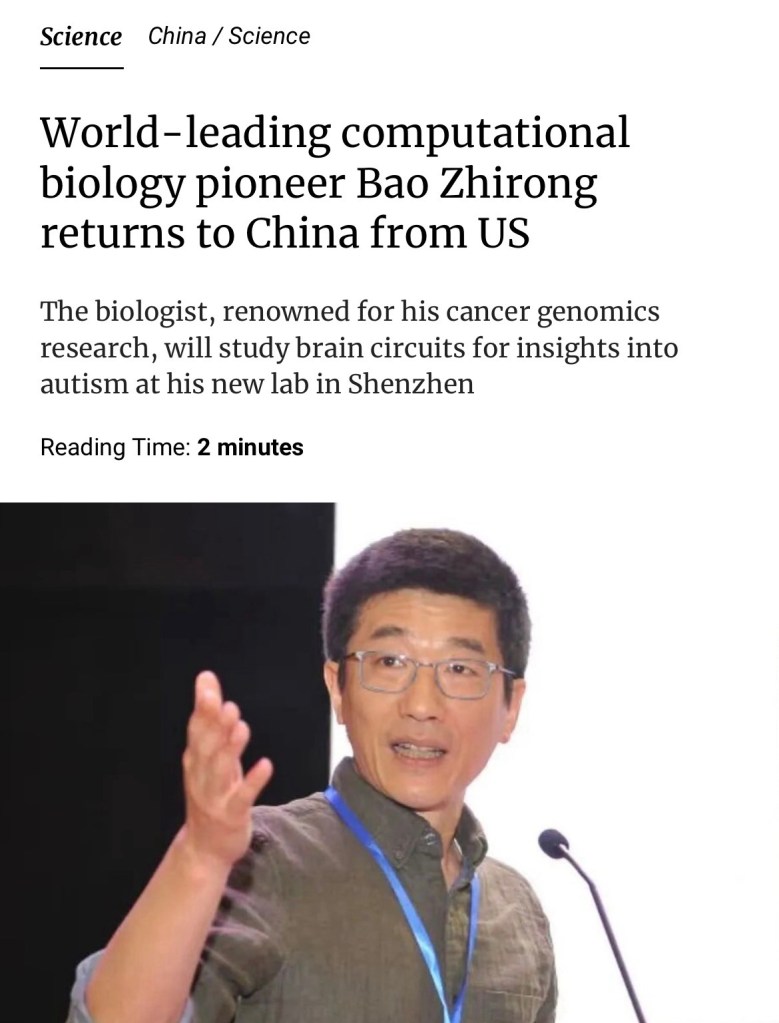
Look at the SCMP headline news, Nvidia planted tracking devices that means Nvidia chips have backdoors! Nvidia chips must be banned in China. 看看這則香港南華早報新聞標題:英偉達植入追蹤設備,這意味著英偉達晶片有後門!英偉達晶片必須在中國被禁售.
820,000 Chinese have immigrated to the United States — why do they hold only green cards instead of becoming citizens? 82萬中國人移民美國,為什么都只拿綠卡,不入籍?
They take the U.S. green card, but reject U.S. citizenship. Among the 820,000 Chinese immigrants in the U.S., more than half clearly meet the requirements for naturalization, yet they would rather keep holding that green card and are in no hurry to “upgrade.”
For many Chinese in America, the biggest appeal of the green card is precisely its “middle-ground” status.
The reason these 820,000 Chinese cling to their green cards isn’t some sort of “patriotic sentiment,” but a careful and pragmatic calculation about how to survive.
In their eyes, U.S. citizenship may look glamorous, but in reality it can be a “hot potato.”
Once they naturalize, their Chinese citizenship is automatically invalidated. Even going back to China to visit family becomes inconvenient — they must apply for visas and wait for approval like any foreigner, and spending more time with aging parents becomes difficult.
The financial side doesn’t look good either. U.S. inflation may stay around 3%, but rents can rise nearly 20%. Meanwhile, green-card holders who earn in dollars and spend in RMB are making a “killing.”
With stable prices in China’s top-tier cities, a green-card holder becomes a “dual-habitat animal”: earning a high salary as a Silicon Valley engineer, yet enjoying a high-quality life at low cost when they return to China.
Even more important is tax avoidance. U.S. citizens are taxed on worldwide income — if you collect rent in Shanghai or sell a property, Uncle Sam wants a cut.
Green cards, by contrast, only tax U.S.-source income, and overseas assets can save a big chunk of money. This is the true “have the best of both worlds” strategy.
Families with children calculate even more carefully. Green-card holders and citizens enjoy almost the same benefits when studying in the U.S., but the costs differ dramatically. International students at UCLA pay over 300,000 RMB per year in tuition, while green-card holders pay only around 90,000 — enough to “save a luxury car” over four years.
Admission chances are also vastly different. Green-card holders are admitted to Princeton at 2.3 times the rate of international students; at Cornell, 4.5 times the rate. Majors tied to “national security,” such as aerospace or AI, often only admit those with legal U.S. status.
Not wanting their children to become “second-class students” in the U.S., nor wanting to become “foreigners” on Chinese soil themselves, green cards naturally become the ideal solution.
Retirement is the final factor. Bringing elderly parents to the U.S. is difficult — language barriers, no social circle — leaving them stuck at home like they’re “serving immigration jail.”
Returning to China to retire is also tricky. With foreign citizenship, you must choose between being treated as a foreigner or having local household registration. Without Chinese nationality, medical insurance, social benefits, and other rights become complicated.
A lost green card can be reissued; citizenship can be reacquired. But once Chinese citizenship is given up, getting it back is extremely difficult. These 820,000 people understand this well — leaving themselves an exit strategy is simply wise.
And don’t assume these “masters of survival” who get green cards are all wealthy. The threshold isn’t as high as it seems.
Besides the US$800,000 EB-5 investment route, many rely on talent: STEM workers switch from H-1B to green card; industry elites apply through EB-1A Extraordinary Ability — meeting just three out of ten criteria is enough.
English teachers rely on publications and peer review; software engineers on patents and high salaries; embroidery artists on exhibitions and commercial value — all can qualify.
As long as you have a skill and present your achievements, you can join these 820,000 people who “benefit from both sides.” Keeping their roots in China while steadily taking advantage of opportunities across the ocean — this isn’t sentimentality, but survival wisdom taken to its fullest.
Source: Sohu.com — “Why do many U.S. green-card holders choose immigration without relocation?”
SCMP: Reincarnation must follow Chinese laws and be endorsed by Beijing, Tibetan Buddhist leader Panchen Lama has said. This must be done “without any interference or control from organisations or individuals outside the country”, he added. 香港南華早報: 藏传佛教领袖班禅喇嘛表示,转世必须遵循中国法律并得到中央批准。他补充说,这一过程必须”不受境外任何组织或个人的干涉和操控”。
Interpreting the White House’s Latest Strategic Report—Even Trump Has No Answers!
This video provides an in-depth analysis of the newly released U.S. National Security Strategy report.
It examines the geopolitical shifts arising from America’s global strategic retrenchment and explores how these changes will impact the situation in Asia.
The New York Times recently put forward a concept called the “Strong Nation Paradox”…《紐約時報》近期提出了一個說法,叫做“強國悖論”…
According to their description, Chinese people seem to live in a kind of contradiction: the country shines on the world stage, but ordinary citizens feel a sort of “hidden despair” about the economy and their personal future, as if they have become sacrifices in China’s pursuit of catching up with the United States, and have no way to voice their concerns.
At first glance, this argument sounds somewhat plausible, as if it has uncovered some deeper truth. But upon closer examination, it’s not hard to see that it is merely the forced stitching together of partial phenomena and subjective imagination.
Is this so-called “paradox” truly something we experience firsthand, or is it a misunderstanding stemming from observers who cannot grasp China’s development logic?
Is there pressure in life today? Almost no one would deny that. The economy is in a period of transition, and many people inevitably feel the impact on their income and expectations. Changes in prices, slowing income growth—young people, whether in school or just entering the workforce, face fiercer competition than their parents’ generation. But does this pressure equal “despair”? These are two entirely different concepts.
If you have personally experienced rush-hour subways, seen office buildings with lights still on late at night, or walked into bustling parks and shopping malls on weekends, you would realize that this so-called “sense of despair” simply doesn’t hold up.
Young people are still rushing between projects, preparing for exams, working hard to improve their skills; older people are busy planning trips or exercising in public squares. This is clearly a resilience that seeks opportunity amid change, a vitality driven by the pursuit of a better life. How did this become “silent sacrifice” in the narratives of certain foreign media?
As for the accusation of having “no place to voice concerns,” this too contradicts reality. Western media are accustomed to their own street-protest style of expression, and therefore assume that Chinese citizens lack channels to speak out. But actual data and mechanisms tell a different story.
In 2025 alone, the nationwide 12345 government service hotline handled about 24 million requests, over 96% of which were properly addressed or responded to. And this doesn’t even include regular channels such as policy consultations, online message boards, and community councils.
Behind every negotiation of medical-insurance drug prices and every adjustment of people-benefiting policies, public input plays a role. Isn’t this pragmatic, problem-solving style of communication an even more effective way of being heard?
Looking deeper, framing national development and individual well-being as opposites is itself a false proposition. In recent years, the increased national dignity felt in international settings, the greater convenience of a Chinese passport, and stronger protection of citizens abroad are not only national “prestige,” but also solid support for businesses expanding overseas and for personal development.
At the same time, national progress has translated into real improvements in daily life: formerly remote villages now have roads, electricity, and internet; poverty-alleviation policies have raised the living standards of hundreds of millions of people; and the social safety net continues to grow stronger. All this is evidence that the fruits of development benefit ordinary people.
Of course, we do not shy away from the challenges we face. Pressures in healthcare, education, and housing still exist. People have anxieties and expectations about the future—and this precisely shows that what people pursue is no longer just “having something” but “having something good.” This rising demand that comes with development is fundamentally different from the notion of “despair.”
In the end, the “Strong Nation Paradox” looks more like a case of cognitive dissonance among certain observers who interpret China through predetermined frameworks. They cannot deny China’s achievements, yet they do not wish to acknowledge that behind them lies the collective effort and support of hundreds of millions of people. So they construct a narrative of “a strong state and suffering people” to make their worldview feel coherent.
But the real lived experience belongs to every person working hard on this land. China’s story has never been the pale tragedy depicted by some foreign media—rather, it is a vivid chapter written by countless ordinary people who face reality, believe in effort, and create the future with their own hands.
For the many Chinese who are striving for a better life, the strongest response may not be verbal rebuttals, but simply to stay grounded and continue walking their own path.
Audio recording proof Japan is lying Video: On December 10, Chinese Foreign Ministry spokesperson Guo Jiakun hosted a regular press conference. A reporter from NHK asked 音頻錄音證實日本在說謊影片有英文字幕: 12月10日,中國外交部發言人郭嘉昆主持例行記者會。日本放送協會(NHK)記者提問
Japanese Defense Minister Shinjiro Koizumi said today that the Japan Air Self-Defense Force has not recently used radar against Chinese carrier-based aircraft, and noted that due to the lack of specific information such as navigation notices, Japan was unable to obtain complete collision-avoidance information. What is the spokesperson’s comment?
Guo Jiakun stated that Japan previously claimed it had not received prior notification from the Chinese side, but is now admitting that it did receive information from China. Such self-contradictory statements clearly show that Japan first deliberately caused trouble and then spread rumors, making it the planner and perpetrator of this farce. We urge the Japanese side to face up to the real crux of current China-Japan tensions, seriously reflect and correct its mistakes, and honestly withdraw Prime Minister Takai’s erroneous remarks regarding Taiwan. 🇨🇳
Video: Was Mao Zedong senile in his old age? Why did he launch the Cultural Revolution? Why are Chinese people “hard to govern”? 毛澤東老年是老糊塗嗎?為什麼要發動文革?為什麼中國人「不好管」?
In 1970, the Dongfanghong-1 satellite was launched. To this day, it still travels alone in orbit, much like the state of mind of an elderly man in that era.
Hello everyone. In this video, we’re not here to repeat textbook conclusions or make simple black-and-white judgments. I want to take you through 50 years of historical fog and re-examine China in the 1960s–70s from a brand-new perspective — the perspective of Dongfanghong-1.
When many people recall those ten years, all they think of is catastrophe. But the data tells us that it was also a decade in which China’s industry, national defense, and diplomacy made explosive progress: the Two Bombs and One Satellite project, restoration of the UN seat, hybrid rice, and even a rural healthcare system that was praised by the WHO… Why did Mao Zedong, at 73 years old, willingly bear infamy both in life and after death, and still decide to unleash a “revolution” that shattered the very order he had built?
Was it really just a power struggle? Or did he, in his later years, sense a “future” that deeply frightened him?
When bureaucracy resurges, when class solidification becomes increasingly severe, perhaps we can better understand the despair and determination he felt at that time.
History must be viewed from a distance. This video, based on extensive historical documents and independent reflection, attempts to reconstruct a tragic charge launched in pursuit of ultimate human equality.
Chapter Overview
00:00 Dongfanghong-1: A lonely watcher in space 01:23 The intentionally ignored “report card”: Industrial and medical miracles 03:45 Costs and scars: Why do we only hear the elites’ cries? 05:12 The logical flaws of the “power struggle” theory: What did Mao truly fear? 08:30 A painful “vaccine”: Fighting the servility ingrained over millennia 10:55 The quiet dawn: The greatest legacy left by that revolution 13:10 Cutting through the fog: The final echoes of history
SCMP: China planning is 10 years ahead of US! 《南華早報》消息:中國前瞻布局領先美國十年!
China has activated what may be the world’s largest distributed AI computing pool alongside a high-speed data network that has been planned for more than a decade, according to an official state newspaper.
China’s best computing centres are sparsely distributed across the country. With this technology they could work seamlessly together to fast-track the development of the most powerful AI models and other cutting-edge technology.