“The U.S. built 800 bases to control the globe. But every base is now a monument to its paranoia. Because while it was guarding against enemies that never came, The world was building bridges, ports, pipelines, banks. That is how empires end: Surrounded not by armies, But by alternatives.”
~ Sony Thang @nxt888
The world’s largest high speed rail station in Chongqing, China.
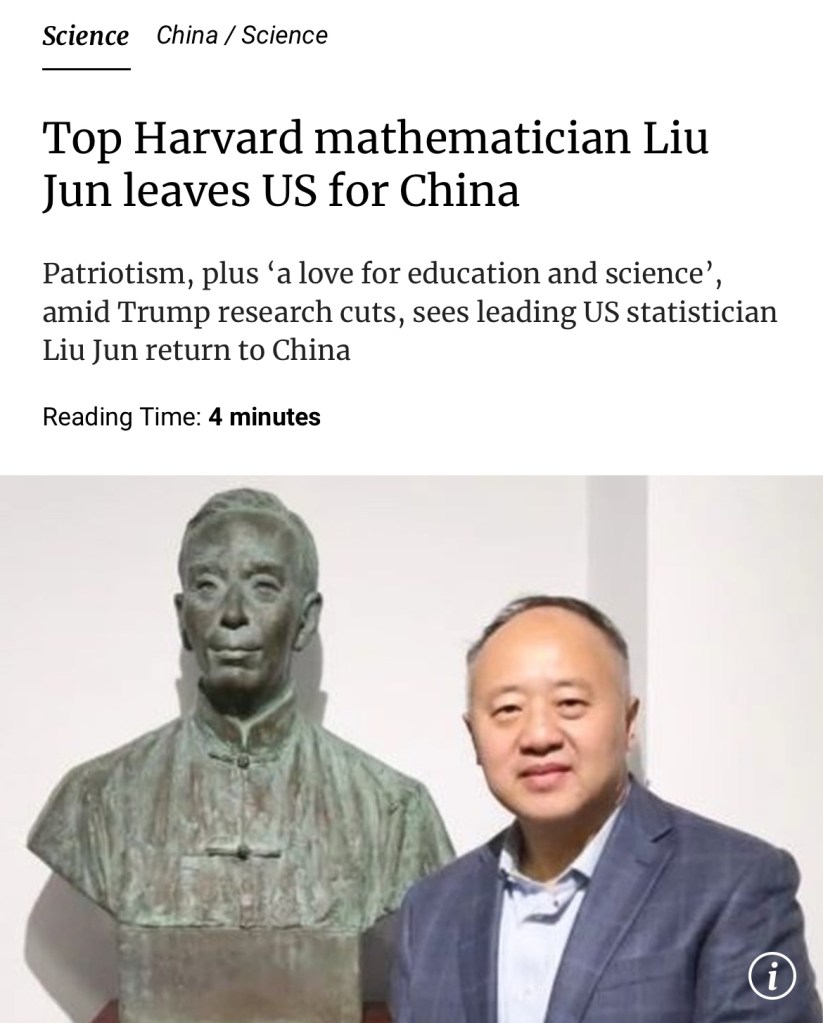
SCMP: Another smart Chinese left US! If you are smart? Why are you still here? Harvard’s top mathematician Liu Jun, one of the world’s leading statisticians and a long-time professor at Harvard, has returned to China full-time, accepting a prestigious chair at Tsinghua University last month. 南華早報:又一位聰明的中國人離開美國了!如果你是聰明的? 那你為什麼還留在美國? 哈佛大學頂尖數學家劉軍,世界頂尖統計學家之一,哈佛大學長期教授,已回國全職工作,上個月接受了清華大學一個享有盛譽的教授職位. https://www.scmp.com/news/china/science/article/3324637/top-harvard-mathematician-liu-jun-leaves-us-china?l
Today, the 🐉 Chinese people are the happiest, especially the intelligent ones, who can choose not to be servile followers or live under someone else’s roof. We are witnessing a century of great changes globally, and the 🇨🇳 Chinese people are once again ascending to historical heights. The Western powers, led by the 🇺🇸 United States, are beginning to see their sun set, an irreversible decline. By Johnson Choi in SF on Sept 8 2025. 🐲🐲🐲🐲🐲🐲🐲🐲 今天的🐉中國人最幸福,尤其是聰明的中國人,可以選擇不做奴才,寄人籬下,我們正在見證全球百年大變局,🇨🇳中國人正在重新走上歷史高點,以🇺🇸美國為首的西方強權,開始日落西山,一去不復返. 作者,蔡永強在美國加州三藩市,九月八日2025年.
China is the world’s largest economy based on Purchasing Power Parity and this is the reason why! 根據購買力平價計算,中國是世界上最大的經濟體,這就是原因!
That is also why a large number of overseas Chinese returned to China to retire. Their US$ retirement fund could buy them 3-7x more in China providing them with freedom, safety, clean environment, world class infrastructure, affordable medical cares, no gun violence, no racism protected by the rules of law. 這就是為什麼大量海外華人回國退休的原因。他們用美元退休金可以在中國買到3到7倍的財富,因為中國為他們提供了自由、安全、清潔的環境、可以負擔得起的醫療服務, 世界級的基礎設施,沒有槍支暴力,也沒有種族歧視,並且受到法治的保護.
GDP, or Gross Domestic Product based on US & US$ which could be misleading. A pizza selling in US is US$20, but the same pizza selling in China is US$7. In order to compare Apple with Apple in terms of pricing, many economists preferred using (Purchasing Power Parity). PPP stands for Purchasing Power Parity, an economic theory comparing the currencies of different countries by measuring the cost of a standard basket of goods and services. It provides a more accurate way to compare national economies and living standards by adjusting for price differences, unlike market exchange rates, making it a useful tool for economists, policymakers, and investors to understand real economic value and make informed decisions.
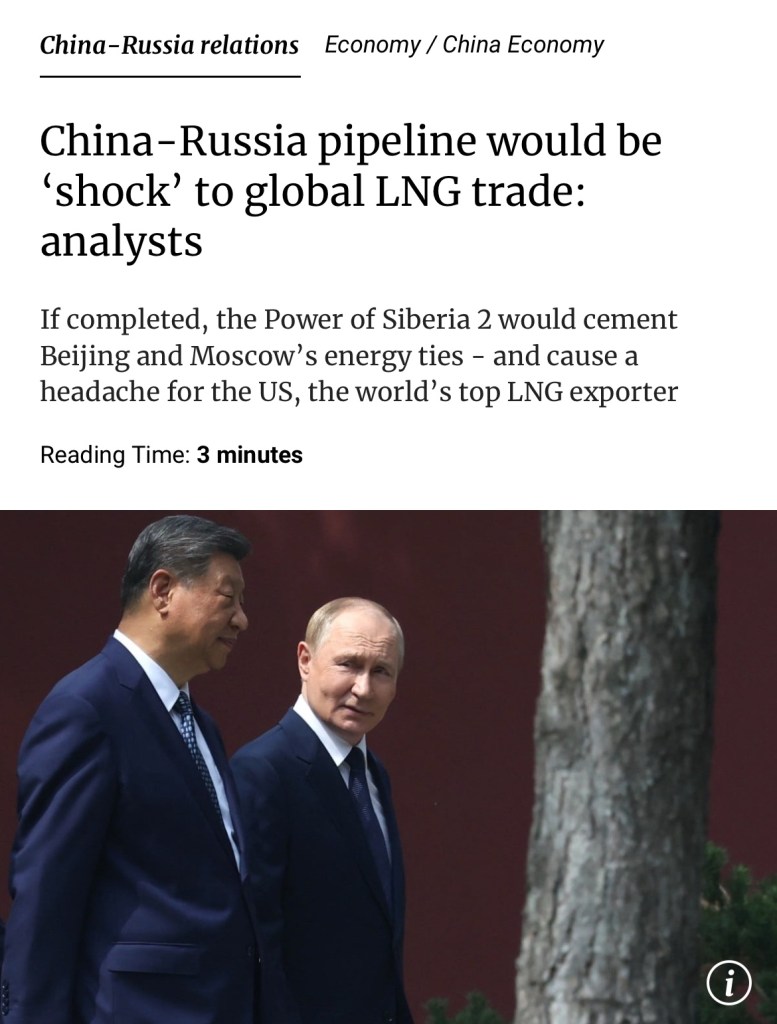
SCMP: This one US will have problems blowing it up (Nord Stream pipelines)! The long-delayed Power of Siberia 2 pipeline between Russia and China would create a “structural shock” if it begins operations, analysts said, and cause “strategic and market challenges” for the United States, the world’s current largest liquefied natural gas (LNG) exporter. China-Russia pipeline would be ‘shock’ to global LNG trade: analysts 《南華早報》:美國要炸掉這個像北溪管線(Nord Stream)可就難了. 分析人士表示,中俄之間長期擱置的“西伯利亞力量2號”管道一旦投入運營,將造成“結構性衝擊”,並給目前全球最大液化天然氣(LNG)出口國美國帶來“戰略和市場挑戰”。分析師認為,中俄管道將對全球液化天然氣貿易造成「衝擊」. https://www.scmp.com/economy/china-economy/article/3324749/china-russia-pipeline-would-be-shock-global-lng-trade-analysts?
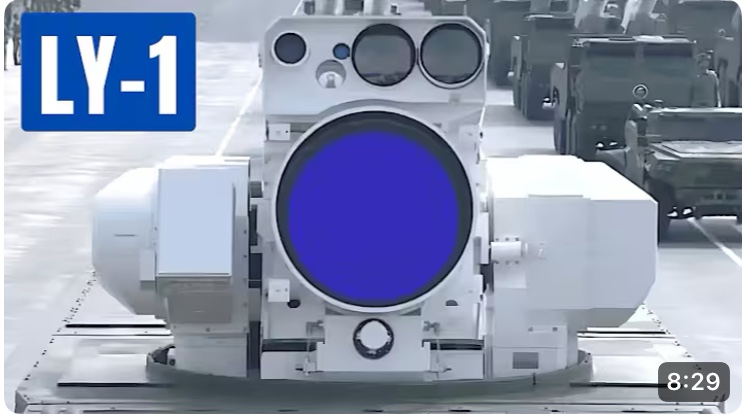
China has taken the military world by storm with the LY-1, its most advanced naval laser weapon system. This article takes an in-depth look at the LY-1, from its development background to its strategic implications. The LY-1 is not only a technological innovation, but also a declaration that the era of directed energy warfare has begun. Compared to conventional missiles, the LY-1 offers the speed of light, cost efficiency, and unlimited capabilities to counter mass drone attacks. This system is also a “game changer” in naval strategy and has the potential to trigger a new global arms race. This article explores the LY-1’s soft-kill (sensor jamming) and hard-kill (physical destruction) capabilities, its strategic role in maritime regions, and challenges such as atmospheric factors and heat management. The LY-1 is proof that China is no longer playing catch-up, but is leading a global arms revolution.
East rise and West Decline, your Chinese Passport/Citizenship and US Green Cards & Citizenship will follow! More Smart Chinese are giving up their US Citizenship than ever before! 東方崛起,西方衰落,你的中國護照/公民身份和美國綠卡/公民身份也將隨之東升西降,越來越多聰明有實力的中國人放棄了美國國籍,成為歷史新高!但美國還是貪官污吏和商人的天堂, 也是愛拿美國福利的福地,但跟著美國的衰落,看來好景不長了!
Why are Chinese elites so worried about China’s rise? Shen Yi, a professor of international politics at Fudan University, pointed out that when China achieves comprehensive technological advancement, those Western green cards, once seen as “gilded passes,” will inevitably depreciate significantly. 中國精英為何對中國崛起心存憂慮?復旦大學國際政治系教授沈逸一針見血地指出:當中國科技實現全面超越之時,那些曾被視作”鍍金通行證”的西方綠卡將不可避免地大幅貶值.
This phenomenon reflects a deep-seated misalignment of values among some elites: they prioritize personal gain over national development and view their overseas identities as speculative bargaining chips to be traded.
The formation of this mindset has a complex historical context. In the early days of reform and opening up, the technological gap made “learning from the strong” an inevitable choice, but some people have transformed this temporary gap into a permanent benchmark of value.
Like arbitrageurs in the financial market, they operate within the price gap between East and West, enjoying the dividends of domestic development while simultaneously craving the premium of Western institutions.
With Huawei’s 5G technology leading the world and the Beidou system successfully deployed, this “double arbitrage” survival strategy faces unprecedented challenges.
More fundamentally, this anxiety stems from a rigid cognitive framework. Some elites equate modernization with Westernization, simplifying technological competition into a contest of institutions while ignoring the diverse paths of civilizational development.
Just as 19th-century European aristocrats feared the Industrial Revolution would destroy the hierarchical order, they worry that technological equality will undermine the “epistemic privilege” on which they depend.
Little do people know that true elites should, like Qian Xuesen, turn knowledge into a propellant for national rejuvenation rather than a means of preserving personal interests.
Why are Chinese elites so worried about China’s rise? Shen Yi, a professor of international politics at Fudan University, pointed out that when China achieves comprehensive technological advancement, those Western green cards, once seen as “gilded passes,” will inevitably depreciate significantly. 中國精英為何對中國崛起心存憂慮?復旦大學國際政治系教授沈逸一針見血地指出:當中國科技實現全面超越之時,那些曾被視作”鍍金通行證”的西方綠卡將不可避免地大幅貶值。
This phenomenon reflects a deep-seated misalignment of values among some elites: they prioritize personal gain over national development and view their overseas identities as speculative bargaining chips to be traded.
The formation of this mindset has a complex historical context. In the early days of reform and opening up, the technological gap made “learning from the strong” an inevitable choice, but some people have transformed this temporary gap into a permanent benchmark of value.
Like arbitrageurs in the financial market, they operate within the price gap between East and West, enjoying the dividends of domestic development while simultaneously craving the premium of Western institutions.
With Huawei’s 5G technology leading the world and the Beidou system successfully deployed, this “double arbitrage” survival strategy faces unprecedented challenges.
More fundamentally, this anxiety stems from a rigid cognitive framework. Some elites equate modernization with Westernization, simplifying technological competition into a contest of institutions while ignoring the diverse paths of civilizational development.
Just as 19th-century European aristocrats feared the Industrial Revolution would destroy the hierarchical order, they worry that technological equality will undermine the “epistemic privilege” on which they depend.
Little do people know that true elites should, like Qian Xuesen, turn knowledge into a propellant for national rejuvenation rather than a means of preserving personal interests.



 Business Blog