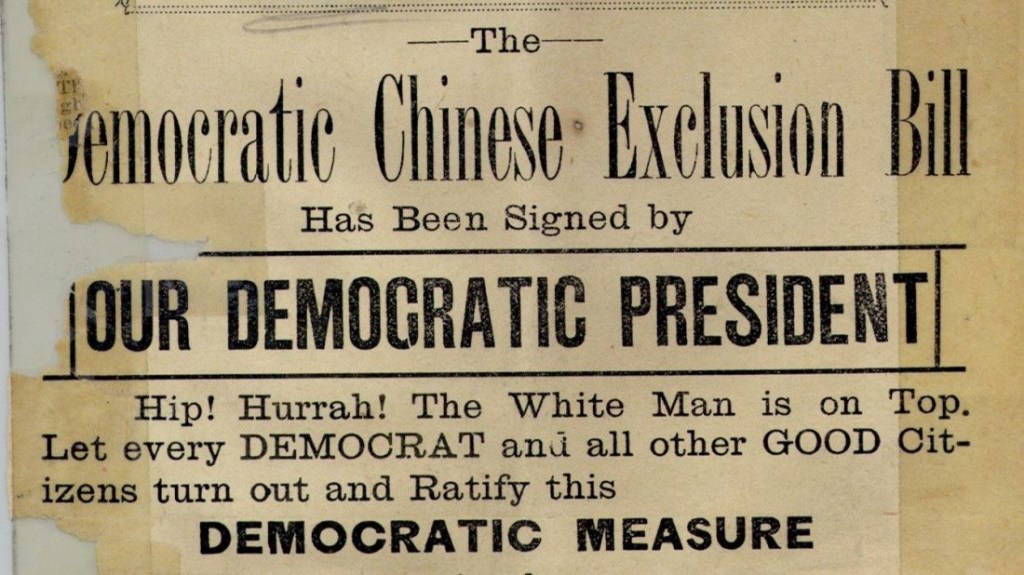
Background of the US’s 1882 Chinese Exclusion Act? Some Chinese Leaders made you believe that the Act was repealed but in fact not. Dozens of Chinese Exclusion Acts were passed last 5 years, same bottle different wines. 美國1882年排華法案的背景知多少? 一些在美國華人領袖讓你相信該法案已被廢除,但事實上並沒有, 過去五年數十項排華法案通過, 同一瓶放不同的酒吧.
1882 Chinese Exclusion Act. By Professor Ling-chi Wang of UC Berkeley 1/1/24
Of late, you must have read about community commemoration or celebrations of the 80th anniversary of the Repeal of Chinese Exclusion Acts in 1943. The act repealed 15 Chinese exclusion laws enacted by the U.S. Congress between 1882-1943 and granted eligible Chinese resident aliens in the U.S. the right of naturalization, The new law gave the impression that U.S. had finally ended the exclusion and discrimination against the Chinese and had granted them the right of naturalization like the rights and privileges accorded immigrants from European countries. It sounds too good to be true! The truth, in fact, is exactly the opposite, if we read the repeal legislation and the legislative history of the bill as it moved through the Congress. It was never the intention of the U.S. Congress to end Chinese exclusion! Let me elaborate.
First, the day the repeal law was enacted, there was NO celebration in Chinaowns with fire-crackers. It was just another day. However, President Roosevelt. and the U.S. Congress did receive some messages of gratitude from Chiang Kai-shek administration in Chongqing, Sichuan for the repeal. These messages were prompted by the spin-masters inside the Beltway who thought orchestrated messages of gratitude from China would help assure American politicians and public that the leaders of China appreciated the action taken by the U.S. Congress. Neither the Chinese nor the American government wanted Chinese in the U.S. and in China to know how the Repeal would extend the exclusion for another 22 years with profound adverse impact on Chinese America!
It is important to know just how the Repeal passed the U.S. Congress. First, President Roosevelt’s message to U.S. Congress in January 1943 made it clear his proposed legislation for the repeal was an urgent American wartime priority and strategy to first, defeat the Germans in Europe and then and only then, the Japanese in Asia. The strategy did not satisfy Chiang who was in dire need for American aids. The challenge was how to convince impatient and demanding President Chiang Kai-shek to militarily tie down and wear out Japan as much as possible in China and the Pacific region before the U.S. enter the Pacific war fully and whole-heartedly. Toward this end, President proposed three carrots to pacify Chiang at little or no cost: (1) repeal the Chinese exclusion laws so that Japan cannot use racist propaganda of American racist laws against Chinese to undermine the morale of Chinese soldiers and Chinese public and justified limited and delayed of U.S. military and economic aid to China; (2) to renounce all the “Unequal Treaties” between the U.S. and China since the Wangxia Treaty of 1844, most of which dealt with trade and investment; Nd (3) to booster Chiang’s ego and make him feel good, Roosevelt decided, against the wishes of Churchchill, to elevate Chiang international status by including him in the Big Four conferences for the settlements of WW II.
As anyone can see, there is neither substance nor cost to the U.S. in all three “concessions.” I already mentioned how insulting the first carrot was. Secondly, renouncing all unequal treaties at the time when Japan had already effectively sealed off and isolated China from any dealings with foreign countries, especially the U.S., including trade, investment, military aids, and travel. It sounded good, but it had zero impact on China. Finally, raising Chiang international standing equal to Stalin, Roosevelt, and Churchchill had no substance nor power because Chiang did not have power to act as equals with the other three. In other words, Roosevelt’s pronouncement of Chiang’s elevated status had no substance nor impact, especially after WW II. His weakness was quickly exposed when he had to flee the Mainland and see U.S. protection in Taiwan.
By the way, the elite in Washington decided in early 1943 that the campaign to repeal the exclusion laws would also exclude Chinese American participation for fear that Chinese presence in the lobbying will cause racist backlash and undermine the chance of its passage. A Citizens Committee to Repeal the Exclusion Laws was formed and Pearl Buch, then at the height of popularity in the U.S., was asked to chair the campaign. The Committee decided to exclude Chinese to minimize political risks. The proposed legislation and the legislative process excluded the Chinese. In other words, there was no Chinese input on how the law should be fashioned and how Chinese interests should be reflected in the final legislation.
It is true that the 15 exclusion laws were repealed but only to be replaced by insidious provisions in the repeal. To make sure that the repeal would not open a floodgate for Chinese immigrants, especially after the defeat of Japan in China, Congress invoked the National Origin Quota Act of 1924 which assigned limited annual quotas for immigrants from Eastern and Southern Europe, meaning the non-Anglo-Saxton, non-Protestant countries. However, the 1924 law did not have quota assigned explicitly to already excluded immigrants from China. So the U.S. Congress decided to limit the number of Chinese immigrants to the U.S. to a quota of one-tenth of one percent, based on the total number of Chinese population in the U.S. in 1890. This translated to only 105 immigrants from China were eligible for immigration to the U.S. Not very sneaky way of continuing the exclusion.
Anyone interested in understanding the vulgarity and cruelty of how racism and anti-Chinese sentiment worked in the U.S. should read the Congressional floor debates before it was voted and passed. Even those in favor of repeal (the Liberal) were just as racist as conservatives across the political spectrum.
One last note, during WW II, some 15,000 Chinese out of the total Chinese population of about 70,000, to the best of my memory, heeded the call to join the U.S. Army to fight against the Japanese Imperial Army in China and the Asia-Pacific theater, some out of patriotism. while others, especially the permanent residents, joined the army on the promise of getting U.S. citizenship. After the war, thousand of Chinese American veterans took advantage of being in China already, married Chinese women before returning to the U.S. or in anticipation of the ordeals awaiting them because of anti-miscegenation laws across the U.S.. Again, the 105 quota, very much in effect in the 1950s, prevented thousands of their wives and children from entering the U.S. Even with the passage of the War Bride Act, wives of Chinese American GIs were subjected to long detention and interrogation in the crowded attic of U.S. Customs Building in downtown S.F., some of them for months, because the Chinese Immigration Station on Angel Island was turned into a prison for POWs.
This is why I refused to take part in any event associated with the Repeal in recent months.