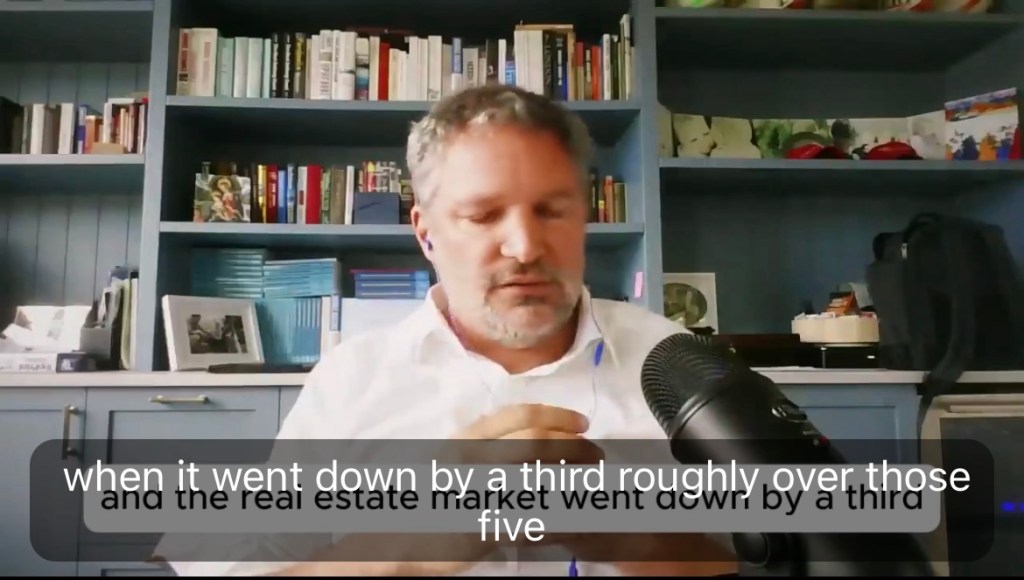
Interesting contrast Western vs Chinese capitalism. Some really thought-provoking insights on the Chinese and US economy here by Gave Vincent the CEO of Gavekal. For instance he explains why the stock market is really not that important in China, especially when compared with the US. 西方資本主義與中國資本主義的有趣對比。 Gavekal 執行長 Gave Vincent 對中美經濟提出了一些真正發人深省的見解。例如,他解釋了為什麼股市在中國實際上並不那麼重要,尤其是與美國相比.
By KJ: Capitalist apologists will always argue, Capitalism is good because capitalist markets lead to robust competition, and that leads to the best products at the lowest prices, as well as a tremendous, constant dynamism that innovates and develops society.
It sounds good in theory, but what they ignore is the actual process as it unrolls.
The US is at the stage of monopoly capitalism. This is essentially what the presenter is noting.
In the capitalist market, firms compete in the marketplace, but then eventually, unless you have strong anti-monopoly/antitrust regulation, one firm will drive all the others out, and gain monopoly (or a cartel of firms will obtain oligopoly). Once there is a monopoly or oligopoly, there are nearly insurmountable barriers to new entry. The game is sealed and rigged.
For example, Microsoft has a monopoly on operating systems and office software. Google has a near monopoly on search and internet advertising, etc.
Now these capitalist monopolies are bad or invariably turn bad: because they have a captive market, they price-gouge (e.g. microsoft), sell crap products that don’t work (e.g. microsoft), set their own rules–for example forcing you to buy upgrades constantly (e.g. microsoft) and steal your information, and most of all they transfer obscene amounts of wealth upwards (e.g. Microsoft’s Bill Gates). Google search no longer works; it is no longer a search engine; it is a monetization scheme and a censorship engine.
They also engage in further regulatory capture and political control.
When you have a set up like this, you get vast immiseration at the bottom, and massive redistribution of wealth upwards.
This over-concentration of wealth leads to a financialized economy: this is because when poor workers cannot afford to create enough consumer demand for things, there is depressed demand for productive goods. And from the standpoint of the capitalist class, there is little incentive to invest in building productive businesses to sell to these immiserated workers, who no longer function as consumers. It is high risk, and low/no return, which individual capitalists or shareholders will not tolerate.
So they “invest” with their capital in rent-extracting ventures–low risk, high return–where they can simply force money out of people (through legal force).
This can be, for example, exorbitant loan sharking from the immiserated classes (while selling them the illusion that they just need this one leg up e.g. student loans, payday loans, etc), or jacked up rents on real property, or steadily increasing insurance premiums.
Or if they do “invest”, they do so under conditions of demanding exorbitant or certain returns, with no interest in creating meaningful long term productive value–they want short term financial gains that they pocket and run. They sack, pillage, frack productive businesses through leveraged financialized buyouts, slash and burn, and then move onto the next new windfall. This is money “creating” money, with no attempt to generate useful goods as an intermediary by-process. In fact, mostly social “bads” are often created. This is capital at its metastasizing cancerous phase.
In Marxist terminology, this process is depicted schematically as initially M (Money, capital) invested in producing C (Commodities) that are sold for more Money (M’), i.e. profit. We depict this schematically as M-C-M’ (or more precisely, M->C->M’)
When you have huge concentrations of wealth, as is inevitable in an unregulated, neoliberal system that we live in, the market always converges to monopoly or near monopoly.
Under monopoly conditions, under the logic of capital, investment has to financialize: it invests in financialized forms of extraction i.e. M-M’, or money simply making demands for more money (monied people, through financial instruments, extracting money from people who don’t have it). In other words, M-C-M’ => M-M’. This monopoly stage also sets the ground for imperialism. WIthout that, it is likely to lead to upheaval and revolution.
It’s like the board game monopoly: one person takes everything, eventually, and the rest are just paying tribute to the monopolist, everytime they roll the dice. Just living and breathing is expensive.
This is why the US is not competitive against China, and why it cannot reshore productive industry. There is no incentive. Money thrown at chip companies will simply be absorbed for rentier speculation or ferreted away, or used for stock buybacks (money driving up the price of money) and eaten and squandered.
Now monopoly itself is not necessarily bad. It’s possible to create a monopoly that serves the people. In fact many Chinese state-owned companies are monopolies–for example, China rail. Under a socialist system, as the market converges to monopoly, the monopoly can be taken over, and run by and for the benefit of the people. People who demand “Single payer healthcare” are actually asking for a state-led monopoly for healthcare.
But where the system is marketized (i.e. not state-run/state directed), China ensures that the market functions properly: there is robust competition, adequate investment, and that robust competition leads to good, productive outcomes. This is the intelligent harnessing of the marketplace for its advantages (not its disadvantages), under an intelligent regime of planning that understands these dynamics, and as such, it builds the platform for intermediary steps towards socialism.
 Business Blog
2 responses to “Interesting contrast Western vs Chinese capitalism”
[…] Based on an article by Johnson Choi, 27.09.2024 https://johnsonwkchoi.com/2024/09/27/interesting-contrast-western-vs-chinese-capitalism/ […]
LikeLiked by 1 person
[…] Based on an article by Johnson Choi, 27.09.2024 https://johnsonwkchoi.com/2024/09/27/interesting-contrast-western-vs-chinese-capitalism/ […]
LikeLiked by 1 person