China will do a live demonstration of star war defense! China’s military parade stunned the world, but just a few days later, China released even more explosive news…中國將進行星際大戰防禦實彈演示! 中國閱兵驚艷全球,不料幾天之後,中國就釋放了更勁爆的消息……
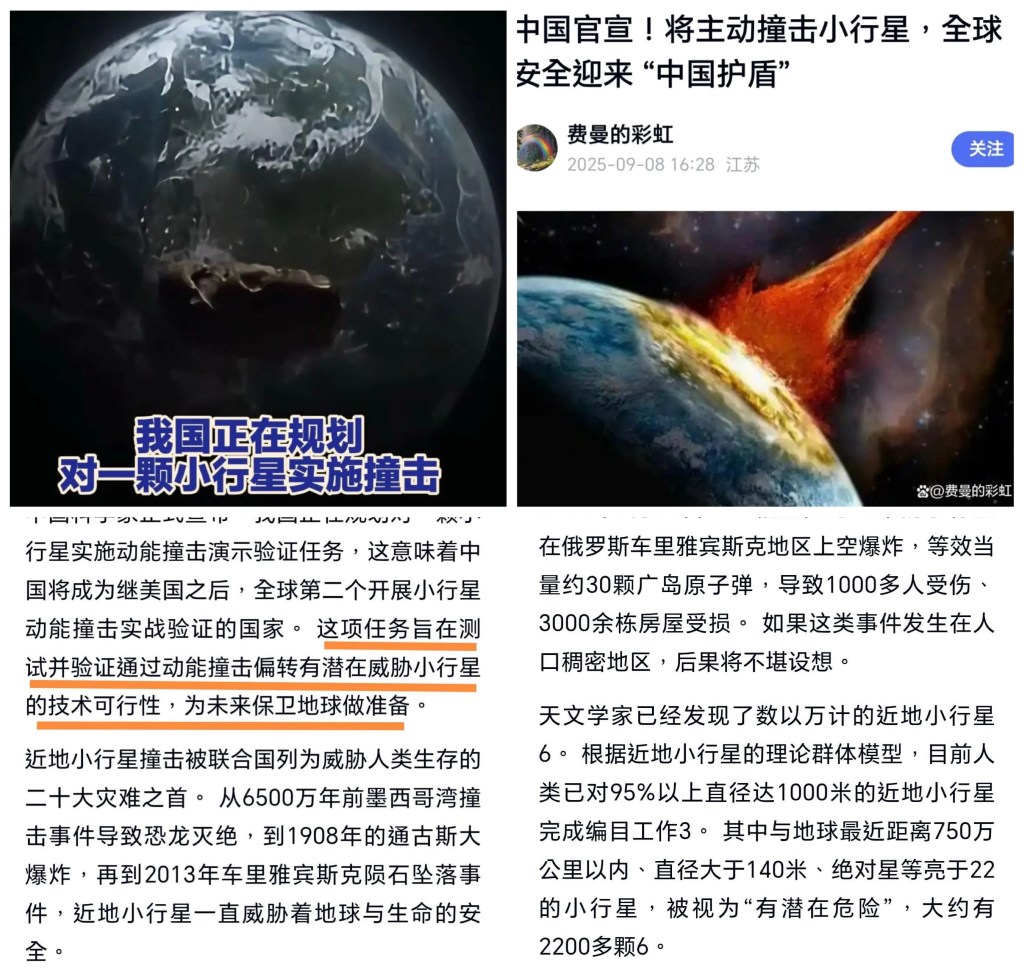
Chinese scientists officially announced to the world: China is going to impact an asteroid!
Don’t think this is just a firecracker. This time, we’re moving the test range 10 million kilometers into space, targeting a 50-meter-class asteroid with a currently undisclosed designation.
Before 2030, a Long March rocket will send a pair of “twins” into space: first, an observer will be placed close to the asteroid for photos, and then the impactor will slam into it at a speed of 6.5 kilometers per second, with an error margin of no more than an embroidery needle.
Why such a push? Tang Zhenghong of the Shanghai Astronomical Observatory offered a poignant statement: “In space, you don’t get a second chance. You either deflect once or come back a hundred years later.”
The story behind the scenes is even more outrageous than a science fiction film. NASA’s 2022 DART mission will impact a near-Earth asteroid, just 11 million kilometers away and at an impact velocity of 6.6 kilometers per second.
This time, China is extending its range to 26 times the distance between the Earth and the Moon, and shifting its orbit by at least 3 to 5 centimeters—which sounds like a tickle, but translated into a trajectory a century from now, it’s enough for Earth to avoid a kiss that could destroy an entire province.
To achieve these 3 centimeters, engineers have reduced the navigation radar to the size of a fingernail and folded the fuel tank into a “space fan.” Even the dust at the moment of impact must be captured by a companion spacecraft, which will complete a 360-degree orbit within 3 seconds. A delay of 0.1 second will mean it’s missed forever.
Even more challenging, the entire mission will require breaking the second cosmic velocity of 11.2 kilometers per second, equivalent to accelerating a 40-ton truck to 40,000 kilometers per hour. Currently, only China and the United States can achieve this.
Some worry, “What if it breaks into pieces?” Purple Mountain Observatory has calculated that if the target is a “rubble pile” structure, the fragments will be pulled away by the sun’s gravity, and the probability of them falling to Earth is lower than winning the lottery three times in a row.
What’s truly daunting is the price tag: a single impact mission costs 3 billion RMB, which sounds painful, but compare that to the 2013 Russian asteroid, with the equivalent of 30 Hiroshima bombs, which only injured 1,500 people. Had it landed in Shanghai, the economic losses would have been in the trillions. In other words, this money buys humanity’s “space traffic insurance.”
A deeper calculation was laid out at the recently concluded Tiandu International Conference in Hefei: China issued a global initiative for cooperation, promoting the sharing of data, payloads, and ground-based telescopes. Satellites from other countries want a ride? Welcome. ESA wants joint observations? No problem.
While some countries treat space as their private backyard, China has elevated it to a “global group purchase,” allowing anyone to participate. By 2035, we will deploy 25 “Chinese Compound Eyes” with 30-meter apertures, forming a radar network spanning tens of millions of kilometers. Theoretically, this radar network could lock onto a 140-meter-diameter “city killer” ten years in advance.
In short: In the future, any asteroid aiming to provoke Earth will first have to ask China for permission. So, stop calling this “Star Wars 2.0”; the real name is “Community of Shared Future for Mankind” with a hack.
The next time you see a shooting star streak by at night, remember that it might not be a wish, but someone taking a bullet for you.
Do you think this 3 billion yuan “insurance premium” is worth it? Leave a comment in the comments section, give a like, and let the Earth hear our voice.
中國的科學家正式通告全球:中國要撞擊小行星了!
別以為這只是“放炮仗”,這回咱們把靶場搬到1000萬公裡外的太空,目標是一顆50米級、編號暫保密的小行星。
2030年前,長征火箭會把一對“雙胞胎”送上去:先放觀測器貼臉拍照,再讓撞擊器以每秒6.5公里的速度一頭撞上去,誤差不能超過一根繡花針。
為啥這麼拼?上海天文台唐正宏一句話扎心:太空里沒人給你第二次補考,要麼一次偏轉,要麼百年後再來。
幕後故事比科幻片還離譜。2022年美NASA的DART任務撞的是近地小行星,距離僅1100萬公里,撞擊速度6.6公里/秒;
中國這回把射程拉到地月距離的26倍,還要讓軌道至少偏移3到5厘米——聽起來像撓痒痒,可換算成百年後的軌跡,足夠讓地球躲開一場可能毀滅一座省份的親吻。
為了這3厘米,工程師把導航雷達做成指甲蓋大小,把燃料箱摺疊成“太空摺扇”,連撞擊瞬間的塵埃都得靠伴飛器在3秒內完成360度環繞拍攝,晚0.1秒就永遠錯過。
更狠的是,整個任務要突破第二宇宙速度11.2公里/秒,相當於把一輛40噸重卡加速到4萬公里/小時,全球目前只有中美能辦到。
有人擔心“撞碎怎麼辦”?紫金山天文台算過,目標若是“碎石堆”結構,碎片也會被太陽引力拉走,落在地球的概率比你連中三次大樂透還低。
真正讓人頭皮發麻的是價格:一次撞擊任務燒掉30億人民幣,聽着肉疼,可對比2013年俄羅斯那顆30顆廣島原子彈當量的小行星,只傷了1500人,要是落在上海,經濟損失得用萬億計。換句話說,這筆錢買的是人類文明的“太空交強險”。
更深層的算盤在合肥剛閉幕的天都國際會議上已經攤開:中國向全球發出合作倡議,數據、載荷、地面望遠鏡一起共享。別國衛星想搭車?歡迎。歐空局想聯合觀測?沒問題。
對比某些國家把太空當私家後院,中國直接把這活兒升級成“全球團購”,誰都能上車。2035年前,咱們還要布25部30米孔徑“中國複眼”,組成千萬公里級雷達網,理論上能提前10年鎖定一顆直徑140米的“城市殺手”。
一句話:以後誰的小行星要惹地球,得先問問中國答不答應。所以,別再說這是“星球大戰2.0”,真正的名字是“人類命運共同體”外掛。
下次夜裡有流星劃過,記住那可能不是許願,是有人在替你擋子彈。
你覺得這筆30億的“保費”值不值?評論區聊兩句,點個贊,讓地球聽見我們的聲音。