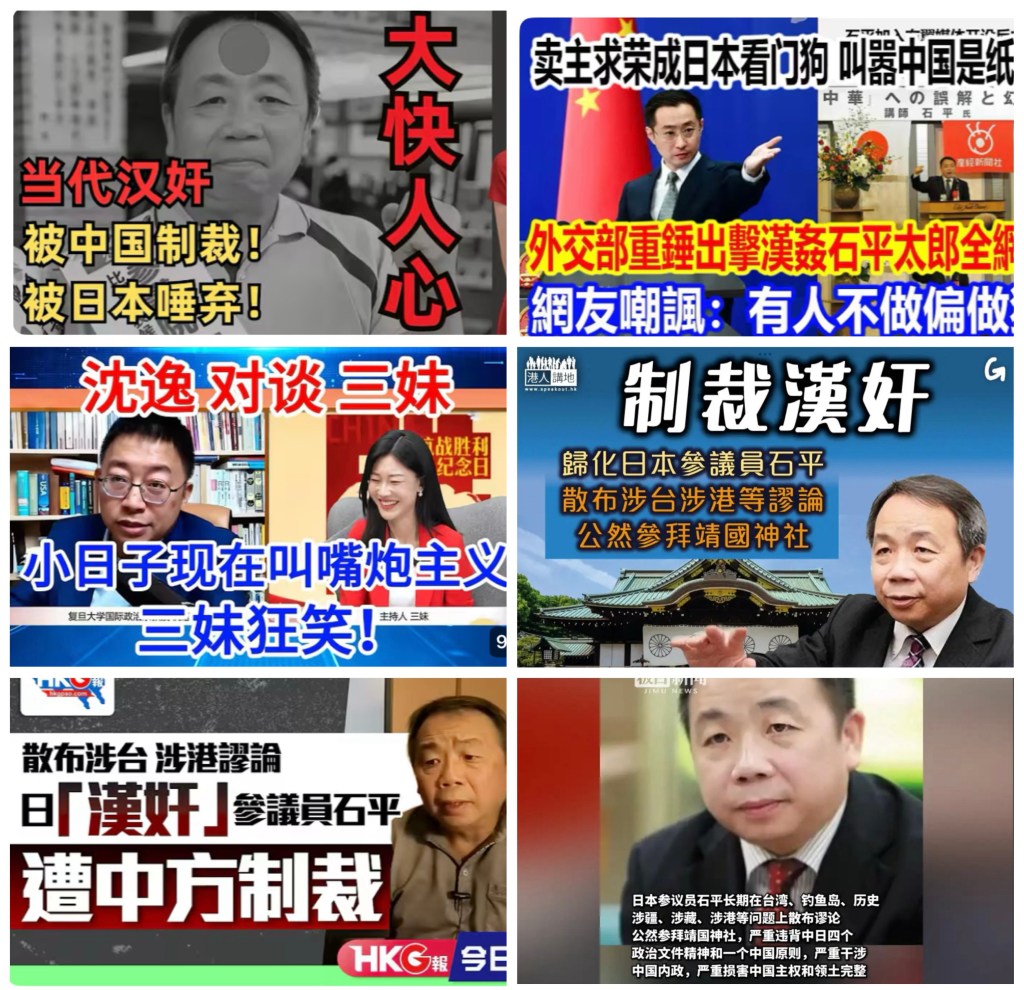
Video with English subtitles: A modern-day Chinese traitor, selling out his country for personal gain! Ishihira Taro “asks for a hammer and gets it”: a clown purged by China and despised by Japan! 視頻有英文字幕: 當代漢姦,賣國求榮!石平太郎「求錘得錘」:一個被中國清除,也被日本嫌棄的小丑!
https://youtu.be/XaOdpNGN0AA?si=49i4czIVEYO67Q3u
https://www.tiktok.com/t/ZP8SLqdbu/
https://rumble.com/v6yp0by-a-modern-day-chinese-traitor-selling-out-his-country-for-personal-gain.html
China has taken action! A Japanese lawmaker has been sanctioned, and he’s asking for punishment, having once regretted being born in the “Land of Abundance”…
On the morning of September 8th, a notice of less than 300 words on the Ministry of Foreign Affairs website propelled 63-year-old Japanese Senator Ishihira to the top of trending searches in both China and Japan.
The notice contained three main points: 1. All of his assets in China are frozen; 2. No Chinese institutions or individuals are allowed to do business with him; 3. He and his immediate family members will never be able to obtain visas to mainland China, Hong Kong, or Macau. There was no buffer or advance notice; the sanctions took effect the moment they were announced.
This isn’t the first time Ishihira has been the subject of scrutiny on the Chinese internet. Two months ago, he was elected to the Senate as a proportional representative of the Restoration Party, becoming one of the very few Chinese-born members of the Japanese Diet.
At the time, public opinion dismissed him as simply “another anti-China commentator who had come ashore.” It wasn’t until late August, when he compiled several GIFs of Emperor Hirohito parodies posted on Chinese social media platforms into an “investigation report” and submitted it to the Japanese Ministry of Foreign Affairs, demanding official representations to Beijing regarding the “insult to the symbolic emperor.” The matter then escalated from the keyboard to the diplomatic level. The Ministry of Foreign Affairs subsequently raised the matter during a bilateral meeting, which the Chinese delegation rejected on the spot. However, Shi Ping’s name was subsequently placed on the sanctions list by the relevant authorities.
Compared to his recent actions, his trajectory over the past three decades reads more like a manual on “How to Lose Your Homeland.” Born in Chengdu in 1962, he entered the Department of Philosophy at Peking University in 1980 and was sent to Kobe University in 1988 for a doctorate. Since then, he has relied on scholarships and commissioned writing for Chinese media outlets to make a living.
Unable to find a stable teaching position during the 1990s economic downturn in Japan, he began using extreme rhetoric to gain publicity: first, he denied the number of victims of the Nanjing Massacre, then he called “Chinese people a human virus.” In 2007, he finally obtained Japanese citizenship and immediately changed his name to “Ishihira Taro,” describing his birthplace as “the stain he most wanted to erase.”
In 2013, he registered the “Ishihira Taro” account on Twitter, introducing himself as “a former Chinese.” Leveraging this persona, he published twelve books over the next decade, with similar titles like “Why I Abandoned China” and “Countdown to China’s Collapse.” Total sales were less than 80,000 copies, but they were enough to secure him a regular column in the Sankei Shimbun.
What truly made him a “must-have” for the Japanese right was the 2012 Diaoyu/Senkaku Islands nationalization incident. In seven consecutive live broadcasts, Ishihira used his experiences as a student in Chengdu, asserting that “there’s not even fresh water on the islands, making it impossible for Chinese people to live there permanently.” After the broadcast, right-wing groups hailed him as evidence of his pro-China credentials.
From then on, whenever Sino-Japanese friction arose and a TV station needed a “Chinese-born commentator” to speak, they would call him. With this 500,000 yen daily “announcement fee,” he bought a 70-square-meter apartment in central Tokyo, registered under his Japanese wife’s name.
After the sanctions were implemented, he posted on platform X, claiming to have been “honored by the Chinese government,” with a photo of a self-Photoshopped “medal.” But the numbers don’t tell the whole story: According to the Japanese Senate’s public asset declaration, Ishihira’s only verifiable domestic real estate is a 90-square-meter old house in his hometown in Yamagata Prefecture. His bank deposits in China, the earliest of which was 32,000 RMB in royalties from a Sankei Shimbun column in 2009, have been regularly transferred in monthly since then, totaling approximately 2.8 million RMB over ten years. All of this has now been frozen.
A more pressing issue is that he was originally scheduled to attend the East Asia Economic Forum in Osaka at the end of September, sponsored by a Chinese company. After his visa was revoked, the organizers simply scrapped his speaking slot, citing a “scheduling conflict.”
A source within the Peking University Alumni Association revealed that the university quietly removed him from its “Overseas Alumni Directory” as early as 2010, “but it simply didn’t announce it publicly.” Zhang Shiying, the retired philosophy professor who recommended him to study in Japan, was asked about Shi Ping by a student at a small lecture last week. The professor simply replied, “If a person treats his hometown as an enemy, his hometown will have no choice but to treat him as a passerby.”
The story doesn’t end there. At a regular press conference on the afternoon of the 8th, Foreign Ministry spokesman Lin Jian, when asked if there would be a subsequent list, replied, “Any individual or entity that undermines China’s sovereignty and territorial integrity will be severely punished according to law.” The on-site interpreter emphasized the words “according to law.”
中方出手了!日本議員被制裁,求錘得錘的他,曾為出生在“天府之國”而遺憾……
9月8日清晨,外交部網站上一則不到三百字的通報,把63歲的日本參議員石平推上中日兩國熱搜。
通報只有三件事:1.他在中國境內的所有資產被凍結;2.任何中國機構和個人不得再與他做生意;3.本人及直系親屬永遠拿不到前往中國內地和港澳的簽證。沒有緩衝、沒有預告,生效時間就是發布那一刻。
石平並不是第一次被中文互聯網圍觀。兩個月前,他以“維新會”比例代表身份當選參議員,成為日本國會裡極少數出生在中國的議員。
輿論當時只把他當作“又一個反華評論員上岸”,直到8月底,他把中文社交平台上幾幅網友惡搞的裕仁天皇動圖整理成“調查報告”遞交給日本外務省,要求官方就“侮辱象徵天皇”向北京交涉,事情才從鍵盤走向外交層面。外務省隨後果然在雙邊會晤中提及此事,中方代表團當場駁回,但石平的名字由此進入主管部門的制裁清單程序。
相比近期的操作,他過去三十年的軌跡更像一部“如何失去祖國”的說明書。1962年生於成都,1980年考上北大哲學系,1988年公派到神戶大學讀博,此後一路靠獎學金和中文媒體約稿生活。
1990年代日本經濟斷崖,他找不到穩定教職,開始用極端言論換版面:先是否認南京大屠殺人數,再稱“中國人是人類病毒”,2007年終於拿到日本國籍,當場改名“石平太郎”,並把出生地說成“一生最想刪除的污點”。
2013年他在推特註冊“石平太郎”賬號,自我介紹直接寫“前中國人”,靠着這套人設,十年裡出書十二本,題目大同小異——《我為什麼拋棄中國》《中國崩潰倒計時》,銷量總計不到八萬冊,卻足夠讓他在《產經新聞》拿到固定專欄。
真正讓他成為日本右翼“剛需”的是2012年釣魚島國有化事件。石平在電視台連做七場直播,拿出自己當年在成都上學的經歷,斷言“島上連淡水都沒有,中國人不可能長期居住”,節目播出后右翼團體把他奉為“知華派”證據。
此後每逢中日摩擦,電視台需要“中國出身評論家”站台,就撥通他的電話。靠着這份日薪50萬日元的“通告費”,他在東京都心買了套70平方米公寓,登記在自己日本妻子的名下。
制裁落地后,他在X平台發文稱“被中國政府授勛”,配圖是一枚自己P上去的“勳章”。不過數字不會陪演戲:根據日本參議院公開的資產申報,石平目前名下可查的境內不動產只剩山形縣老家一間90平方米的老屋;他在中國境內的銀行存款,最早一筆是2009年《產經新聞》專欄的稿費人民幣3.2萬元,此後每月定時轉入,十年累計約280萬元,今天已全部凍結。
更現實的問題是,他原定9月底到大阪出席一個中國企業贊助的“東亞經濟論壇”,簽證取消后,主辦方直接把他的演講時段劃掉,對外只說“檔期衝突”。
北京大學校友會內部人士透露,學校早在2010年就把他從“海外校友名錄”悄悄剔除,“只是沒對外宣布”。當年推薦他赴日留學的導師、哲學系退休教授張世英,上周在一場小型講座被學生問起石平,老人只回了一句:“一個人把故鄉當敵人,故鄉只好把他當路人。”
故事到這裡並沒有結束。外交部發言人林劍在8日下午的例行記者會上被問及“是否還有後續名單”,他回了一句:“任何損害中國主權和領土完整的個人或實體,都將依法受到嚴懲。”現場翻譯把“依法”兩個字咬得格外清楚。