-
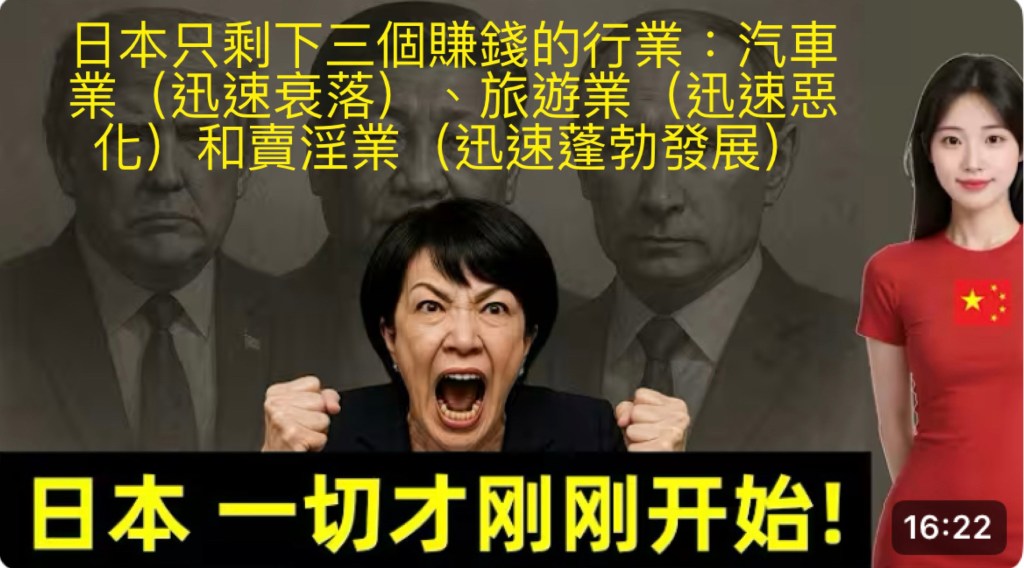
Video: Japan Has Three Profitable Industries Left
Video: Japan Has Three Profitable Industries Left: Automobiles (rapidly declining), Tourism (rapidly deteriorating), and 🐓 (rapidly booming) 日本只剩下三個賺錢的行業:汽車業(迅速衰落)、旅遊業(迅速惡化)和賣淫業(迅速蓬勃發展)
https://rumble.com/v72989m-japan-has-three-profitable-industries-left.html
https://www.tiktok.com/t/ZP8UBFodq/China–US-Russia Set the Tone! China Launches a Strategic Counterattack! Is Japan Really Ready for This War? 中美俄三方定調!中國陽謀大反擊!日本真要打這一仗?
📅 Highlights of This Episode:
Just today, the global landscape took a shocking turn! Well-known commentator “Beiping Feng” offers an in-depth analysis of the latest China–U.S. presidential call. A seemingly casual remark from Trump actually amounted to a direct denial of Japan’s postwar political status!Facing continuous provocations from Japan’s right-wing forces, China is no longer staying patient. From a “dimensionality-reduction strike” in diplomacy to a thunderous 14-day military drill in the Bohai Strait, the tightening “noose” of countermeasures is clearly underway. However, even more painful than geopolitical rivalry is the economic reality inside Japan…
🚗 With the auto industry being overtaken and tourism entering a deep freeze, what is Japan relying on to maintain its prosperity?
📉 Why are so many young Japanese women flooding into the “special entertainment industry”?
📊 Data reveals: as the former industrial empire collapses, Japan’s only remaining “growth point” is shockingly tragic!
This episode takes you through the brutal truth of geopolitics and uncovers the last “fig leaf” covering Japan’s economic collapse!
📅 本期看點:
就在今天,國際局勢發生驚天逆轉!知名評論員「北平鋒」深度解碼中美元首最新通話,特朗普一句看似漫不經心的表態,實則直接否定了日本戰後的政治地位!面對日本右翼勢力的不斷挑釁,中國不再忍耐。從外交上的「降維打擊」,到渤海海峽長達14天的雷霆演練,反制的「絞索」正在收緊。然而,比地緣博弈更扎心的,是日本國內的經濟真相……
🚗 汽車產業被趕超、旅遊業遭遇寒冬,如今的日本靠什麼維持繁榮?
📉 為什麼日本年輕女性紛紛湧入「特殊娛樂產業」?
📊 數據揭秘:當昔日的工業帝國崩塌,日本唯一的「增長點」竟讓人如此唏噓!
本期視頻,帶你看清地緣政治的殘酷真相,揭開日本經濟崩盤下最後一塊遮羞布!
-
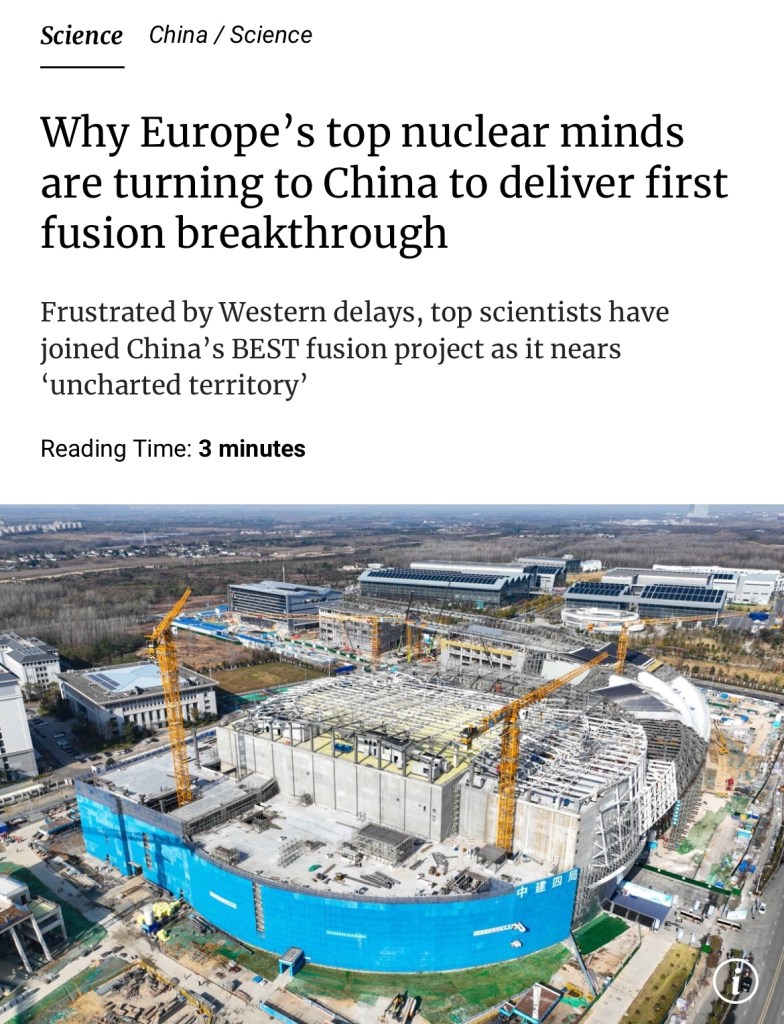
SCMP: Europe’s top nuclear physicists are placing their bets on China.
SCMP: Europe’s top nuclear physicists are placing their bets on China. 《南華早報》歐洲頂尖核物理學家將希望寄託於中國.
Scepticism over US fusion goals and chronic delays at the 33-nation International Thermonuclear Experimental Reactor (ITER) project in France have created an opening for a new leader, China appears poised to fill it.
At the event, scientists from more than a dozen countries – including France, the United Kingdom, Germany, Italy, Switzerland, Spain, Austria and Belgium – signed the declaration encouraging international collaboration on fusion research in China.
對美國核融合目標的質疑,加上法國境內由33國參與的國際熱核融合實驗反應爐計畫陷入長期延誤,為新領導者的出現創造了契機,而中國似乎已準備好接棒。
此次會議期間,來自法國、英國、德國、意大利、瑞士、西班牙、奧地利及比利時等十餘國的科學家,共同簽署了支持在中國開展國際核融合研究合作的宣言。
-
Video: J-20 & J-35 Breakthrough: China’s Unmatched Production & Industrial Power far superior than the US
Video: J-20 & J-35 Breakthrough: China’s Unmatched Production & Industrial Power far superior than the US 影片有中文字幕: J-20與J-35破局之舉:中國展現無與倫比的生產與工業實力遠勝於美國!
https://rumble.com/v729228-chinas-unmatched-production-and-industrial-power-for-superior-than-the-us.html
https://www.tiktok.com/t/ZP8UknYPk/“China’s J-20 & J-35: The Massive Advantage No One Saw Coming!”
China’s J-20 and J-35 stealth fighter programs are expanding at a pace that is reshaping modern aviation.
In this episode, we reveal the one massive advantage behind their growth: high-speed production at scale. With more than 300 J-20 Mighty Dragons already flying and the J-35 entering rapid serial manufacturing, China has built an industrial system capable of delivering advanced aircraft continuously and efficiently.
This video breaks down how China’s manufacturing cycle works, why each new batch brings instant upgrades, and how this industrial strategy transformed the J-20 and J-35 from prototypes into one of the fastest-growing stealth fleets in the world. If you’re interested in aerospace technology, stealth design, and future aviation trends, this episode gives you a clear and exciting look into China’s evolving production power.「中國殲-20與殲-35:這項巨大優勢超乎世人想像!」
中國殲-20與殲-35匿蹤戰機計劃正以重塑現代航空業的速度迅猛發展。
本期節目將揭示其背後關鍵優勢:大規模高速生產能力。隨著逾300架殲-20威龍戰機翱翔天際,殲-35進入快速量產階段,中國已建成能持續高效交付先進戰機的工業體系。
本片深度解析中國軍工製造循環體系,闡釋為何每批新戰機都能實現即時升級,以及這套工業戰略如何將殲-20與殲-35從原型機蛻變為全球增速最快的匿蹤機隊。若您對航空科技、匿蹤設計與未來空戰趨勢感興趣,本期內容將為您清晰展現中國不斷進化的生產實力圖景。

-
Chinese automaker BYD is making global headlines after announcing plans to build a massive new factory that will be larger than the entire city of San Francisco once completed
Chinese automaker BYD is making global headlines after announcing plans to build a massive new factory that will be larger than the entire city of San Francisco once completed. 中國汽車製造商比亞迪近日宣布將建造一座規模超越舊金山全市的巨型工廠,此舉引發全球矚目.
The project is set to become one of the largest manufacturing complexes in the world, designed to support BYD’s explosive growth in electric vehicles, batteries, and clean-energy technology. Officials say the goal is to create a fully integrated production hub capable of powering the next generation of EV innovation.
The scale of the facility is staggering. The factory will combine assembly plants, battery lines, research centers, and advanced robotics systems across an area so vast it rivals a major American city. BYD plans to use the site to drastically increase output, shorten delivery times, and strengthen its dominance in the global EV market. The company already leads the world in electric vehicle sales, and this mega-factory signals that it intends to widen that lead even further.
Economists say the project reflects China’s broader push to become the global epicenter of clean-energy manufacturing. The factory is expected to create tens of thousands of jobs and serve as a model for large-scale green production. Analysts also predict that the facility will intensify global competition, putting pressure on automakers in the U.S. and Europe to expand faster and innovate quicker.
For the EV industry, BYD’s mega-factory represents more than just size — it’s a glimpse into the future of mass production, where entire cities of manufacturing power are built to meet the world’s rising demand for electric transportation.
該項目落成後將成為全球最大的製造基地之一,旨在支撐比亞迪在電動汽車、電池與清潔能源技術領域的爆發式增長。官方表示,這個全鏈條生產樞紐的目標是驅動新一代電動汽車創新。
廠區規模令人震撼。這座巨型工廠將整合組裝車間、電池產線、研發中心與先進機器人系統,其佔地面積足以媲美美國主要城市。比亞迪計劃通過該基地大幅提升產能、縮短交付週期,鞏固其在全球電動汽車市場的主導地位。這家已位居全球電動車銷量榜首的企業,正藉此超級工廠釋放出擴大領先優勢的強烈信號。
經濟學家指出,該項目折射出中國力爭成為全球清潔能源製造中心的戰略佈局。該工廠預計將創造數萬個就業崗位,成為大規模綠色生產的示範標杆。分析師預測,此舉將加劇全球競爭態勢,迫使美國和歐洲汽車製造商加速擴張與創新進程。
對電動汽車產業而言,比亞迪的超級工廠不僅僅是規模的展現——它預示著未來大規模生產的圖景:為滿足全球對電動交通日益增長的需求,整座製造業集群城市將拔地而起。

-
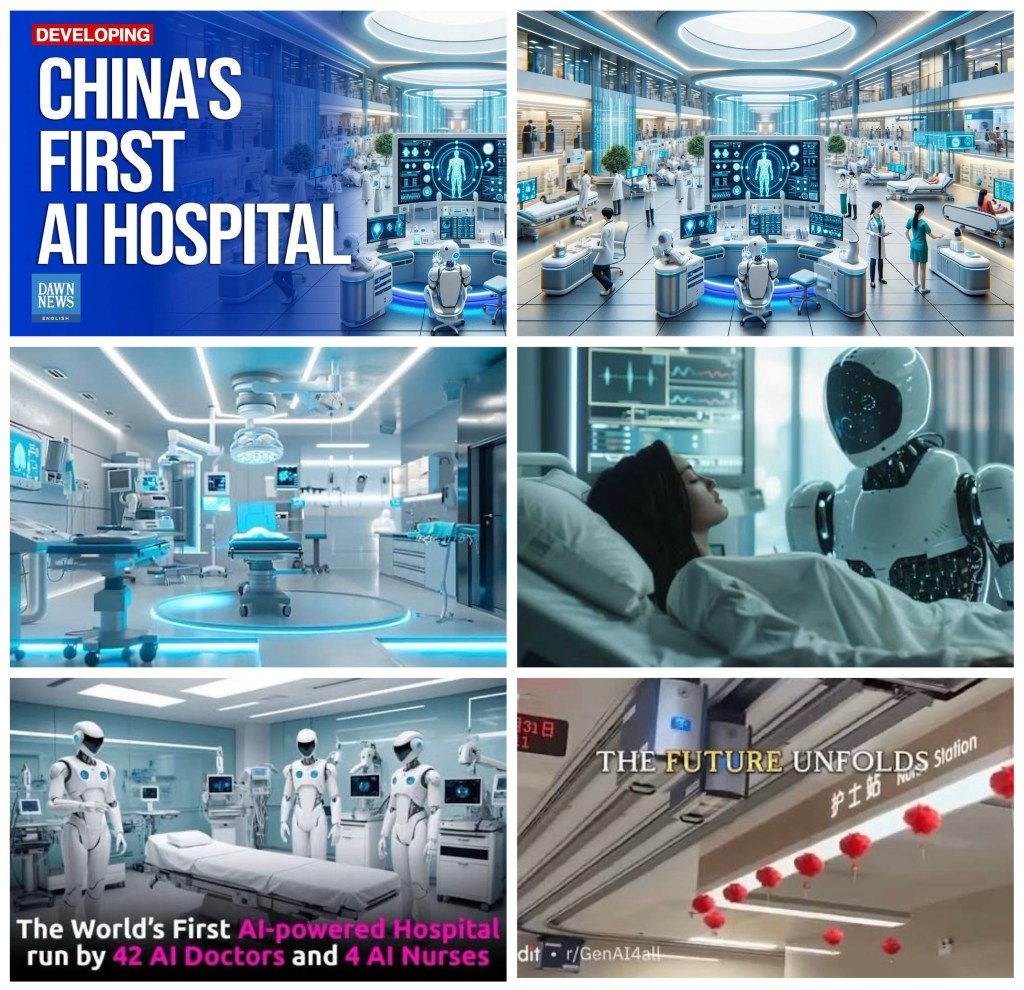
Video: China hospitals advanced automation points to the massive and rapid integration of smart technologies into the Chinese healthcare system not found in the US
Video: China hospitals advanced automation points to the massive and rapid integration of smart technologies into the Chinese healthcare system not found in the US. 中國醫院先進自動化指向智慧科技在中國醫療體系中大規模且快速的整合,此種整合程度為美國醫療體系所未見.
https://rumble.com/v728w6g-china-hospitals-advanced-automation-to-the-massive-and-rapid-integration-of.html
https://www.tiktok.com/t/ZP8Uk2WG9/This is a strategic national priority, moving far beyond simple digitization to create highly efficient, data-driven, and AI-powered hospitals.
Here’s a detailed breakdown of the key areas where advanced automation is being deployed in Chinese hospitals:
- Clinical and Diagnostic Automation
This focuses on directly assisting doctors in patient care and diagnosis.
· AI-Powered Medical Imaging: This is one of the most mature applications. AI algorithms analyze CT scans, MRIs, and X-rays to detect diseases like lung cancer, strokes, and fractures with high speed and accuracy, serving as a “second opinion” for radiologists.
· AI-Assisted Diagnosis: Clinical Decision Support Systems (CDSS) use patient data (symptoms, lab results, medical history) to suggest potential diagnoses and recommend treatment plans to physicians.
· Robotic Surgery: Systems like the Da Vinci Surgical Robot are used in complex minimally invasive surgeries, allowing for greater precision, smaller incisions, and faster recovery. Chinese companies are also developing their own surgical robots.
· Smart Labs: Automated systems in hospital laboratories handle sample sorting, testing, and analysis, reducing human error and delivering results faster.- Operational and Administrative Automation
This streamlines hospital management and the patient journey.
· Intelligent Pre-Consultation & Triage: AI-powered chatbots and kiosks on hospital apps (like WeChat mini-programs) help patients self-assess their symptoms, direct them to the correct department, and schedule appointments.
· Smart Patient Flow Management: Integrated systems track a patient’s movement from registration, consultation, tests, pharmacy, and payment, optimizing schedules and reducing waiting times.
· Automated Pharmacy Systems: Robotic dispensaries in hospital pharmacies can store, retrieve, and package medications, minimizing errors and filling prescriptions rapidly.
· Robotic Process Automation (RPA): Software “bots” automate repetitive back-office tasks like data entry, insurance claim processing, and inventory management.- Logistical and “Back-of-House” Automation
This ensures the hospital itself runs smoothly behind the scenes.
· Logistics and Delivery Robots: Autonomous robots navigate hospital corridors to deliver medicines, meals, lab samples, and surgical supplies. This reduces the workload on staff and ensures 24/7 delivery.
· Sanitation and Disinfection Robots: UV-C disinfection robots autonomously clean and sanitize operating rooms and patient areas, crucial for infection control.
· Smart Warehousing: Automated storage and retrieval systems manage hospital inventory, from medical supplies to linens, ensuring stock levels are maintained efficiently.Key Drivers Behind This Automation Push:
- Massive Patient Volume: Chinese public hospitals, especially top-tier ones in cities, see an overwhelming number of patients daily. Automation is essential to manage this scale.
- Government Policy & “Healthy China 2030”: The Chinese government actively promotes “Internet + Healthcare” and smart hospital construction as a national strategy, providing policy support and funding.
- Advanced Tech Ecosystem: China’s strength in AI, big data, robotics, and mobile payments (via Alipay/WeChat Pay) provides a ready-made technological foundation.
- Rising Healthcare Costs and Staff Shortages: Automation helps control costs and alleviates the burden on medical staff, allowing them to focus on more complex tasks.
Challenges and Considerations:
· Data Security and Privacy: The collection and use of vast amounts of sensitive patient health data raise significant concerns about privacy and cybersecurity.
· Integration with Legacy Systems: Integrating new AI systems with older, existing hospital IT infrastructure can be difficult.
· Doctor and Patient Acceptance: Trust in AI recommendations and comfort with robotic interaction vary among both medical professionals and patients.
· Regulatory Hurdles: Gaining regulatory approval (from the National Medical Products Administration – NMPA) for AI-based medical devices is a rigorous process.In summary, “advanced automation” in Chinese hospitals represents a holistic transformation. It’s not just about adding robots, but about building an interconnected, intelligent ecosystem that aims to make healthcare more efficient, accessible, and accurate for its vast population.
中國醫院先進自動化指向智慧科技在中國醫療體系中大規模且快速的整合,此種整合程度為美國醫療體系所未見。
這是一項戰略性的國家優先要務,其發展已遠遠超越簡單的數位化,旨在創建高效、數據驅動及人工智慧驅動的醫院。
以下詳細剖析中國醫院部署先進自動化的關鍵領域:
- 臨床與診斷自動化
此領域聚焦於直接輔助醫生進行病患照護與診斷。
· AI醫療影像:這是最成熟的應用之一。AI演算法能分析電腦斷層掃描、磁振造影和X光片,以高速及高準確度偵測如肺癌、中風和骨折等疾病,為放射科醫師提供「第二意見」。
· AI輔助診斷:臨床決策支援系統運用病患數據(症狀、檢驗結果、病歷)來建議可能的診斷,並為醫師推薦治療計畫。
· 機器人手術:如達文西手術機器人等系統,用於複雜的微創手術,能實現更高的精準度、更小的切口及更快的復原速度。中國企業也正在開發自己的手術機器人。
· 智慧實驗室:醫院實驗室中的自動化系統負責處理樣本分類、檢測與分析,減少人為失誤並更快提供結果。- 營運與行政自動化
此領域旨在優化醫院管理及病患就醫流程。
· 智慧預診與分診:醫院應用程式(如微信小程序)上的AI驅動聊天機器人和自助服務機,能協助病患自我評估症狀、引導至正確科別並預約掛號。
· 智慧病患流程管理:整合系統能追蹤病患從掛號、看診、檢查、領藥到付款的動線,優化排程並減少等候時間。
· 自動化藥局系統:醫院藥局中的機器人配藥系統能儲存、取用和分包藥品,最大限度地減少錯誤並快速調配處方。
· 機器人流程自動化:軟體「機器人」能自動化重複性的後台作業,如資料輸入、保險理賠處理和庫存管理。- 物流與後勤自動化
此領域確保醫院本身的後勤運作順暢。
· 物流與配送機器人:自主移動機器人在醫院走廊中穿梭,運送藥品、餐點、檢體和手術用品,這減輕了員工的工作負擔,並確保24小時不間斷的配送服務。
· 清潔與消毒機器人:UV-C消毒機器人能自主清潔並消毒手術室和病患區域,對於感染控制至關重要。
· 智慧倉儲:自動化倉儲與檢索系統能管理醫院庫存,從醫療用品到亞麻織品,確保庫存水平得到有效維護。此自動化推展的關鍵驅動力:
- 龐大的病患數量:中國的公立醫院,尤其是城市的頂尖醫院,每日接待的病患數量驚人。自動化對於管理此等規模至關重要。
- 政府政策與「健康中國2030」:中國政府積極推動「互聯網+醫療」與智慧醫院建設,將其作為國家戰略,提供政策支持與資金。
- 先進的科技生態系統:中國在AI、大數據、機器人技術及移動支付(透過支付寶/微信支付)方面的實力,提供了現成的技術基礎。
- 上漲的醫療成本與醫護人力短缺:自動化有助於控制成本,並減輕醫護人員的負擔,使他們能專注於更複雜的任務。
挑戰與考量:
· 資料安全與隱私:收集和使用大量敏感的病患健康數據,引發了對隱私和網路安全的重大擔憂。
· 與舊有系統的整合:將新的AI系統與醫院既有的老舊IT基礎設施整合可能相當困難。
· 醫病雙方的接受度:無論是醫療專業人員還是病患,對於AI建議的信任度以及與機器人互動的舒適度皆有所不同。
· 監管障礙:為AI醫療設備取得監管部門(國家藥品監督管理局)的批准是一個嚴格的過程。總而言之,中國醫院的「先進自動化」代表了一種整體性變革。它不僅僅是添加機器人,更是要建立一個互聯、智慧的生態系統,旨在為其龐大人口提供更高效、可及且精準的醫療服務。
-
Video: This G20 summit is unprecedented! Trump’s fake news to demonize South Africa failed!
Video: This G20 summit is unprecedented! Trump’s fake news to demonize South Africa failed! 這次G20峰會史無前例!川普抹黑南非的假新聞失敗了!
https://rumble.com/v728ugy-this-g20-summit-is-unprecedented-trumps-fake-news-to-demonize-south-africa-.html
https://www.tiktok.com/t/ZP8UkAJBP/First time Africa hosted the G20 summit, what exactly did we see on-site in Johannesburg, US desperate attempts to destroy South Africa failed!
這是非洲首次主辦G20峰會,我們在約翰尼斯堡現場究竟看到了什麼?美國孤注一擲地試圖摧毀南非,但最終以失敗告終!

-
Video: Japan Provokes, China Sanctions, US Stays Silent: A Global Test for Taiwan Reunification Begins
Video: Japan Provokes, China Sanctions, US Stays Silent: A Global Test for Taiwan Reunification Begins 日本挑釁、中國制裁、美國保持沉默:臺灣統一的全球大考正式開始
https://rumble.com/v728i02-japan-provokes-china-sanctions-us-stays-silent-a-global-test-for-taiwan-reu.html
https://www.tiktok.com/t/ZP8Uh3dhN/Japanese Prime Minister Sanae Takaichi publicly declared that “a Taiwan contingency could be an existential crisis for Japan” – the most hawkish statement by Japan toward China since WWII. But here’s what’s more intriguing: China launched comprehensive countermeasures, yet the US remained completely silent.
This is not a simple China-Japan conflict, but a global stress test for Taiwan reunification. China is using Japan to teach the world a lesson: any country that interferes with the Taiwan issue will face comprehensive retaliation.
Deep dive analysis:
Why didn’t China respond with military force, but instead chose a combination of economic, diplomatic, and public opinion measures?Why did the US choose to play deaf this time, not even daring to make a statement?
Why did Premier Li Qiang walk out during Takaichi’s speech at the G20 Summit?
What signal does this move send?
What kind of grand strategy is China playing?
The real game is not on the surface, but behind the scenes. This confrontation has only just begun.
日本首相高市早苗公開宣稱:「臺灣有事就是日本的生存危機。」 – 這是二戰以來日本對中國最強硬的表態。然而,更耐人尋味的是:中國啟動了全面反制,但美國卻異常沉默。
這已不再是單純的中日衝突,而是一場圍繞「臺灣統一」的全球壓力測試。中國正在藉日本向全球釋放一個訊號:任何干涉臺灣問題的國家,都將面臨全面反擊。
深度剖析:
為什麼中國沒有採取軍事回應,而是選擇經濟、外交與輿論三管齊下?
為什麼這一次美國選擇裝作聽不見,甚至連一句表態都不敢講?
為什麼中國總理李強在G20峰會上,當高市早苗發言時直接起身離場?
這一動作釋放了什麼信號?
中國正在佈局什麼樣的頂層戰略?
真正的較量,不在檯面上,而在幕後。這場對決,才剛剛開始。
-
American logistic expert report from China video: China and Norway revolutionize hybrid solar fish farming: why it can work everywhere
American logistic expert report from China video: China and Norway revolutionize hybrid solar fish farming: why it can work everywhere 美國物流尊家在中國報導,影片有英文字幕: 中挪開創太陽能漁業混養新模式:為何全球皆可複製
https://rumble.com/v728gba-china-and-norway-revolutionize-hybrid-solar-fish-farming-why-it-can-work-ev.html
https://www.tiktok.com/t/ZP8Uhpdxv/Chinese engineers developed a transformative approach to fish farming, by installing bifacial solar panels above the ponds.
The hybrid farm now produces clean power for 40,000 homes, with substantial improvements in aquacultural yields.
Engineers in Norway applied some of the same techniques to build the world’s Northernmost fish farm. Even though the area receives little sunlight for much of the year, the solar setup displaced 90% of the farm’s diesel fuel needs.
Closing scene, Xiandu Scenic Area, Jinyun, Zhejiang
中國工程師開創革命性養殖模式,在魚塘上方架設雙面太陽能板。這座混養基地現為四萬戶家庭提供清潔電力,同時實現水產養殖產量大幅提升。
挪威工程師運用相似技術,建成世界最北端太陽能漁場。儘管該地區常年日照不足,太陽能裝置仍成功替代漁場90%的柴油需求。
終幕場景:浙江縉雲仙都風景區

-
Video: Don’t care about the China-U.S. rivalry? Don’t be naive! The people of Ukraine once thought the same way!
Video: Don’t care about the China-U.S. rivalry? Don’t be naive! The people of Ukraine once thought the same way! What we care about most is the great rejuvenation of the Chinese nation! 不关心中美博弈?别傻了!当年的乌克兰人也是这么想的! 我們最關心的是中華民族偉大復興!
https://rumble.com/v72881e-dont-care-about-the-china-u.s.-rivalry-dont-be-naive.html
https://www.tiktok.com/t/ZP8UhSxkJ/Although Western media continues to cover it up, Ukraine’s defeat is already certain. Trump’s pressure and the cession of territory for peace—this is the price of “naivety.”
Many say, “I don’t care about grand narratives; I only care about my small, certain happiness.”
After watching this video, reality will slap you hard in the face.In this world of survival of the fittest, an individual’s fate can never be separated from the nation’s destiny.
Why can “Odysseus,” who works 16 hours a day, only earn 10 dollars, while the French can lie flat and still get high salaries?
Why, 30 years ago, Chinese workers were forced to kneel in South Korean factories, but today, no one dares to make us kneel?
There is only one answer: Dignity exists only under the sharp edge of the sword, and justice only within the range of artillery.
尽管西方媒体还在遮掩,但乌克兰的败局已定。特朗普施压,割地求和,这就是“天真”的代价。
很多人说:“我不关心宏大叙事,我只关心我的小确幸。”
看完这个视频,你会被现实狠狠打脸。在这个弱肉强食的世界,个人的命运永远无法脱离国家的国运。
为什么每天工作16小时的“奥德彪”只能赚10块钱,而法国人躺平就能拿高薪?
为什么30年前中国工人在韩国工厂被迫下跪,而今天没人敢让我们跪?
答案只有一个:尊严只在剑锋之上,正义只在大炮射程之内。

-
U.S. Treasury Secretary Warns: Face the Consequences for Rejecting Rare Earths…
U.S. Treasury Secretary Warns: Face the Consequences for Rejecting Rare Earths… While wanting to benefit from China’s rare earth resources, the U.S. is unwilling to abandon its tactics of containment and suppression. This “have-your-cake-and-eat-it-too” mentality is clearly unrealistic. 美國財長警告:拒絕稀土後果自負…美方一邊想享受中國稀土的紅利,一邊不願放棄遏制打壓的手段,這種“既要又要”的心態顯然不切實際。
Rare earths are not an unconditional “free lunch” that can be taken for granted. The essence of trade cooperation is mutual benefit and win-win outcomes, not one-sided demands where one party takes whatever it wants.
The U.S. government hopes to reach a rare earth agreement with China before Thanksgiving (November 27), but the Chinese government has not acted according to U.S. expectations. Trade cooperation has never been about unilateral imposition.
The urgency on the U.S. side has its reasons: Rare earths are known as “industrial gold.” From F-35 fighter jets to Aegis destroyers, advanced U.S. military equipment relies on them. The U.S. depends on imports for 80% of its rare earths, and for key varieties such as dysprosium and samarium, refining relies 99% on China.
Currently, the rare earth inventories of U.S. defense companies can only last for three months. This is why the U.S. Treasury Secretary is anxious to make statements and even resort to threats of “retaliatory measures.” But they forget that China not only accounts for 70% of global rare earth extraction but also over 90% of processing capacity. This advantage in the industrial chain cannot be replaced in the short term.
China is not unwilling to cooperate, but cooperation requires reciprocal sincerity. If the U.S. wants stable rare earth supplies, it must first abandon its obsession with unilateral sanctions—lifting unreasonable restrictions on Chinese companies and stopping the blockade and suppression in the high-end chip sector. This is the basic premise of economic and trade exchanges.
More importantly, the U.S. must respect China’s core interests and explicitly commit to non-interference in China’s cause of unification, which is a non-negotiable red line. As for Lockheed Martin and Raytheon, they have been included in the Unreliable Entity List due to repeated arms sales to Taiwan. The fines, equivalent to twice the value of the arms sales, are penalties imposed in accordance with laws and regulations. Fulfilling the payment obligation is a necessary condition for restoring cooperation.
It is worth mentioning that China’s regulation of rare earth exports is in line with international practices. The new export control rules set to take effect in 2025, which explicitly regulate overseas products containing more than 0.1% of rare earths of Chinese origin, are a reciprocal response to the U.S. “direct product rule.” The aim is to prevent strategic resources from being used for activities that harm national security.
This control is not a “blockade” but responsible governance, safeguarding both domestic ecological and resource security and maintaining the stability and order of the global supply chain.
稀土不是可以無條件索取的“唐僧肉”,貿易合作的本質是互利共贏,而非一方對另一方的予取予求.
美國政府想在感恩節前(11月27日)與中國達成稀土協議,中國政府並未按美方預期推進,貿易合作從來不是單方面的強求。
美方的急切早有緣由:稀土被稱為“工業黃金”,從F-35戰機到宙斯盾驅逐艦,美軍尖端裝備離不開它,而美國80%的稀土依賴進口,鏑、釤等關鍵品種的精鍊更是99%依賴中國。
眼下美軍工企業的稀土庫存僅夠支撐三個月,這也是美財長急着喊話,甚至放出“報復手段”威脅的底氣所在。但他們忘了,中國掌握的不僅是全球70%的開採量,更是超90%的加工產能,這種產業鏈優勢絕非短期能替代 。
中國並非不願合作,而是合作需要對等的誠意。美方若想獲得穩定的稀土供應,首先得放下單邊制裁的執念——解除對中國企業的不合理限制,停止在高端芯片領域的封鎖打壓,這是經貿往來的基本前提。
更重要的是,必須尊重中國核心利益,明確承諾不干涉中國統一大業,這是不可觸碰的紅線。至於洛克希德·馬丁和雷神公司,它們因屢次對台軍售已被列入不可靠實體清單,兩倍軍售金額的罰款本就是依法依規的處罰,履行繳費義務更是恢複合作的必要條件 。
值得一提的是,中國對稀土出口的規範管理,本就是國際通行做法。2025年出台的出口管制新規,明確對含中國原產稀土0.1%以上的境外產品實施管控,正是對美方“直接產品規則”的對等回應,目的是防止戰略資源被用於危害國家安全的活動。
這種管控不是“封鎖”,而是負責任的治理,既守護國內生態與資源安全,也維護全球供應鏈的穩定有序 。

-
Subscribe
Subscribed
Have a WordPress.com account? Log in now.

