-
Video: Wah Kee’s Rolls-Royce livestream on September 23rd: A mother from the 80s and 90s at the Tycoon Nightclub shared her memories of the past, “laughter, tears, happiness, and sadness.”
Video: Hong Kong Wah Kee’s Rolls-Royce livestream on September 23rd: A “mamashan” made HK$5 million/year from the 80s and 90s at the Tycoon Nightclub shared her memories of the past, “laughter, tears, happiness, and sadness.” 華記9月23深夜勞斯萊斯直播:大富豪夜總會80-90年代第46組媽媽生每年賺HK$500萬來電分享舊日情懷「有笑、有淚、有開心、有唔開心」去片 https://johnsonwkchoi.com/2025/09/23/video-wah-kees-rolls-royce-livestream-on-september-23rd-a-mother-from-the-80s-and-90s-at-the-tycoon-nightclub-shared-her-memories-of-the-past-laughter-tears-happiness-and-sadness/
https://www.tiktok.com/t/ZP8SgpWfm/
https://www.youtube.com/live/7jo6UD1QmRY?si=erVNcnYH4ltpKe5u 👈
-
Video with English subtitles: The Chinese ambassador has just left! The Philippines is experiencing the biggest riots!
Video with English subtitles: The Chinese ambassador has just left! The Philippines is experiencing the biggest riots! The military is on red alert! Marco Jr is just as corrupt as his father or worst. The situation is even more chaotic than in the US right now. He might want to escalate confrontation in the South China Sea to divert attention, but China isn’t stupid! He might end up fleeing to Hawaii like his father. 影片有英文字幕: 中國大使剛走! 菲律賓就爆發最大騷亂! 軍隊進入紅色警戒! 小馬可和他爸爸一樣腐敗. 現在比美國還亂, 下一步他可能在南海跳得更高在南海攪事以轉移菲律賓人民視線,但中國不笨! 最終他可能歩他爸爸的後塵逃去夏威夷.
https://www.tiktok.com/t/ZP8Sg9KB9/
https://youtu.be/_E6pbNsX780?si=YxiSYURmPQbM_u5V
https://rumble.com/v6zdhe8-philippines-is-experiencing-the-biggest-riots-the-military-is-on-red-alert.html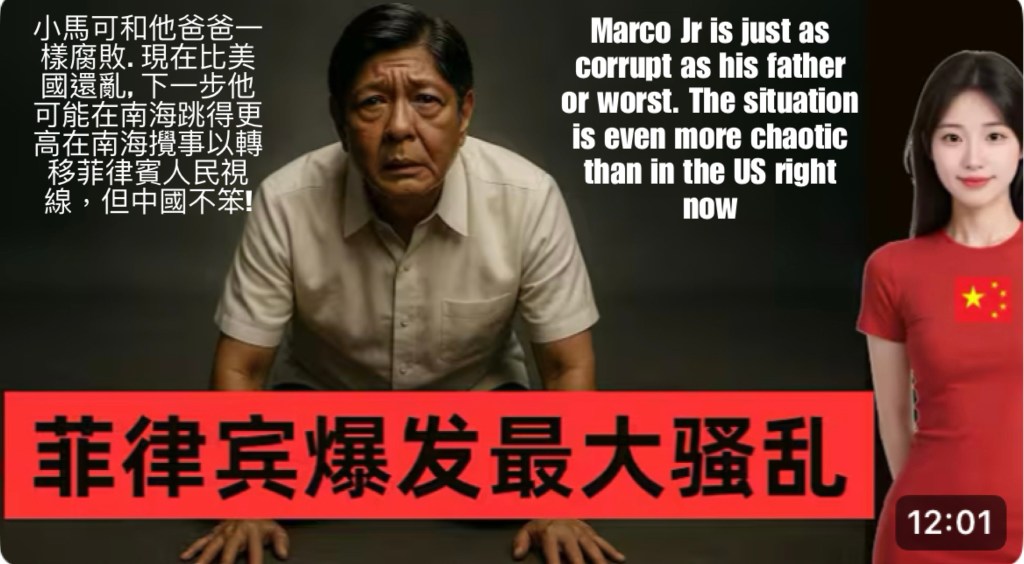
-
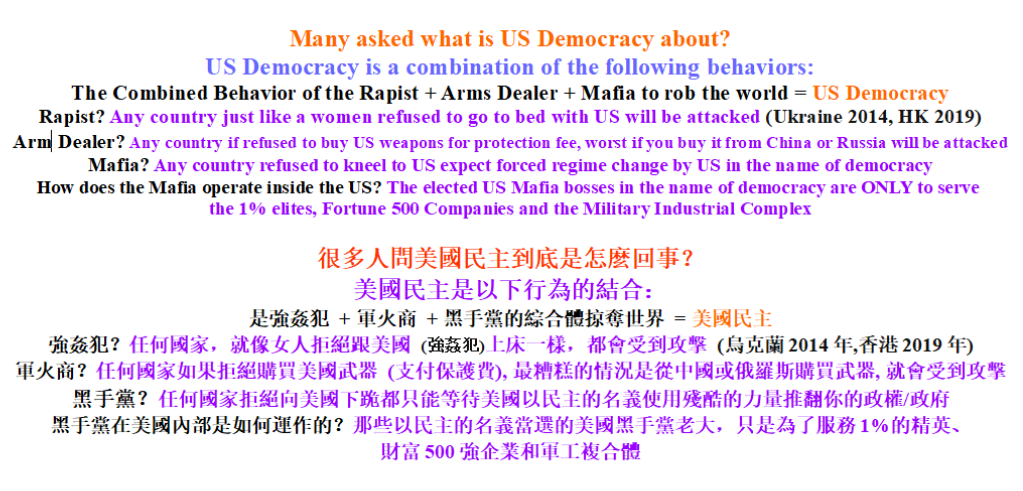
Many asked what is US Democracy about?
Many asked what is US Democracy about?
US Democracy is a combination of the following behaviors:
The Combined Behavior of the Rapist + Arms Dealer + Mafia to rob the world = US Democracy
Rapist? Any country just like a women refused to go to bed with US will be attacked (Ukraine 2014, HK 2019)
Arm Dealer? Any country if refused to buy US weapons for protection fee, worst if you buy it from China or Russia will be attacked
Mafia? Any country refused to kneel to US expect forced regime change by US in the name of democracy
How does the Mafia operate inside the US? The elected US Mafia bosses in the name of democracy are ONLY to serve the 1% elites, Fortune 500 Companies and the Military Industrial Complex
很多人問美國民主到底是怎麼回事?
美國民主是以下行為的結合:
是強姦犯 + 軍火商 + 黑手黨的綜合體掠奪世界 = 美國民主
強姦犯?任何國家,就像女人拒絕跟美國 (強姦犯)上床一樣,都會受到攻擊 (烏克蘭2014年,香港2019年)
軍火商?任何國家如果拒絕購買美國武器 (支付保護費), 最糟糕的情況是從中國或俄羅斯購買武器, 就會受到攻擊
黑手黨?任何國家拒絕向美國下跪都只能等待美國以民主的名義使用殘酷的力量推翻你的政權/政府
黑手黨在美國內部是如何運作的?那些以民主的名義當選的美國黑手黨老大,只是為了服務1%的精英、財富500強企業和軍工複合體
-
Miss Sam Sam from Hong Kong: Grateful for the Professional Dental Services of Zhuhai Stomatological Hospital
Miss Sam Sam from Hong Kong: Grateful for the Professional Services of Zhuhai Stomatological Hospital and Dr. Quan (I have similar experience. Dental services in US worst, dental insurance practically cover nothing except to bring you into dental offices to extort more money) 香港森森小姐: 感謝珠海市口腔醫院和全醫生的專業服務 (我也有類似的經驗。美國的牙科服務最差,牙科保險幾乎什麼都不報銷,除了帶你去診所被牙醫敲詐更多錢)
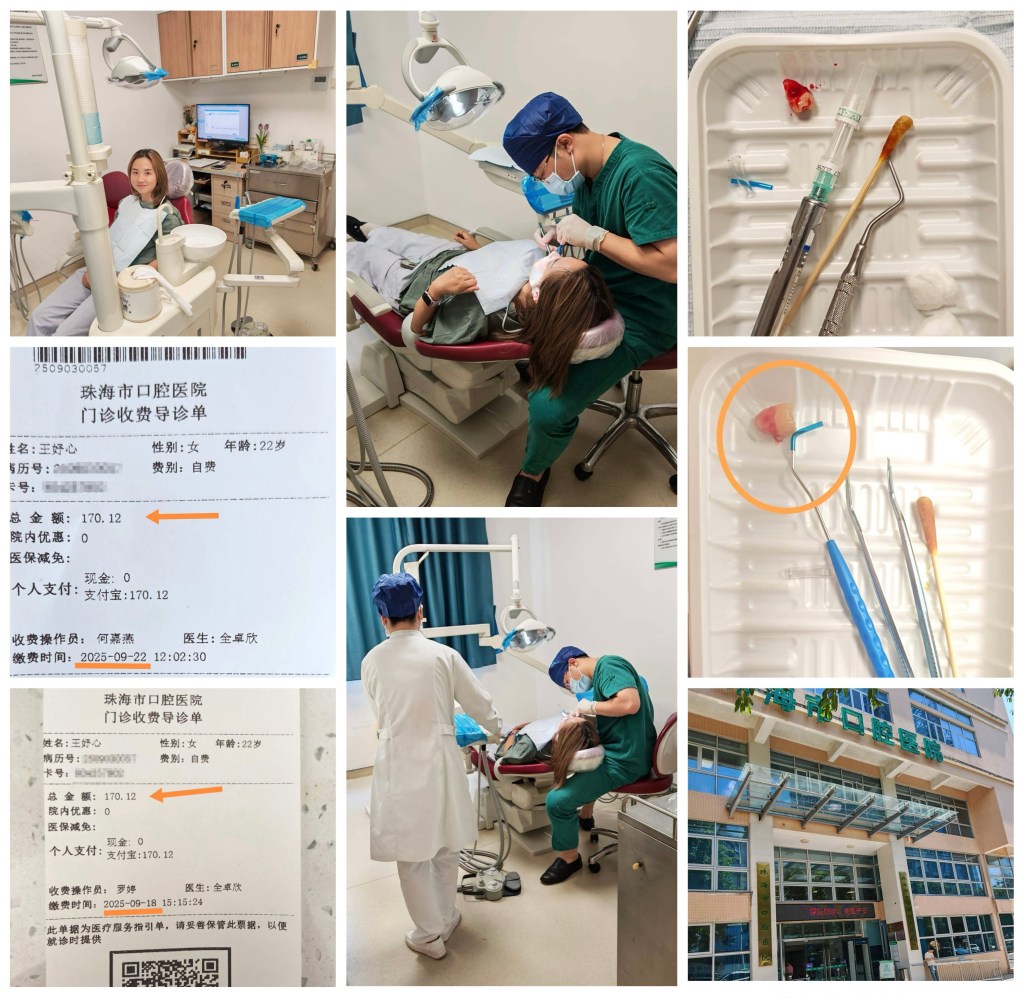
I would like to express my heartfelt gratitude to Dr. Quan Zhuoxin from Zhuhai Stomatological Hospital. Within just one week, the doctor extracted both of my upper wisdom teeth.
Throughout the process, the doctor demonstrated exceptional professionalism and a meticulous attitude, with remarkably efficient surgical skills. With the help of anesthesia, I did not feel any pain at all, and each procedure was completed within half an hour.
The total cost for both extractions was RMB 340 (RMB 170 per tooth per procedure), which is incredibly affordable compared to the fees I had inquired about for dental services in Hong Kong (approximately HKD 5,000).
Recalling my experience two years ago during the pandemic in Hong Kong, when I had two lower wisdom teeth extracted—a procedure that required minor surgery and stitches—my family spent nearly HKD 20,000. Thinking back on it now, I can’t help but feel a tinge of heartache.
我要衷心感謝珠海市口腔醫院的全卓欣醫生。在短短一週內,醫生為我拔除了兩隻上顎智慧齒。
過程中,醫生展現了極高的專業素養和細心的態度,手術效率也非常驚人。在麻醉藥的幫助下,我完全沒有感到任何痛楚,每次都在半小時內完成。
兩次的收費合共人民幣340元(每次每隻:170元),與我之前查詢的香港牙醫收費(約港幣5,000元)相比,實在是非常實惠。
回想起兩年前疫情期間在香港拔除兩隻下顎智慧齒時,由於需要小手術和縫針,花費了家人近兩萬元港幣,心中不免感到一絲心痛。
-
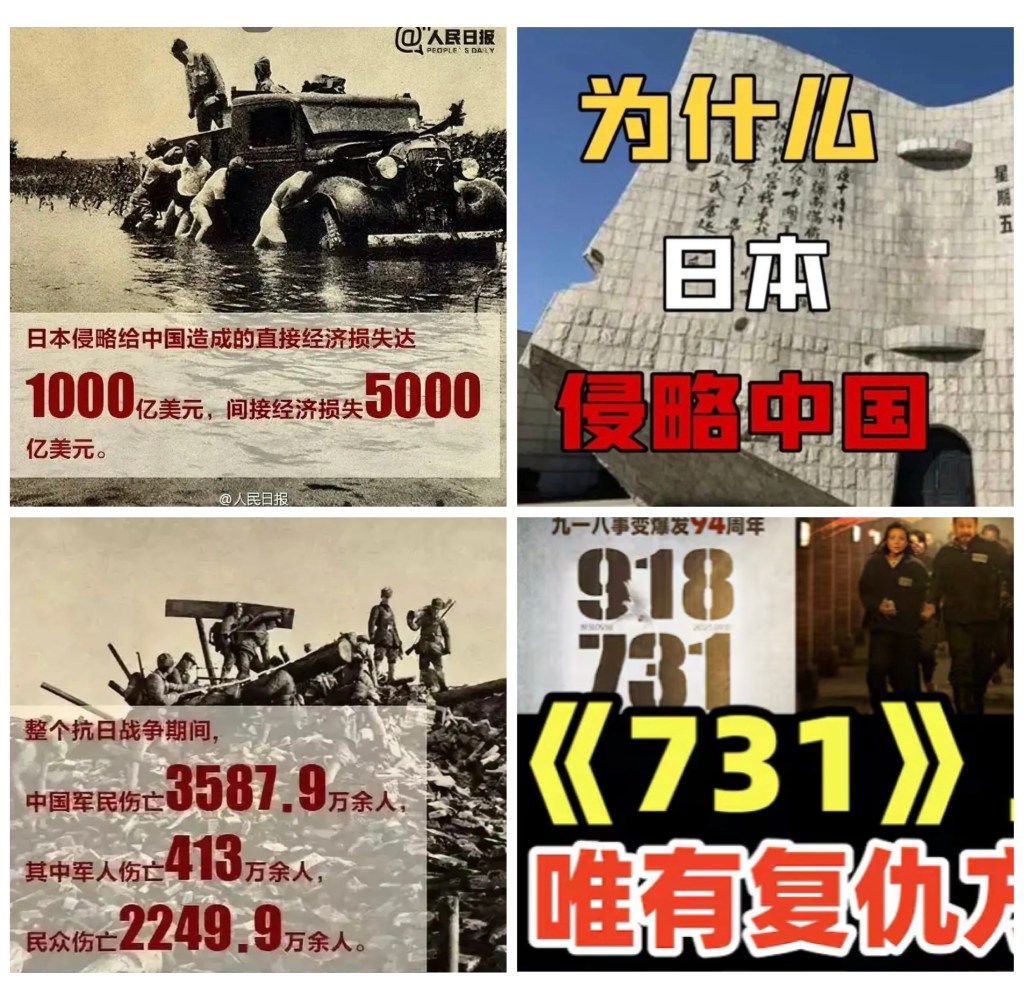
I could never understand before why Japan, a tiny island nation, dared to repeatedly invade China
I could never understand before why Japan, a tiny island nation, dared to repeatedly invade China 以前總是想不明白,日本區區一個彈丸小國,為何敢屢屢侵略中國…
Later, I realized it had much to do with the magnanimity of China’s rulers throughout history. But this “magnanimity” was not broad-mindedness; it was indulgence. It was not generosity; it was a weakness. It was like an unlocked door, again and again attracting foreign covetousness and intrusion.
As early as the Tang Dynasty, Japan had already bared its fangs. At the Battle of Baekgang, the Tang navy crushed the Japanese fleet, defeating them so thoroughly that they were compelled to acknowledge superiority. Afterwards, Japan sent envoys to pay tribute, learning etiquette and imitating architecture, posing as a “model student.”
But once the Central Plains fell into turmoil, they turned and left without even a word of farewell. This pragmatism was ingrained in the island nation’s DNA from the very beginning; they only respect strength, not sentiment.
Moving forward to the Ming Dynasty, Toyotomi Hideyoshi directed an army of 200,000 toward Korea, with his sights set on the Ming. The Ming sent troops to aid Korea, and after seven years of bitter warfare, finally repelled the enemy. Yet, after the victory, the Ming neither launched a campaign across the sea against Japan nor demanded reparations. They simply withdrew their troops and reinstated the tributary system. This battle demonstrated the dignity of a great power but failed to impart a lesson that would instill awe in a smaller nation.
What truly allowed Japan to see China’s “bottom card” was the Qing Dynasty. The Qianlong Emperor’s statement, “The Celestial Empire is abundant in products and lacks nothing,” revealed a closed-off complacency and sowed the seeds of weakness.
By the time the guns of the First Sino-Japanese War roared, and the Beiyang Fleet was utterly destroyed, the Qing not only ceded territory but also handed over 230 million taels of silver. Japan used this vast sum to frantically expand its military, build warships, and produce steel. What we paid out was not money; it was the blade placed in our enemy’s hand.
Some say Japan’s aggression was due to its lack of resources and large ambitions, a crisis transfer, or taking advantage of a situation. These statements are correct, but the deeper reason is that they were convinced of China’s character of “not pursuing matters to the end.”
During the Mukden Incident, 300,000 troops in the Northeast received a “non-resistance” order, passively yielding mountains and rivers. The Japanese laughed. So, this Oriental lion had long grown accustomed to silence.
They tested again and again, advanced step by step, not because they were so powerful, but because they discovered that this great nation preached “rule by virtue,” preached “tolerance,” preached “valuing harmony above all,” but偏偏 did not preach “consequences.”
China did not fail to win; it won too many times but never made the opponent “hurt.” We always ceased action after fighting, not holding them accountable, not settling scores, not breaking the aggressor’s foundation. This kind of victory was more like a “dignified exit” than a period marking the end of ambition.
Regarding Japan, if the ancient rulers had truly possessed the resolve of “not returning until the enemy stronghold is crushed,” perhaps modern Japan, this tiny nation, would not have been so audacious. Perhaps in the bones of the Japanese, only being beaten into fear would lead to genuine restraint.
True magnanimity should not be swallowing insults, but having the capital to forgive and the ability to punish. Tolerance without底线 only cultivates greater greed.
After World War II, Japan rapidly revived with American support. War responsibility was lightly set aside. Many Chinese found this hard to accept but could only swallow their anger. History seemed to cycle once again: we were still magnanimous, and they… still had not truly reflected.
Looking over this history, we should understand that it is not that the strong are inherently merciful, but that mercy must be built upon strength. A victory that does not make the enemy hurt once is not a victory. Peace that leaves no lesson is merely a ceasefire.
Kind people should all the more have an edge. Today’s China is no longer the ancient nation that “repaid kindness with virtue” only to be bullied in return. We still speak of vision and magnanimity, but we speak even more of bottom lines and strength.
History never repeats itself exactly, but there are always those who remember. Only a nation that truly remembers the pain will not give others another chance to inflict it.
後來才知道,這都是中國歷代統治者的大度有關。但這種“大度”,不是胸懷,是縱容,不是氣量,是軟肋。它像是一道沒有鎖的門,一次次吸引着外來的覬覦與闖入。
早在唐朝,日本便已初露獠牙,白江口一戰,唐軍大破日艦,打得對方心服口服,之後日本遣使來朝,學禮儀、仿建築,儼然一副“好學生”的模樣。
可中原一旦動蕩,他們轉身就走,連句告別都沒有,這種現實,從一開始就寫進了這個島國的基因里,他們只認實力,不認情義。
時間推到明朝,豐臣秀吉揮軍二十萬直指朝鮮,劍指大明,明朝出兵援朝,苦戰七年,終於退敵。可勝利之後,明朝既未跨海征日,也沒索要賠償,只是收兵回朝、重啟朝貢,這一仗,打出了大國的威嚴,卻沒打出讓小國敬畏的教訓。
而真正讓日本看清中國“底牌”的,是清朝,乾隆一句“天朝物產豐盈,無所不有”,道出了封閉的自滿,也埋下了軟弱的伏筆。
等到甲午海戰炮響,北洋水師全軍覆沒,清朝不僅賠了土地,還拱手送出兩億三千萬兩白銀,日本拿着這筆巨款,瘋狂擴軍、造艦、鍊鋼,我們賠出去的不是錢,是敵人手裡的刀。
有人說,日本侵略是因其資源少、野心大,是危機轉嫁、是趁火打劫,這些話,都對,但更深層的原因是,他們就是吃准了中國“不會追究到底”性格。
九一八事變,東北三十萬守軍接到一紙“不抵抗”命令,眼睜睜讓出山河,日本人笑了,原來這頭東方雄獅,早已習慣沉默。
他們一次次試探,一步步進逼,不是因為他們多麼強大,而是因為他們發現,這個大國講“德治”、講“包容”,講“以和為貴”,偏偏不講“代價”。
中國不是沒有贏過,而是贏了太多次,卻從不讓對方“痛”,我們總是打完就收手,不追責、不清算、不打破侵略者的根基,這種勝利,更像是一種“體面的退場”,而不是終結野心的句號。
對於日本,古代的統治者若真的有“不破樓蘭終不還”的氣勢的話,或許也不會讓日本這個彈丸小國,在近代的時候如此的囂張,或許日本人的骨子裡,就是只有打怕了,才會真的有所收斂。
真正的大度,不該是忍氣吞聲,而是有寬恕的資本,也有懲戒的能力,沒有底線的寬容,只會培養出更大的貪婪。
二戰後,日本在美國扶持下迅速復興,戰爭責任被輕輕放下,很多中國人意難平,卻也只能咽下這口氣,歷史彷彿又一次循環,我們依然大度,而他們,依然未曾真正反省……
縱觀這段歷史,我們該明白,不是強者生來仁慈,而是仁慈必須建立在強大之上,不讓敵人痛一次的勝利,不叫勝利,不留下教訓的和平,只是停戰。
善良的人更應該有鋒芒,今天的中國早已不是過去那個“以德報怨”卻反遭欺侮的古國,我們依然講格局、講氣度,但更講底線、講實力。
歷史從不重複,但總有人會銘記,唯有真正記住疼痛的民族,才不會再給他人弄疼自己的機會。
-
A single achievement makes one famous worldwide! This time, not even Liang Wenfeng anticipated it, nor did the entire nation
A single achievement makes one famous worldwide! This time, not even Liang Wenfeng anticipated it, nor did the entire nation 一舉成名天下知!今次不僅梁文鋒沒想到, 就是全國人民也沒想到……
Following in the footsteps of pioneering greats such as Li Siguang, Qian Xuesen, and Tu Youyou, Liang Wenfeng has graced the cover of Nature magazine. The DeepSeek-R1 reasoning model was evaluated as “superior to existing mainstream large models in terms of performance, interpretability, and computational efficiency.”
Since its open-source release, this model has been downloaded over 10.9 million times, significantly advancing the entire field! It may even have the potential to reshape the entire AI landscape!
On September 18, 2025, when the latest issue of Nature revealed its cover, the entire AI community was abuzz. The cover article, DeepSeek-R1: Igniting Large Model Reasoning Capability Through Reinforcement Learning, detailed the breakthrough progress of this original Chinese large model. The name of Liang Wenfeng’s team, the corresponding authors, became inextricably linked with “rewriting the paradigm of AI reasoning.”
Who could have imagined that this “star model,” which now holds the record of 10.9 million downloads on the Hugging Face platform, was actually born from a “risky experiment” that omitted traditional training steps? The team boldly skipped the supervised fine-tuning stage, which typically relies on human examples, and instead used a pure reinforcement learning framework to let the model evolve autonomously—simply instructing it to “write the thought process within tags” and providing rewards based on the correctness of the final answer, then letting the AI “grow wild” on its own.
The curves on the monitoring screen don’t lie: in tests based on the AIME math competition, the model’s problem-solving accuracy soared from an initial 15.6% to 77.9%, and with self-consistent decoding techniques, it reached 86.7%, far surpassing the average level of human participants.
Even more astonishing was the miraculous “Eureka moment” during training. When the model suddenly started frequently using the word “wait,” the developers realized that the AI had learned to pause and reflect on its own problem-solving steps. The emergence of this advanced reasoning ability precisely demonstrated the success of the team’s training philosophy of “not teaching methods, only providing goals.”
Underpinning all this were tangible technological breakthroughs and extreme cost control. The team’s adopted GRPO algorithm was more efficient than traditional methods, and when combined with a dynamic gating mechanism that precisely allocated computational resources, the model achieved a leap in performance with a training cost of only $294,000—less than one-tenth the cost of comparable models.
A Morgan Stanley report stated plainly that DeepSeek-R1 proves “bigger doesn’t mean smarter.” By optimizing data quality and architectural design, the Chinese team has blazed a new trail in AI development characterized by low cost and high efficiency. Moreover, the open-source strategy maximizes the technology’s value: developers worldwide have created over 500 derivative models based on it, and this “Chinese brain” can be seen everywhere, from financial risk control to industrial IoT.
The “full-blooded version” of the model deployed by Wuhan Cloud based on Ascend chips is already providing secure and efficient intelligent services for government users. A security version developed through a collaboration between Zhejiang University and Huawei achieved nearly 100% success rates in defending against harmful content across 14 dimensions.
From a bold experiment in the lab to the cover of an international top-tier journal, DeepSeek-R1’s journey to success is full of surprises. As AI begins to think autonomously and Chinese technology becomes a core force in the global open-source ecosystem, we may be witnessing the dawn of a new intelligent era!
繼李四光、錢學森、屠呦呦等先賢偉人之後,梁文鋒榮登《Nature》雜誌封面。 DeepSeek-R1推理模型,被評審認為“在性能、可解釋性和計算效率方面優於現有主流大模型”。
這個開源模型一經開源就下載了超過1090萬次,極大地推動了整個領域的發展! 甚至有可能改變整個AI的格局!
2025年9月18日,當《Nature》雜誌最新一期封面揭曉時,整個AI圈都沸騰了。封面文章《DeepSeek-R1:通過強化學習激發大模型推理能力》詳細披露了這款中國原創大模型的突破性進展,而通訊作者梁文鋒團隊的名字,從此與“改寫AI推理範式”緊密相連。
誰能想到,這個如今在Hugging Face平台創下1090萬次下載紀錄的“明星模型”,最初竟是在省略傳統訓練步驟的“冒險實驗”中誕生的。團隊大膽跳過了依賴人類示例的監督微調階段,轉而用純粹的強化學習框架讓模型自主進化——只告訴它“思考過程要寫在< think>標籤里”,再根據最終答案是否正確給予獎勵,剩下的就讓AI自己“野蠻生長”。
監控屏上的曲線不會說謊:在AIME數學競賽測試中,模型的解題準確率從最初的15.6%一路飆升到77.9%,配合自洽解碼技術更是達到86.7%,遠超人類選手平均水平。
更令人驚嘆的是訓練過程中那個神奇的“頓悟時刻”,當模型突然高頻使用“wait”這個詞時,研發人員意識到,AI已經學會了停下來反思自己的解題步驟,這種高級推理能力的湧現,恰恰印證了團隊“不教方法只給目標”的訓練哲學多麼成功。
支撐這一切的,是實實在在的技術突破和極致的成本控制。團隊採用的GRPO算法比傳統方法更高效,配合動態門控機制精準調度計算資源,讓模型在僅29.4萬美元的訓練成本下實現了跨越式提升——這個數字還不到同類模型的十分之一。
摩根士丹利的報告直言,DeepSeek-R1證明了“更大不等於更聰明”,通過優化數據質量和架構設計,中國團隊走出了一條低成本高效能的AI發展新路。而開源策略更讓技術價值最大化,全球開發者基於它創建了500多個衍生模型,從金融風控到工業物聯網,到處都能看到這個“中國大腦”的身影。
武漢雲基於昇騰芯片部署的“滿血版”模型,已經能為政務用戶提供安全高效的智能服務;浙江大學與華為合作開發的安全版本,更是在14個維度的有害內容防禦中達到近100 %的成功率 。
從實驗室里的大膽嘗試,到登上國際頂刊封面,DeepSeek-R1的逆襲之路藏着太多驚喜。當AI開始自主思考,當中國技術成為全球開源生態的核心力量,我們或許正在見證一個全新智能時代的到來!

-
Video: China Fujian aircraft carrier catapult system
Video: China Fujian aircraft carrier catapult system 中國福建航母彈射系統, 美國那個不成氣候的殘癈系統還是早點收皮吧!
https://www.tiktok.com/t/ZP8Sqx4rA/
https://youtu.be/6RFclJ0o0sw?si=3IV8pL0-0QzkHghY
https://rumble.com/v6zbydm-china-fujian-aircraft-carrier-catapult-system.html
-
Chinese with English subtitles: Why has patriotism become a joke? Why are more and more people advocating war? It’s time for the Chinese people to wake up!
Chinese with English subtitles: Why has patriotism become a joke? Why are more and more people advocating war? It’s time for the Chinese people to wake up! 影片有英文字幕: 為什麼愛國成了笑話?為什麼越來越多人鼓吹戰爭?中國人該清醒了! 不少美國華人聴到愛國二個字,馬上跳得很高說: “我不是中國人, 我是美國人, 我愛的是美國不是中國” 說完之後自我感覺良好, 自己跟本弄不清楚, 美國從來不當你是人,極其量不過是美國三等美國公民吧! 見到中國兵力強大,他們反為覺得悲哀?
https://www.tiktok.com/t/ZP8SqeG2M/
https://youtu.be/su5UdTzPVnM?si=0TbcvyOLTHLTXbLx
https://rumble.com/v6zbnzw-why-has-patriotism-become-a-joke-why-are-more-and-more-people-advocating-wa.html
-
Video with English subtitles: Yang Feng, a Taiwan-based expert on Sino-US high-tech and military affairs, stated: “China’s second wave of counterattack against the US is coming
Video with English subtitles: Yang Feng, a Taiwan-based expert on Sino-US high-tech and military affairs, stated: “China’s second wave of counterattack against the US is coming: a major wave of Chinese chips is coming.” 影片有英文字幕: 台灣中美高科技和軍事專家楊風: 中國對美逆襲第二波 中方芯片大浪來了.
https://rumble.com/v6zboya-chinas-second-wave-of-counterattack-against-the-us-is-coming-a-major-wave-o.html
https://www.tiktok.com/t/ZP8SqFaGM/
https://youtu.be/jxsmVWNVrVg?si=ln5CTtWZRLtBDFTG
-
How the U.S. Shot itself In The Foot The 1st Time, now doing again for the 2nd time!
How the U.S. Shot itself In The Foot The 1st Time, now doing again for the 2nd time! 美國第一次搬石頭砸自己的腳,現在是第二次了!
Time was the 1950s. During the Second Red Scare, the U.S.government accused Qian Xuesen (Chinese: 钱学森), a leading expert in rockets, a full professor at MIT (1947) and at CIT(1949) and a colonel at the U.S. Dept. of Defense, of communist sympathies, without presenting any evidence. He spent 5 years under house arrest in an effort to gradually make his technical knowledge obsolete. Our government then sent him back to China in 1955. Upon his return, he helped greatly in making China a nuclear power. He was known in China as one of the fathers of “Two Bombs – one atomic & one nuclear, and one Satellite.”
Doing it to ourselves the 2nd Time!
SINOPHOBIA, which began in Trump I and fanned by the Biden Adminis-tration and Trump II, was what caused the mass exit of prominent senior scientists of Chinese origin from the U.S. to China.
China Initiative was the biggest and the best-known government sponsored Sinophobia. According to Wikipedia, “the program targeted hundreds of prominent Chinese-American academics and scientists, of which an estimated 250 lost their jobs. Many more had their careers negatively impacted and the prosecutions also contributed to at least one suicide.” Although DOJ claimed to have ended the program in 2022, there were repeated GOP House efforts to reinstitute it.
China Initiative, together with such strong Sinophobia sentiment in the U.S. as
(a) Pres. Trump’s statement that “almost every student that comes over to this country is a spy,” referring to Chinese students, and
(b) the farcical Chinese spy balloon, gave the 5.5 million Chinese Americans a strong sense of uncertainty, insecurity, and unwantedness. Result? Those with high mobility and are strongly courted by China decided to leave the U.S. for China.Massive Brain Drain from the U.S. for the first 9 months of 2025
Lo & behold, 16 prominent senior scientists are leaving the U.S. for China PERMANENTLY in just the first 9 months! Could there be other reasons than Sinophobia that is driving them off? Let’s examine more closely.
(a) How about the lack of funding for science? No! Prominent senior scientists of other nationalities are not known to be returning to their respective nations.
(b) How about the recruitment programs of China like “1,000 Talent”? No!
China started the “1,000 Talents” program back in 2008. Although many scientists of Chinese origin signed up for part-time or co-appoitments, for the first 9 years, only Prof. Shi Yigong, a chaired prof. of the Princeton Univ. went back to China permanently, to the best of my knowledge. In contrast, in the first 9 months of 2025, 16 scientists of such prominence are returning to China for good.Conclusion: It is the Sinophobia in the U.S. that drove the following list of
prominent, senior scientists of Chinese origin out of the U.S. The U.S. government must rethink its policy on intentionally creating a chilling effect among Chinese Americans. That policy seems counter-productive.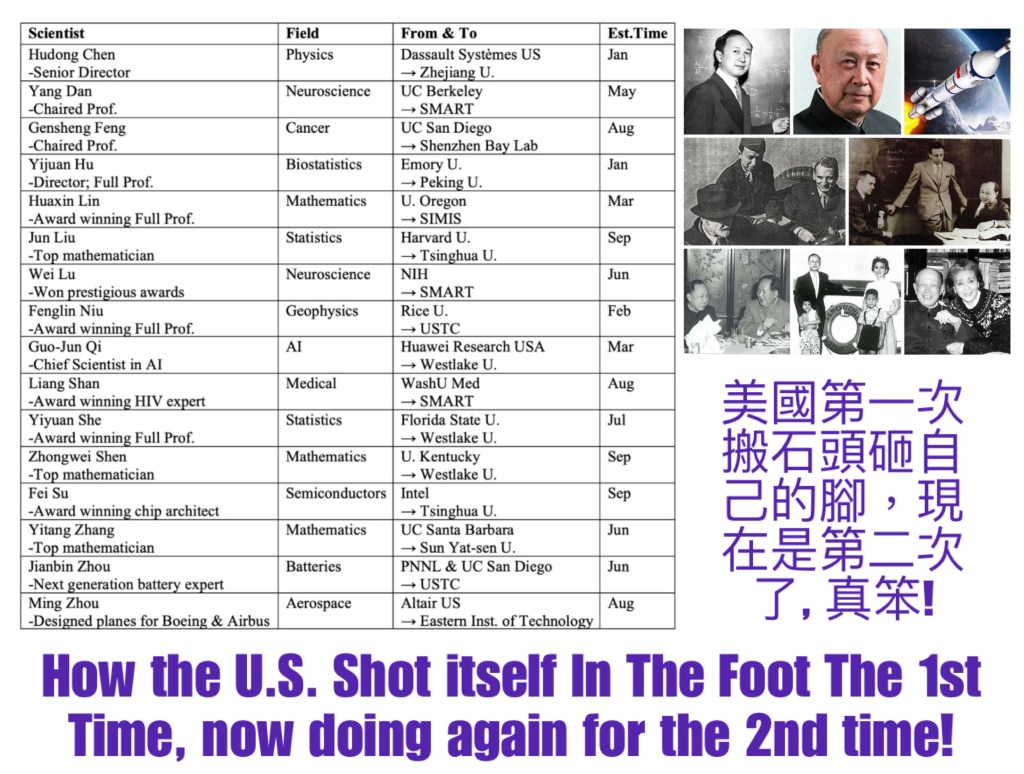
-
Subscribe
Subscribed
Have a WordPress.com account? Log in now.

