Video: West is out of touch with the rest of the world politically, EU funded study admits 歐盟資助的研究承認,西方在政治上與世界其他地區脫節
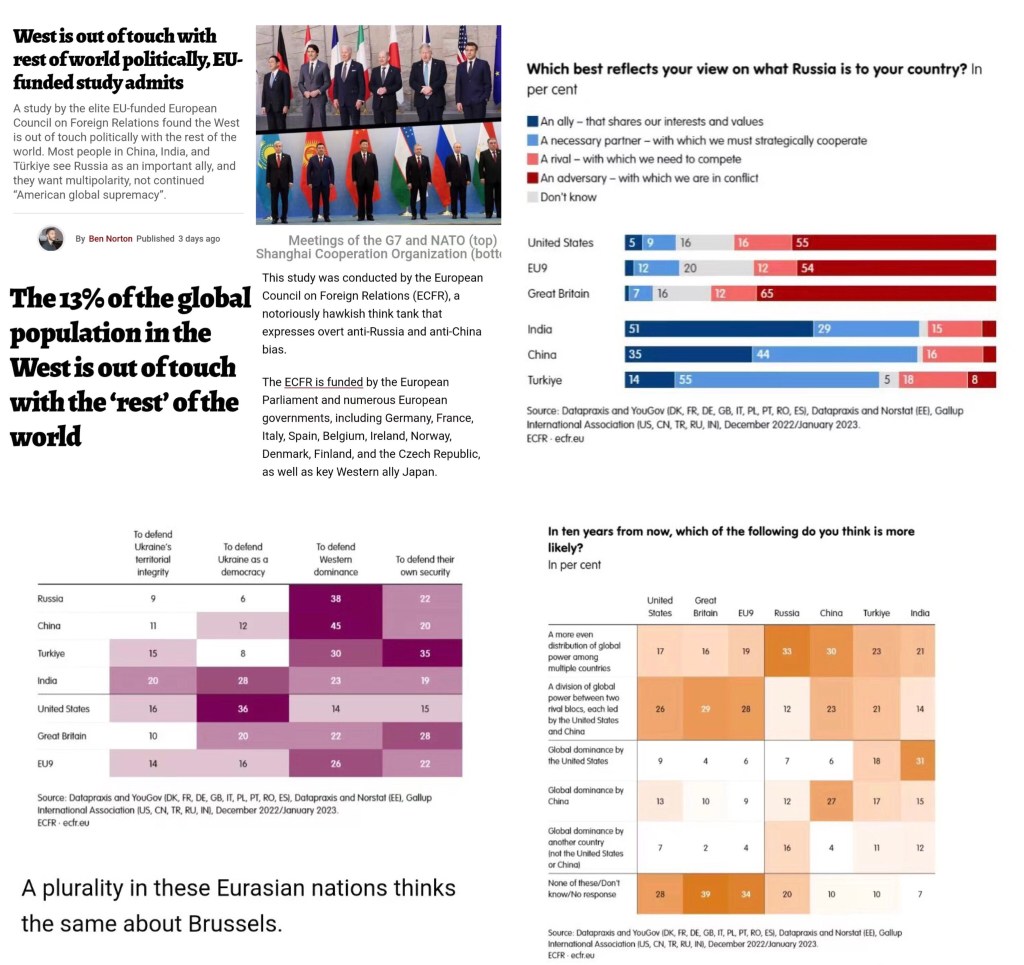
A government-funded think tank found that, while the United States and Europe are growing closer together, the West is increasingly out of touch politically with the rest of the world.
The report, from the EU member state-financed European Council on Foreign Relations, conceded that the system of “American global supremacy” is in rapid decline, and many people in the Global South want a new “multipolar world”.
The series of polls concluded that NATO’s proxy war in “Ukraine confirmed the renewed centrality of American power to Europe”, uniting the West under Washington’s leadership. Today, Europeans and North Americans “hold many views in common about major global questions”.
But this “consolidation of the West is taking place in an increasingly divided post-Western world”, the study acknowledged. The Global South is moving in the opposite direction.
It described “a wide gap between the West and the ‘rest’ when it comes to their desired outcomes for the war and differing understandings of why the US and Europe support Ukraine”.
The report admitted that, even if Ukraine somehow managed to win the NATO proxy war with Russia, “it is highly unlikely to restore a US-led global liberal order”, and, instead, “the West will have to live, as one pole of a multipolar world”.
The 13% of the global population in the West is out of touch with the ‘rest’ of the world
This study was conducted by the European Council on Foreign Relations (ECFR), a notoriously hawkish think tank that expresses overt anti-Russia and anti-China bias.
The ECFR is funded by the European Parliament and numerous European governments, including Germany, France, Italy, Spain, Belgium, Ireland, Norway, Denmark, Finland, and the Czech Republic, as well as key Western ally Japan.
For the report, the ECFR commissioned polling in:
China India Türkiye Russia United States Britain It also surveyed people in nine major European Union member states, which it referred to collectively as the EU9:
Denmark Estonia France Germany Italy Poland Portugal Romania Spain The pollsters interviewed a total of 19,765 adults in late December 2022 and early January 2023.
The sample of participants in the West was representative of the general population. But the study disclosed that, in China, India, and Russia, the people surveyed in the polling only came from large cities, meaning the results may not reflect the views of those living in rural areas.
The study suffered from bias. This slant was clear when the report misleadingly referred to the NATO-Russia proxy war in Ukraine facilely as “Putin’s war” and “Russian aggression”, as if the West did not play a fundamental role in starting the conflict in the first place by sponsoring a violent coup d’etat in Kiev in 2014, repeatedly violating promises not to expand NATO east after the 1990 reunification of Germany, sabotaging the Minsk accords and peace talks, and ignoring Moscow’s 2021 request for security guarantees.
But despite the ECFR study’s many flaws, its results convey an unmistakable message: The West is out of touch with the rest of the world.
The report acknowledged this, choosing as its title: “United West, divided from the rest“.
The Western nations surveyed in the study have a combined population of nearly 1 billion – approximately 13% of the global population of 8 billion.
This is a mere fraction of the populations of China (1.41 billion), India (1.39 billion), Russia (142 million), and Türkiye (83 million).
Together, these countries have a population of just over 3 billion – making up around 38% of the total global population.
The ECFR polling shows how significantly the public opinion of the 13% in the West differs from that of the Eurasian powers.
The West’s view of the Ukraine war is not shared by the rest of the world
In its report, the European Council on Foreign Relations stated that the proxy war in “Ukraine marks both the consolidation of the West and the emergence of the long-heralded post-Western international order”.
“Many in China state that American and European support for Ukraine is driven by the desire to protect Western dominance”, the study acknowledged.
“And for the vast majority of Chinese and Turks, Western support for Ukraine is motivated by reasons other than a defence of Ukraine’s territorial integrity or of its democracy”, it added.
45% of people surveyed in China, 38% in Russia, 30% in Türkiye, and 23% in India said the US is supporting Ukraine simply in order “to defend Western dominance”.
A plurality in these Eurasian nations thinks the same about Brussels.
40% of people surveyed in China, 46% in Russia, 27% in Türkiye, and 23% in India said Europe is supporting Ukraine in order “to defend Western dominance”.
The report admitted that “people in non-Western countries possess a clear preference for the war to end now – even if it means Ukraine having to give up territory”.
54% of people surveyed in India, 48% in Türkiye, 44% in Russia, and 42% in China think “the conflict between Russia and Ukraine needs to stop as soon as possible, even if it means Ukraine giving control of areas to Russia”.
Despite biased wording from the pollsters, an additional 12% of people in India, 8% in Türkiye, 29% in Russia, and 12% in China said “Western dominance of the world needs to be pushed back, even if it means accepting Russian territorial aggression against Ukraine”.
While a majority of people in the United States, Britain, and EU consider Russia to be an “adversary with which we are in conflict”, the situation is the opposite in India, China, and Türkiye.
In India, 80% of people surveyed see Russia as an ally or partner (51% as an “ally that shares our interests and values” and 29% as a “necessary partner with which we must strategically cooperate”).
In China, 79% of people surveyed see Russia as an ally or partner (35% as an ally and 44% as a necessary partner).
In Türkiye, 69% of people surveyed see Russia as an ally or partner (14% as an ally and 55% as a necessary partner).
Another question in the poll showed how Western media propaganda has manipulated public opinion.
The proxy war in Ukraine has made Russia seem stronger in India, Türkiye, China, and the country itself, whereas people across the West now see Moscow as weaker.
This was another example of where Western views were the exact opposite of those in the Global South.
The ECFR report admitted that, while US “President Joe Biden has framed the war [in Ukraine] as a struggle between democracy and authoritarianism”, this is not how people in the Global South see it.
The pollsters asked participants which country they consider “comes closest to having a real democracy”. This question, again, reflected the bias of the study, turning the survey into a contest to see which country is supposedly the most democratic of all.
Yet despite these limitations, more than three-quarters of people surveyed in China (77%) considered their country to “come closest to having a real democracy”.
A separate study conducted in 2022 by another Western government-backed organization, the NATO-linked Alliance of Democracies Foundation, found that 83% of people in China consider their government a democracy, and 91% said they value democracy as important. (In the United States, on the other hand, just 49% of people said their government is a democracy.)
The ECFR study also acknowledged, “Most people in major non-Western countries such as China, India, Turkiye, and Russia predict the West will soon be just one global pole among several. The West may still be the strongest party but it will not be hegemonic”.
A plurality of people surveyed in China (30%) and Russia (33%) think the world will become increasingly multipolar.
This is in stark contrast to the plurality of those surveyed in Britain (29%), the EU (28%), and the US (26%), who see the world returning to a bipolar system of cold war competition between a US-led bloc and a China-led bloc.
The ECFR wrote:
The West may be more consolidated now, but it is not necessarily more influential in global politics. The paradox is that this newfound unity is coinciding with the emergence of a post-Western world. The West has not disintegrated, but its consolidation has come at a moment when other powers will not simply do as it wishes.
By Benjamin Norton Ben Norton is a journalist, writer, and filmmaker. He is the founder and editor of Multipolarista, and is based in Latin America.
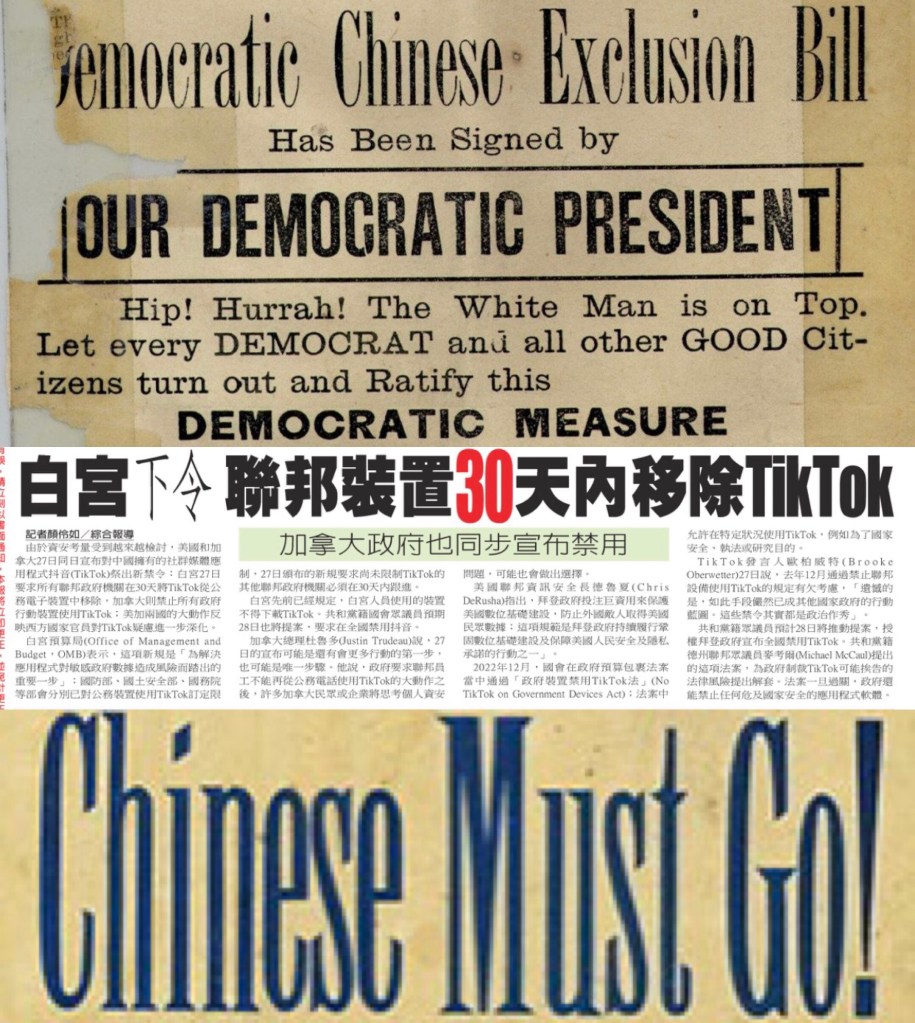
Biden reintroduced 1882 Chinese Exclusion Acts through Presidential Exclusive Order – Anything associated with Chinese is bad! Chinese must go! 拜登通過總統行政令重新引入1882年排華法案 – 凡是與華人有關的東西都是壞的! 中國人必走, 滾蛋!
Can you imagine the insanity of our government? And is there any hope there will be peace? And what is the price to destroy China?
The following is an excerpt from the Quincey Institute publications:
There are three hearings on Capitol Hill today, including the markup of a terrible bill by the House Foreign Affairs Committee Chairman on TikTok that would seemingly
1) ban all transactions with anyone that the Treasury determines knowingly provides sensitive personal information of a US citizen to a Chinese owned/controlled entity or any entity operating under the jurisdiction of China. Technically this means that if you were processing payroll records or health insurance records for a Chinese-owned corporation operating in the US your bank accounts and credit cards would be frozen. Similarly if you were using Chinese owned networked software to process any employee financial information or for communications purposes. The scope of this is dependent on various legal definitions of foreign vs US person, “knowingly”, etc. but it’s potentially quite dramatic.
2) impose the full scope of US sanctions on any foreign person anywhere in the world who uses/operates or sells/deals in any networked software application owned or even ‘influenced’ by China and that is used for any of a long list of nefarious Chinese purposes, including anything to do with their military, surveillance, or targeting audiences for “information campaigns”. Further, any foreign person who attempts to “steer” US policy or regulatory decisions in a direction beneficial to China would also be sanctioned. Any US person knowingly facilitating or assisting any of the above listed activities would also be sanctioned. The full scope of sanctions implies that bank accounts / assets / credits connected to the US financial system would be frozen.
We can’t see this becoming law as written, but it highlights the craziness of current China discourse in DC. The Ranking Democrat on the Committee (Rep. Meeks) will oppose the bill.
On top of this rapidly worsening economic decoupling, the machinery at the Pentagon has cranked up and substantial parts of the security bureaucracy seem to believe increasingly that actual war is inevitable – as indicated by the Minihan memo and the interservice competition for resources. We don’t think the White House wants war, but it is extremely difficult to move the entire national security establishment.
Professor Ling-chi Wang of US Berkeley: What can I say? We now have a 流氓政府 in all three branches of our government! I am glad the Xi Jinping government in Beijing is vigorously resisting the US attempt to impose our form of government on China and other countries and rejecting the so-called values of the Western civilization on the Chinese.
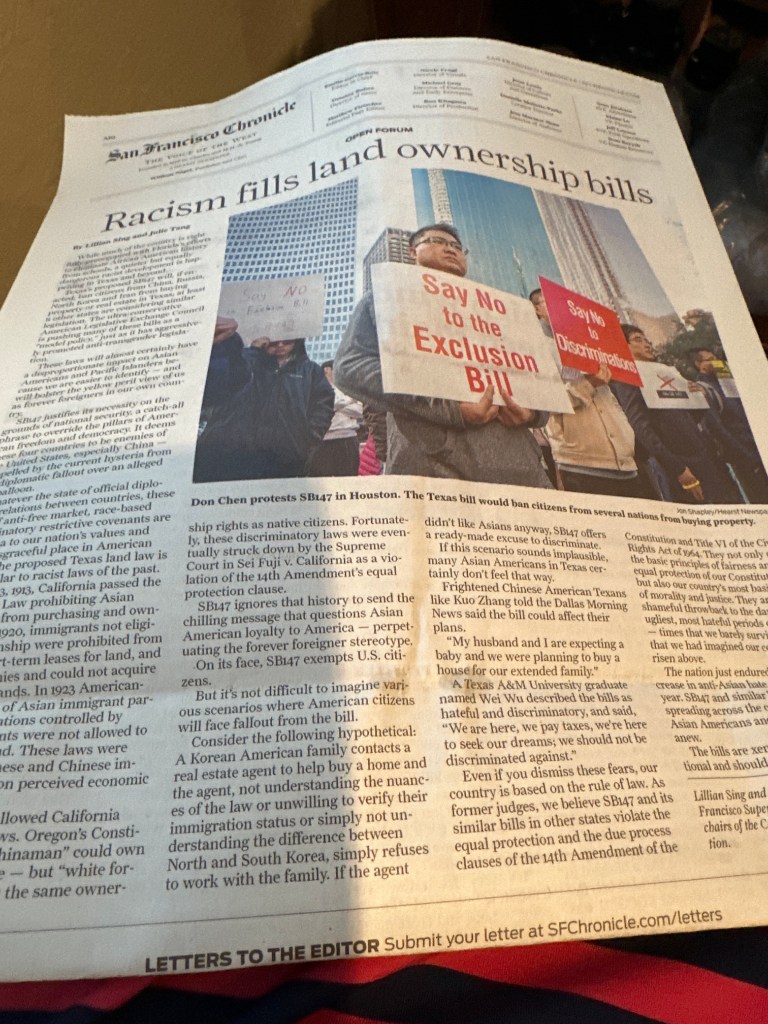
San Francisco Chronicle: While Florida targets Black history, Texas Republicans plan to make life miserable for Asian Americans 佛羅里達州針對黑人歷史,德克薩斯州共和黨人計劃讓亞裔美國人的生活悲慘 By SF Superior Court Judges Lillian Sing and Julie Tang Feb. 27, 2023
While much of the country is rightfully preoccupied with Florida’s efforts to eliminate African American history from schools, a quieter but equally dangerous racist development is happening in Texas and beyond.
Texas’s proposed SB147 will, if enacted, ban citizens from China, Russia, North Korea and Iran from buying property or real estate in Texas; at least 11 other states are considering similar legislation. The ultra-conservative American Legislative Exchange Council is pushing many of these bills as a “model policy,” just as it has aggressively promoted anti-transgender legislation.
These laws will almost certainly have a disproportionate impact on Asian Americans and Pacific Islanders because we are easier to identify — and will bolster the yellow peril view of us as forever foreigners in our own country.
SB147 justifies its necessity on the grounds of national security, a catch-all phrase to override the pillars of American freedom and democracy. It deems these four countries to be enemies of the United States, especially China — propelled by the current hysteria from the diplomatic fallout over an alleged spy balloon.
Whatever the state of official diplomatic relations between countries, these sorts of anti-free market, race-based discriminatory restrictive covenants are anathema to our nation’s values and have a disgraceful place in American history. The proposed Texas land law is eerily similar to racist laws of the past.
On May 3, 1913, California passed the Alien Land Law prohibiting Asian immigrants from purchasing and owning land. In 1920, immigrants not eligible for citizenship were prohibited from entering short-term leases for land, and stock companies and could not acquire agricultural lands. In 1923 American-born children of Asian immigrant parents or corporations controlled by Asian immigrants were not allowed to lease or own land. These laws were directed at Japanese and Chinese immigrants, based on perceived economic threats.
Fifteen states followed California creating similar laws. Oregon’s Constitution stated no “Chinaman” could own property in the state — but “white foreigners” could enjoy the same ownership rights as native citizens. Fortunately, these discriminatory laws were eventually struck down by the Supreme Court in Sei Fuji v. California as a violation of the 14th Amendment’s equal protection clause.
SB147 ignores that history to send the chilling message that questions Asian American loyalty to America — perpetuating the forever foreigner stereotype.
On its face, SB147 exempts U.S. citizens. But it’s not difficult to imagine various scenarios where American citizens will face fallout from the bill.
Consider the following hypothetical: A Korean American family contacts a real estate agent to help buy a home and the agent, not understanding the nuances of the law or unwilling to verify their immigration status or simply not understanding the difference between North and South Korea, simply refuses to work with the family. If the agent didn’t like Asians anyway, SB147 offers a ready-made excuse to discriminate.
If this scenario sounds implausible, many Asian Americans in Texas certainly don’t feel that way.
Frightened Chinese American Texans like Kuo Zhang told the Dallas Morning News said the bill could affect their plans. “My husband and I are expecting a baby and we were planning to buy a house for our extended family.”
A Texas A&M University graduate named Wei Wu described the bills as hateful and discriminatory, and said, “We are here, we pay taxes, we’re here to seek our dreams; we should not be discriminated against.”
Even if you dismiss these fears, our country is based on the rule of law. As former judges, we believe SB147 and its similar bills in other states violate the equal protection and the due process clauses of the 14th Amendment of the Constitution and Title VI of the Civil Rights Act of 1964. They not only offend the basic principles of fairness and equal protection of our Constitution, but also our country’s most basic sense of morality and justice. They are a shameful throwback to the darkest, ugliest, most hateful periods of our past — times that we barely survived and that we had imagined our country had risen above.
The nation just endured a 339 % increase in anti-Asian hate crimes last year. SB147 and similar legislation spreading across the country will target Asian Americans and Pacific Islanders anew. The bills are xenophobic, unconstitutional and should not be passed.
Lillian Sing and Julie Tang are retired San Francisco Superior Court judges and co-chairs of the Comfort Women Justice Coalition.
Message from Audrey, wife of Edward Liu: 我以為Eddie的情況會慢慢好轉的,萬萬想不到他離開得如此倉促和突然。Edward突然的辭世對我和女兒是莫大的打擊和傷心。但願上天賜我力量支撐下去。非常感謝您們的問候!您們的關心問候使我心靈得安慰,感謝萬分! 請代我感謝各位朋友的問候! (The following use Google Translate) I thought Eddie’s situation would gradually improve, but I never expected him to leave so hastily and suddenly. The sudden death of Edward was a great shock and heartbreak to my daughter and me. May God give me the strength to carry on. Thank you very much for your greetings! Your concern and greetings comfort my soul, thank you very much! Please thank all friends for your greetings on my behalf!
Exclusive: US military uses balloons, disguises recon aircraft as civilian planes to spy on China: report 獨家報導: 美軍用氣球、偵察機偽裝成民用飛機監視中國
High altitude balloons are widely used for weather surveillance by countries around the world, but the US recently created a series of “spying” dramas hyping China’s unmanned airship that went out of control, which not only built up tensions, but also seriously harmed China’s rights through the use of force. An exclusive report obtained by the Global Times on February 20 shows that the US military frequently conducted close-in reconnaissance on China, including the use of balloons, making the US the top spying country in the world.
MizarVision: In 2022, the US military carried out close-in reconnaissance operations in the South China Sea over 600 times
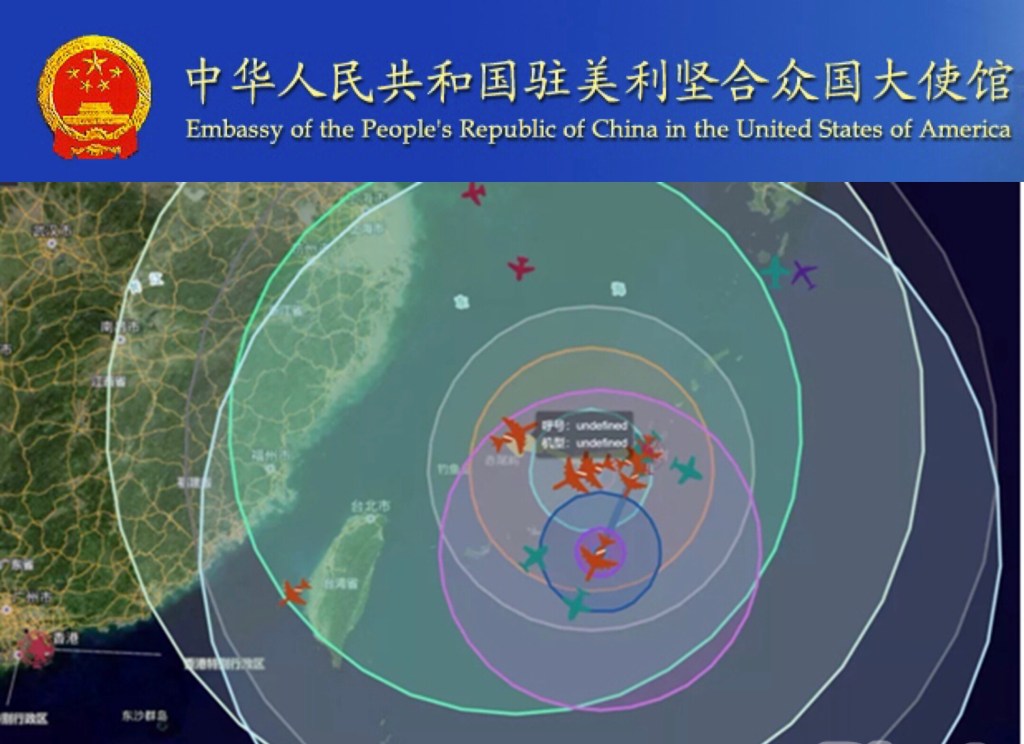
In 2022, the US military carried out close-in reconnaissance operations in the South China Sea over 600 times using spy planes, MizarVision, a Chinese technology and intelligence company, told the Global Times, citing open source Automatic Dependent Surveillance-Broadcast (ADS-B) data.
Several US military spy aircraft operate in the East China Sea and the Philippine Sea on August 9, 2022 amid PLA’s large-scale exercises around the island of Taiwan. Photo: Courtesy of MizarVision
The real figure could be higher, as some US aircraft turn off their ADS-B trackers or use fake ones, MizarVision said.
Similar close-in reconnaissance sorties also took place in the East China Sea, including in August, when the Chinese People’s Liberation Army (PLA) conducted large-scale exercises around the island of Taiwan, according to the company’s monitoring.
Frequently deployed aircraft include the EP-3E electronic signals reconnaissance plane, the P-8A maritime patrol and reconnaissance plane, the RC-135 reconnaissance aircraft, the E-8C airborne command and control plane and the U-2 high altitude reconnaissance plane, said the intelligence company.
The US military also uses other types of aircraft as well as vessels, and also disguises them as civilian airliners and commercial ships through fake identification codes and by customizing commercial aircraft into spy planes, MizarVision said, adding that such techniques have been used to spy on China’s Hainan Island and Xisha Islands in the South China Sea.
The US military has also used spy balloons, including in an exercise with the Philippines in the Bashi Channel from March to April 2022. Made of polyethylene plastic, the balloon can be used for communications, navigation and remote sensing for more than 45 days at a time, according to MizarVision.
High-altitude balloons for scientific research activities are widely used, it is impossible that the Chinese balloon was used for “high altitude reconnaissance”
But it is a normal practice to use balloons for scientific research purposes.
The World Meteorological Organization on Friday said that weather balloons have been a vital part of the global observation network over the past decades, serving as bases for weather forecasts and climate surveillance. Some 1,000 weather balloons carrying radio detectors send data every day.
Using high altitude balloons for scientific research activities has become an international norm, with data from the China Science Daily showing that by 2018, the US had released more than 2,000 high altitude balloons, France around 3,000, and Japan more than 800.
With technological advances, balloon activities by scientific research organizations and companies around the world are becoming more frequent, which also makes cross-border flights more frequent, including those from the US. When such incidents happen, they are often solved through dialogues.
Resolving a problem peacefully is a key principle of the UN Charter, shooting down Chinese unmanned airships violates international law and norms
But this time, when China’s civilian weather scientific research airship accidentally drifted into the US, it disregarded facts and China’s friendly communication, took the chance for political manipulation and ill-intended hype, and accused China of using the balloon for “spying” purposes.
A source close to the Chinese military told the Global Times that it is impossible that the Chinese balloon was used for “high altitude reconnaissance,” as even Pentagon officials and US experts said satellites would do a better job than a balloon for military reconnaissance.
The source said that the current political atmosphere in the US does not respect professionalism and common sense, as it intentionally creates anti-China stunts.
The US is conducting so-called analyses on the balloon’s payload, and these results could be faked to further throw mud at China, said the source.
Zhu Yaochun, deputy secretary-general of the China Air Transport Association, told the Global Times that the US’ shooting down of the Chinese airship using a fighter jet and missile was an obvious overreaction and does not conform to international law and norms.
In international practice, civilian unmanned aircraft that accidentally enter another country’s airspace should be escorted, warned, expelled or forced to land, as resolving a problem peacefully is a key principle of the UN Charter, Zhu said.
According to international law, the illegality of an unmanned aircraft entering another country’s airspace without authorization can be exempted in the event of force majeure, danger or emergency evasion, Zhu pointed out.
By contrast, the US is conducting real military reconnaissance on China using technologies including balloons.
The purpose of this kind of close-in reconnaissance is to gather intelligence on the PLA’s maritime activities, including those by nuclear-powered submarines, collect electronic information that could decipher the PLA’s communications and grasp radar information, learn China’s defense facilities by using optical and radar devices, as well as understand the PLA’s warplane sortie patterns and reaction times, which serve the US’ hegemonic aims, observers said.


 Business Blog