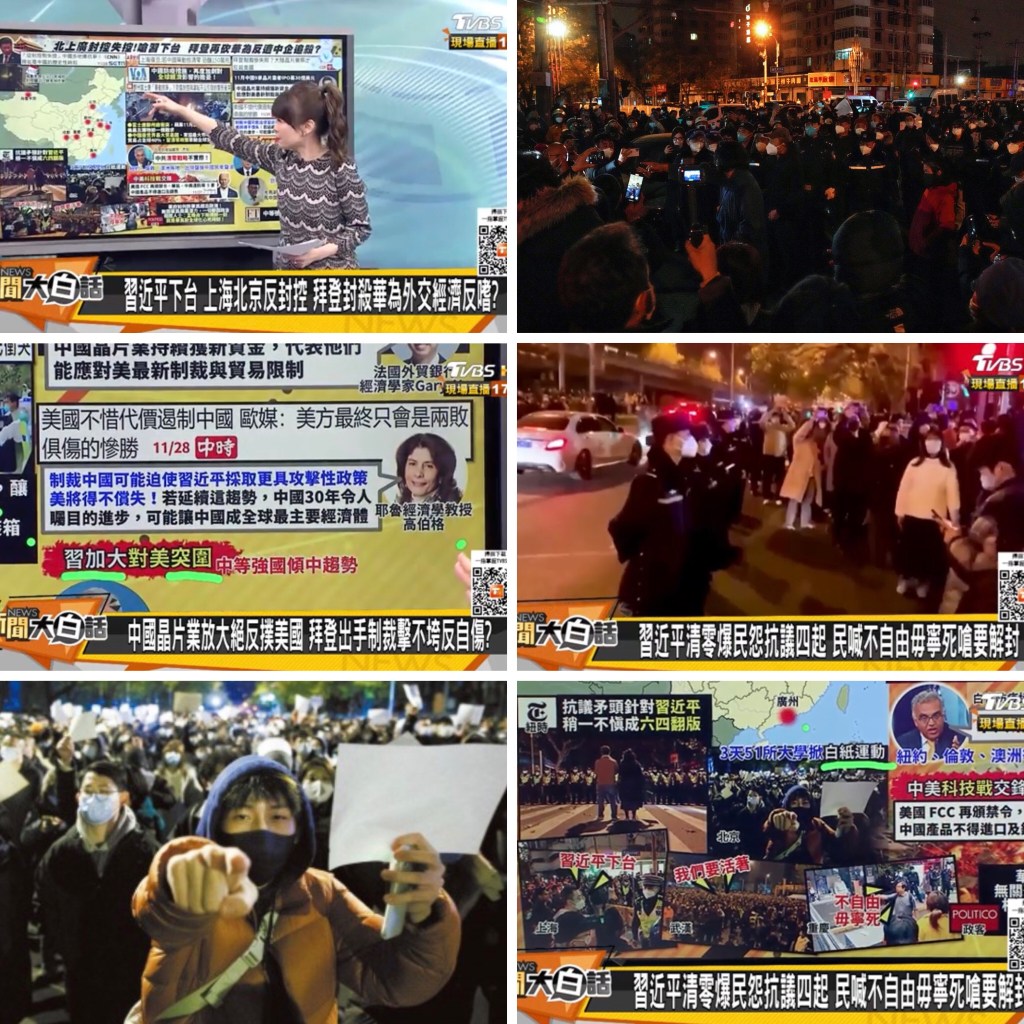
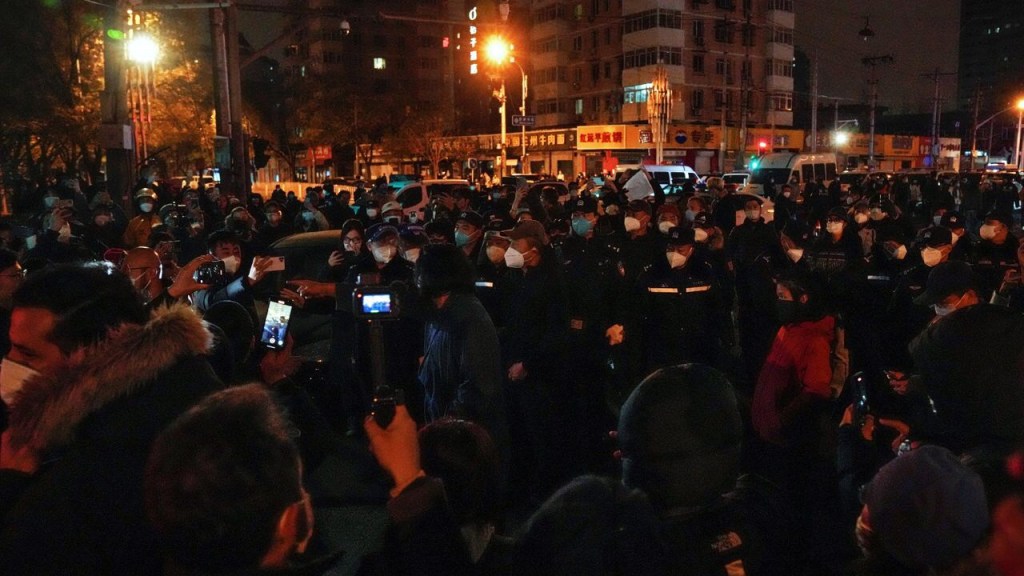
The Western media and various commentators on Chinese social media assert that barricades set up due to lockdowns prevented firefighters from reaching the building in time. But these claims are contradicted by the fact that the obstructing bollards—vertical posts that serve as traffic barriers—were erected years before the pandemic. Claims that residents were not allowed to evacuate are also contradicted by videos showing residents fleeing the building. Moreover, the district where the fire took place was not under a strict lockdown at the time.
The Western media and various commentators on Chinese social media assert that barricades set up due to lockdowns prevented firefighters from reaching the building in time. But these claims are contradicted by the fact that the obstructing bollards—vertical posts that serve as traffic barriers—were erected years before the pandemic. Claims that residents were not allowed to evacuate are also contradicted by videos showing residents fleeing the building. Moreover, the district where the fire took place was not under a strict lockdown at the time.
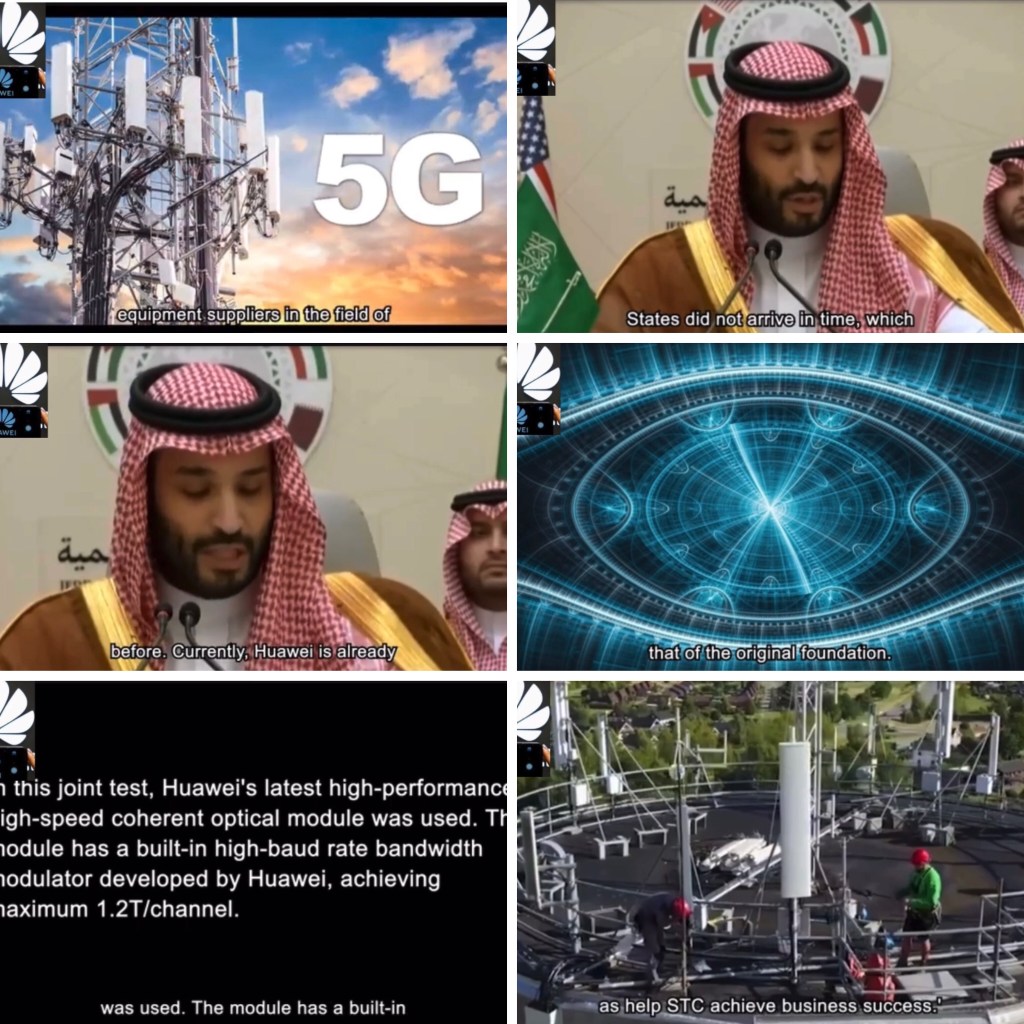
Another top technology was born! Saudi Arabia’s strong support has helped Huawei achieve a new breakthrough! After the birth of cutting-edge 5G technology, Huawei was known to the world. However, the outstanding cell phone business has always made Huawei be mistaken as a cell phone manufacturer, but in fact, its main business is communication business, which has already occupied a large share of the market in Europe and America in the 4G era.
Huawei has successfully surpassed Europe and the United States in the 5G era, becoming the only manufacturer that can achieve end-to-end deployment, leaving Nokia, Ericsson, Qualcomm and other established giants behind, but this has also triggered a series of policy adjustments in the United States.
In addition, those countries that trust Huawei have taken the lead in the layout of the new era. Saudi Arabia’s strong support has also allowed Huawei to accelerate its digital transformation and complete the world’s first 1.2T/channel test. So, what does technology mean?
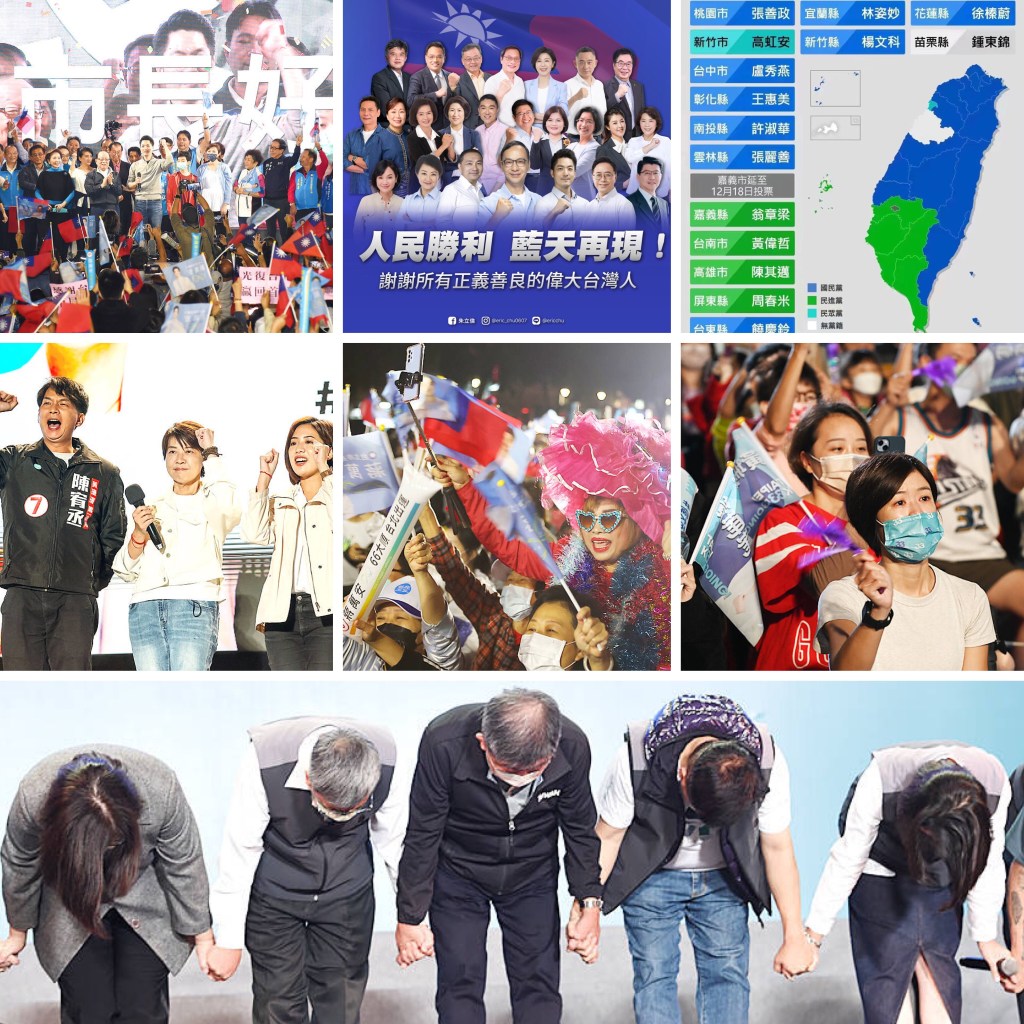
Former Minister of Health, Chen Shih-chung (陳時中), responsible for Taiwan island’s covid policy, ran for the Mayor of Taipei, and was thoroughly trounced. By KJ of SF Bay Area China Group 11/26/22
So much for the much-vaunted, super-successful”Taiwan Covid policy” that the Western MSM likes to brag about. The voters didn’t think much of Taiwan’s Antony Fauci and his Covid “successes”–that only the Western press seems to have discerned–and sent him packing. https://www.taipeitimes.com/News/taiwan/archives/2022/11/27/2003789683
Voters in Taiwan overwhelmingly chose the opposition Nationalist party in several major races across the self-ruled island in an election in which lingering concerns about threats from China took a backseat to more local issues. Translation: Voters ignored DPP threat inflation or rejected it
Tsai will finish her term in 2024, but she is seriously hobbled. It’s hard not to see this as a referendum on her China-baiting “independence” policy, her hosting of Pelosi, her alignment with Ukrainian fascism (see below), her “Southbound strategy” (which has resulted in the enslavement of thousands of Taiwanese in SEA), and her selling out the crown jewels of TSMC to the US (that the founder of TSMC opposed).
“…Kuomintang (KMT) stomped home to victory in local elections on Saturday as President Tsai Ing-wen’s efforts to frame the vote as being about showing defiance to China’s rising bellicosity failed to pay off.
The KMT was taking the lead or claimed victory in 13 of the 21 city mayor and county chief seats up for grabs, including the capital Taipei, compared to the DPP’s five, broadly in line with expectations and similar to the results of the last local elections in 2018.
The elections for mayors, county chiefs and local councillors are ostensibly about domestic issues such as the COVID-19 pandemic and crime, and those elected will not have a direct say on China policy. But Ms Tsai, who leads the ruling Democratic Progressive Party (DPP), had recast the election as being more than a local vote, saying the world is watching how Taiwan defends its democracy amid military tensions with China, which claims the island as its territory.” https://www.sbs.com.au/news/article/taiwan-president-tsai-ing-wen-resigns-as-party-leader-over-election-results/buhkxtom8
President Bush, Madam First Lady, distinguished speakers and guests. Ladies and gentlemen, good morning. I would like to begin my talk by thanking the George W. Bush Institute, the National Endowment for Democracy, and Freedom House for inviting me to speak at this important event on the threats freedom faces, and how we can advance liberty worldwide.
Just a couple of weeks ago, in recognition of the unprecedented challenge facing democracy and its advocates, Taiwan hosted the 11th Global Assembly of the World Movement for Democracy. With our partner, the National Endowment for Democracy, we welcomed more than 200 advocates of democracy, some of whom have devoted their lives to this work, and others who have recently started careers advancing this cause. These supporters of democracy make connections and strategized on how we all can work together better to make democracy stronger and more resilient.
At this Global Assembly, we had the special honor of welcoming parliamentarians and members of civil society from Ukraine. I had the pleasure of meeting them and of speaking to them in person. They came not only with stories of courage, but also with warnings. Though he was held back by the war, Chairman Oleksandr Merezhko of the Ukrainian Parliament’s Foreign Affairs Committee still appeared online at the Assembly to share his assessment that, “The grand strategy of authoritarian regimes is to divide and destroy democracies one by one.” He also summed up the response that we must adopt, that is, “The rallying cry from all democracies must be one for all and all for one.”
In addition, this past August, Taiwan organized the Regional Religious Freedom Forum. Participants from across the Indo-Pacific shared their stories and advocacy experiences, and discussed how to secure the right to practice one’s faith at a time when religious freedom around the world is being curtailed by authoritarian powers.
These recent events are just part of why I am very pleased to see Mr. Wilson, Dr. Twining, Mr. Abramowitz, and Mr. Turkel among the speakers at this important gathering on the global struggle for freedom. Their presence at this conference can serve as an inspiration to our existing collaborations. I hope you all can learn from their experiences in Taiwan while you formulate ways to push back against authoritarian threats and utilize “technology to secure the future of freedom”.
I want to reiterate here that this conference on the world’s struggle for freedom could not have convened at a more significant time, as democracies and the rules-based international order are being challenged on a daily basis. As we work to resolve the lingering effects of the pandemic on the global economy and health, the fluid political situation in many countries around the world have only added to the already long list of challenges before us.
The dangerous potential of authoritarian regimes to corrode democratic institutions and tarnish human rights and civic space cannot be ignored. Russia’s unprovoked invasion of Ukraine serves as a prime example. This war is proof that dictatorships will do whatever it takes to achieve their goal of expansionism.
Regretfully, the Taiwanese people are very familiar with such aggression, and we have our own experience with the struggle for freedom. Only about three decades ago, members of civil society in Taiwan took to the streets. They protested and advocated for the lifting of martial law. They asked for more political and social rights for the citizens, and they advocated for the democratization of Taiwan. At the heart of this struggle was the embrace of democracy, a choice that the Taiwanese people fought for after decades of authoritarian rule. And once the Taiwanese people took this path, there was no turning back.
In recent years, the beautiful island we call home has been confronted by increasingly aggressive threats from our authoritarian neighbor, the People’s Republic of China. From daily military intimidations, gray zone activities, and influence operations, to cyber attacks and periodic attempts at economic coercion, China has taken a range of actions with the goal of creating doubt and undermining confidence in what the Taiwanese people have worked so diligently for, that is, our democratic way of life.
But the people of Taiwan continue to meet these persistent threats with calm and composure. And the Taiwanese people have never shied away from utilizing their skills and expertise to counter authoritarian interference. For Taiwan, democracy is more than a fundamental value that unites our people; it is also a critical asset in addressing major challenges. Taiwan is now in the position to share its experience with the world and create alliances, allowing democracies to more effectively deal with crises, and counter the threats of authoritarianism.
As we observe Russia’s illegal invasion of Ukraine from the other side of the world, Taiwan has been honored to play a role in assisting Ukraine in its struggle to defend its sovereignty and freedom. Together with like-minded partners, we will also make efforts to support Ukraine’s reconstruction of its schools, hospitals, and infrastructure that have been destroyed by the war.
Our efforts must not stop here. The menacing behavior of authoritarian regimes should be a wake-up call to all democracies. We must work together to strengthen our resilience and safeguard our values. But we can only achieve this goal with ample understanding of authoritarian tactics. That is why I’m pleased to learn that the George W. Bush Institute is already tackling important tasks such as combating disinformation, reducing corruption that fuels authoritarian governments, supporting civic renewal, and advancing human rights as national security.
With all these ongoing efforts, we can now work together on countering and reducing influence exerted by authoritarian regimes worldwide. We must also strengthen the alliance of democracies to safeguard and serve the interests of the international community. I know there is an important panel in this conference on how the United States can help support democracy and human rights. US administrations and members of Congress have always been staunch supporters of Taiwan’s democratization and the democratic institutions we now enjoy. I hope Taiwan, along with the US, can now lend its support to those struggling to advocate for democracy and human rights in other countries. Before I conclude, I want to take this opportunity to thank the United States for its unwavering support for Taiwan, and thank the U.S. Congress for passing legislation to help ensure Taiwan’s security. Of course, I also want to thank President Bush and the George W. Bush Institute, the National Endowment for Democracy, and Freedom House for the invitation to speak. As Ukrainian parliamentarian Kira Rudik told us why she was in Taiwan, she said, “History is teaching us over and over again that unpunished and unremedied evil deeds will return.” Let us work together to ensure that the expansionist deeds of authoritarian states neither flourish nor return. Thank you very much.
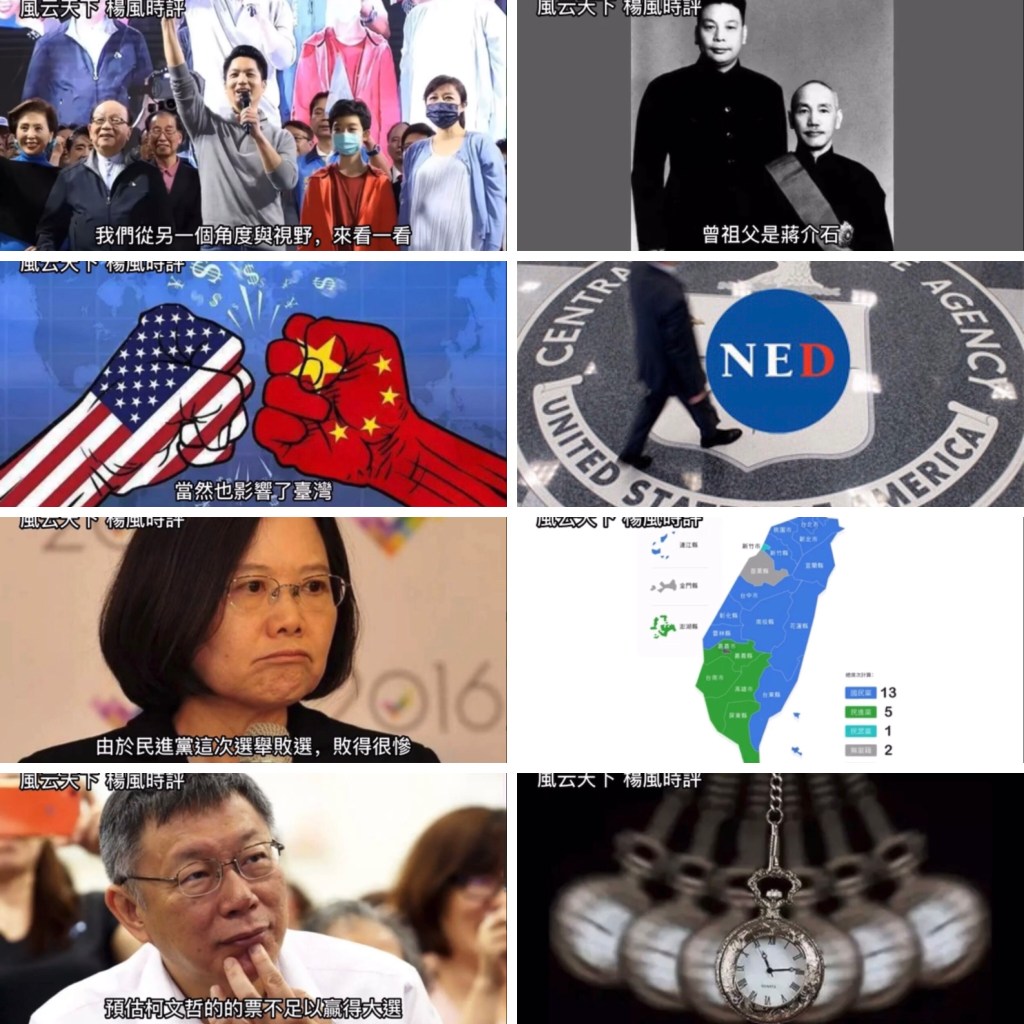
Professor Ling-Chi Wang of UC Berkeley: Even Tsai Ing-wen and Joe Biden are not on the ballot in Taiwan’s local elections yesterday, they are the biggest losers. The candidates of Tsai, as the chair of Taiwan’s ruling Democratic Progressive Party (DPP), in the county and city elections, campaigned uniformly on Tsai’s slogan, 抗中护台, oppose China and defend Taiwan, and in the final weeks of the campaign, Tsai vigorously and repeatedly declared that voting for the KMT candidates meant voting for Xi Jinping. In other words, she turned the elections into a referendum on herself against Xi and urged the voters to overwhelmingly reject Xi and China. She was following the marching order from Washington, DC: President Biden, the U.S. Congress, and the mainstream media in the U.S. that China was the most serious threat to Taiwan, the U.S., and the world, a fiction they concocted to demonize and generate fearing hatred of Mainland China and Xi Jinping.
Well, they were wrong: they misread the sentiment and perception of the voters in Taiwan; they drank the poisonous coolaide or medicine they concocted and they suffered the inevitable consequences.
A word of caution: On the surface, the KMT appeared to be the winner of the political landslide. Being badly divided, we still don’t know how the KMT will emerge as the ruling party and who will be the candidate for the presidency of Taiwan province in two years. The KMT for sure will reaffirm the 1992 Consensus between the Mainland and Taiwan. Exactly how to interpret of Consensus is very much disputed. Besides, howt the U.S. will manage and run Taiwan, regardless who is running the island, is still unknown. I hope the people in Taiwan, especially the KMT party, will learn from the outcomes of the elections and try to manage their relations with the Mainland in their best interest: engage with the Mainland based on the principles of the Consensus.
US backed separatist planning to turn Taiwan into Ukraine rejected by voters, a huge setback for the Americans, Taiwan president resigns as party leader after election loss 美支持台獨蔡英文謀劃把台灣變成烏克蘭 遭選民否決 美國嚴重受挫 蔡英文敗選辭去黨魁 11-26-22
TAIPEI, Taiwan (AP) — Taiwan President Tsai Ing-wen resigned as head of the ruling Democratic Progressive Party following local election losses on Saturday suffered by her party.
Voters in Taiwan overwhelmingly chose the opposition Nationalist party in several major races across the self-ruled island in an election in which lingering concerns about threats from China took a backseat to more local issues.
Tsai had spoken out many times about “opposing China and defending Taiwan” in the course of campaigning for her party. But the party’s candidate Chen Shih-chung, who lost his battle for mayor of Taipei, only raised the issue of the Communist Party’s threat a few times before he quickly switched back to local issues as there was little interest, experts said.
Tsai offered her resignation on Saturday evening, a tradition after a major loss, in a short speech in which she also thanked supporters.
US backed separatist planning to turn Taiwan into Ukraine rejected by voters, a huge setback for the Americans, Taiwan president resigns as party leader after election loss 美支持台獨蔡英文謀劃把台灣變成烏克蘭 遭選民否決 美國嚴重受挫 蔡英文敗選辭去黨魁 11-26-22
TAIPEI, Taiwan (AP) — Taiwan President Tsai Ing-wen resigned as head of the ruling Democratic Progressive Party following local election losses on Saturday suffered by her party.
Voters in Taiwan overwhelmingly chose the opposition Nationalist party in several major races across the self-ruled island in an election in which lingering concerns about threats from China took a backseat to more local issues.
Tsai had spoken out many times about “opposing China and defending Taiwan” in the course of campaigning for her party. But the party’s candidate Chen Shih-chung, who lost his battle for mayor of Taipei, only raised the issue of the Communist Party’s threat a few times before he quickly switched back to local issues as there was little interest, experts said.
Tsai offered her resignation on Saturday evening, a tradition after a major loss, in a short speech in which she also thanked supporters.
Bye-bye, Kiev, hello Cote d’Azur: As Westerners send aid to support US proxy war against Russia in Ukraine here’s how Ukraine’s corrupt elites are profiting from the conflict. Nov 24. 2022
Officials and oligarchs have diverted much of the financial support sent to Kiev
Since the beginning of Russia’s military offensive in Ukraine, the US, EU, and their allies have provided Kiev with $126 billion worth of aid, a number almost equal to the country’s entire GDP. Moreover, millions of Ukrainians have found refuge in the EU, where they were given housing, food, work permits, and emotional support. The scope is huge, even by Western standards. Considering that the bloc has been funding Kiev while coping with an economic and energy crisis of its own, the assistance is perhaps especially notable.
Kiev bases its endless funding requests on the collapse of its economy, due to the war, and its need to “resist Russian aggression.” But is the aid reaching its intended destination?
The Monaco Battalion While Ukraine has undergone a general mobilization affecting all men under the age of 60, many former and current high-ranking officials, politicians, businessmen, and oligarchs have moved to safety abroad – mainly to the EU.
The mass flight of Ukrainian elites started even prior to the armed conflict. On February 14, 2022, 37 deputies from the Ukrainian president’s parliamentary faction (Servant of the People) suddenly went missing. Had MPs not been banned from leaving the country the very next day, others would have definitely joined them. Meanwhile, former officials and oligarchs enjoyed more freedom to move around. According to the Italian newspaper La Repubblica, 20 business jets took off from Kiev’s Boryspol airport on the 14th as well.
Tycoons were at the front of the line. Entrepreneur and MP Vadim Novinsky, businessmen Vasily Khmelnitsky and Vadim Stolar, Vadim Nesterenko, and Andrey Stavnitzer all left the country on charter flights. Millionaire politician Igor Abramovich booked a private flight to Austria for 50 people – taking relatives, business partners, and fellow party members aboard. Oligarchs flew from Kiev to Nice, Munich, Vienna, Cyprus, and other EU destinations. Another group of businessmen took off from Odessa on private planes. The owner of Vostok Bank departed for Israel, while the head of the Transship group flew to Limassol. An ex-governor of the Odessa region, Stalkanat’s Vladimir Nemirovsky, also left the country.
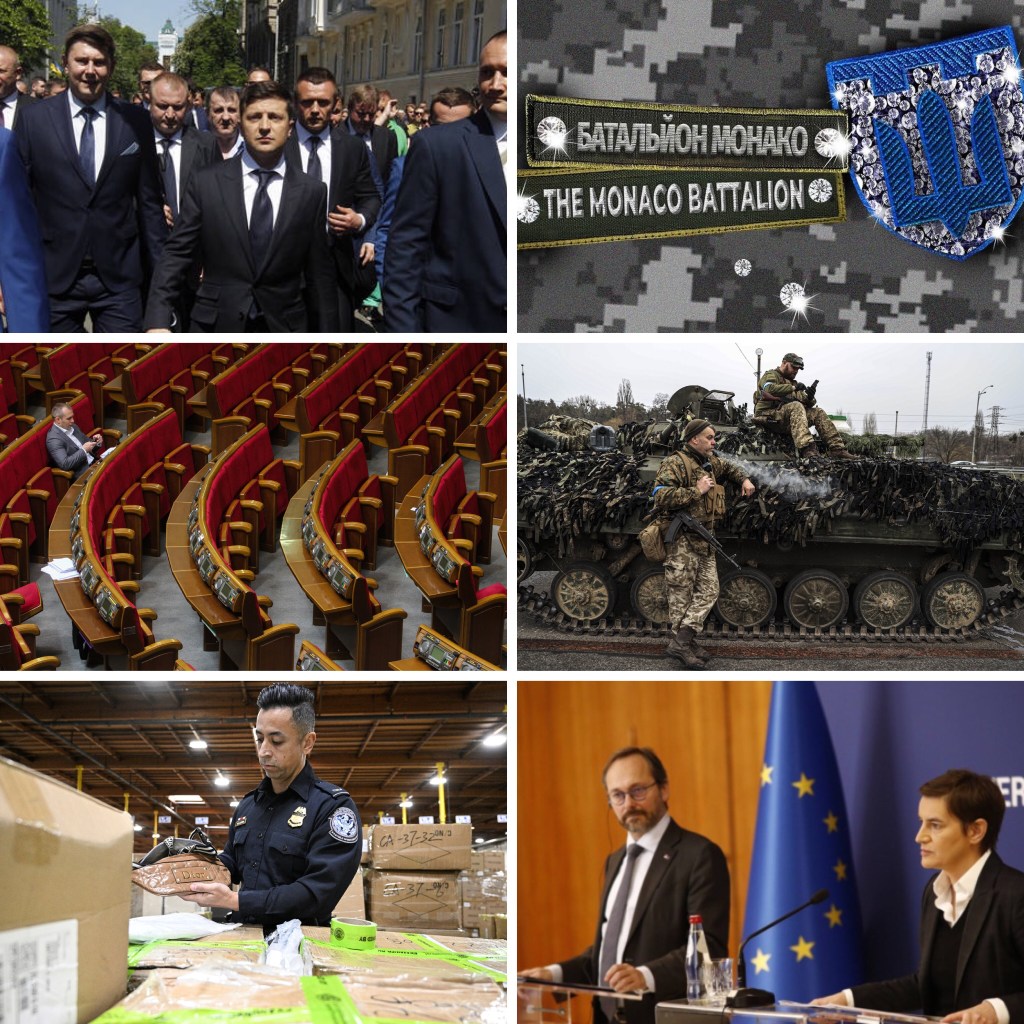
In the summer and early fall of 2022, Ukrainska Pravda prepared several investigative documentaries about fit-for-service Ukrainian billionaires and officials spotted vacationing on the Côte d’Azur during the war. A movie with the ironic title ‘The Monaco Battalion’ shows Ukrainian oligarchs resting at their villas, mansions, and on yachts. In the first part, we see businessman Konstantin Zhevago, who is included on Interpol’s wanted list, relaxing on his private yacht worth $70 million. The yacht graces the shoreline of the Côte d’Azur as Zhevago’s family disembarks. Kharkov entrepreneur Alexander Yaroslavsky, who promised to sell his yacht and transfer the funds towards the restoration of Kharkov, can be seen sailing alongside.
Ukrainska Pravda journalists also got a glimpse of the Surkis brothers in France, who are currently renting apartments worth €2 million per year. Meanwhile, a $300,000 Bentley belonging to Ukrainian businessman Vadim Ermolaev was spotted near the casino in Monaco, and Eduard Kohan, the co-founder of Euroenergotrade, was seen at one of Monte Carlo’s chic hotels.
A whole colony of Ukrainian oligarchs has apparently taken up residence in the elite French commune of Cap-Ferrat. Land developer Vadim Solar, oligarchs Dmitry Firtash, Vitaly Khomutynnik, and Sergey Lovochkin are among those enjoying high life in the middle of the war. The Cap-Ferrat villa once belonging to King Leopold II of Belgium was bought by the richest Ukrainian oligarch Rinat Akhmetov. His neighbors are Alexander Davtyan, president of the Investment Group DAD LLC, and Vladislav Gelzin, a former deputy of the Donetsk Regional Council.
As the creators of the film repeatedly emphasize, deputies and businessmen of “pro-Russian” parliamentary factions left the country during the war. Yet many active supporters of the current government also prefer to defend their homeland from abroad.
Ukrainska Pravda managed to interview Andrey Kholodov, an MP from Vladimir Zelensky’s Servant of the People party, from his current residence in Vienna. The Austrian capital was also chosen by nationalist Nikita Poturaev and Sergey Melnichuk, a former head of the Aidar battalion known for war crimes reported by Amnesty International. The former head of the Constitutional Court of Ukraine, 59-year-old Alexander Tupitsky, and 45-year-old ex-prosecutor general of Ukraine Ruslan Ryaboshapka also preferred foreign ‘trenches’.
Members of the Ukrainian parliament are in no hurry to adopt vitally important laws for the country during wartime. According to the Telegram channel Volyn News, as of March 11, more than 20 MPs had moved abroad for unspecified reasons. The geography is extensive: Great Britain, Poland, Qatar, Spain, France, Austria, Romania, Hungary, UAE, Moldova, Israel, etc. In March, the Prosecutor General’s Office of Ukraine launched an investigation into the actions of six parliamentarians who have remained abroad.
Apparently, neither war nor punishment can put Ukrainian legislators to work. Only 99 deputies out of 450 attended the session of the Parliament on July 20. Presumably distracted by summer, the Côte d’Azur, the Maldives, and yachts… As for defending Ukraine itself – just leave it to the foreign volunteers, they say.
Where’s all the military and humanitarian aid going? Some Western benefactors have recently noticed that most of the military and humanitarian aid never reaches Ukraine’s army or ordinary citizens.
In an original documentary, CBS reported that about 70% of military aid failed to find its way to the intended beneficiaries and donor countries are often unable to control its intended use. According to the creators of the report, some of the weapons are sold on the black market. As US Marine Corps veteran Andy Milburn said, “I can tell you unarguably that on the frontline units these things are not getting there. Drones, Switchblades, IFAKs. They’re not, alright. Body armor, helmets, you name it.”
The Grayzone writes that weapons and humanitarian aid provided by the West to the Ukrainian military is being stolen along the way and never reaches the soldiers. At the same time, Ukrainian MPs recently gave themselves a 70% pay raise. The author of the piece argues that billions of dollars from the US and the EU have been diverted.
A Ukrainian soldier named Ivan told journalists about Western funds never reaching the front: “Imagine telling an American soldier that we are using our personal cars in the war, and we’re also responsible for paying for repairs and fuel. We’re buying our own body armor and helmets. We don’t have observation tools or cameras, so soldiers have to pop their heads out to see what’s coming, which means at any moment, a rocket or tank can tear their heads off.”
Samantha Morris, a medical doctor from the US, drew attention to the theft of medical supplies and the overall corruption: “The lead doctor at the military base in Sumy has ordered medical supplies from and for the military at different points in time, and he has had 15 trucks of supplies completely disappear,” she said. The doctors couldn’t even set up courses for medical assistants until a friend of the Sumy Region governor interceded.
CNN talked to a retired US colonel who said that Ukrainian troops are short on supplies. Small arms, medical equipment, field hospitals, and a lot more are under the control of private organizations – more concerned about stealing money than saving the lives of their compatriots.
As Stephen Myers, a former member of the US Department of State Advisory Committee on International Economic Policy, insisted, “There is little to prevent a field commander from diverting some of the equipment to buyers, aka the Russians, the Chinese, the Iranians or whomever, while claiming the equipment and weapons were destroyed…”
Thousands of tons of humanitarian aid is being stolen. In September, the National Anti-Corruption Bureau of Ukraine (NABU) proved that the head of the Office of the President, Andrey Yermak, his deputy Kirill Tymoshenko, the head of the Servant of the People party, David Arakhamiya, and his friend Vemir Davityan were behind the large-scale theft of humanitarian aid in Zaporozhye Region. Zaporozhye officials Starukh, Nekrasova, Sherbina, and Kurtev only superficially carried out the task of distributing aid. In six months, they organized the theft of 22 sea containers, 389 railway cars, and 220 trucks. Humanitarian aid was sold in ATB and Selpo – supermarkets owned by Gennady Butkevich and Vladimir Kostelman, respectively. Of course, Tymoshenko, Nekrasova and Davityan all became ‘refugees’ and found asylum in Vienna.
Admittedly, not everyone is on the run. Andrey Yarmolsky, the scandalous former deputy head of the Volyn regional administration – accused of stealing humanitarian aid, supplying defective bulletproof vests, and illegally moving men out of the country – was promoted. He now works for the National Security and Defense Council.
Medical supplies are also being stolen. The Telegraph reportsthat “some of the donated supplies later made their way onto the hospitals’ pharmacy shelves: priced, and listed for sale.” Health workers appropriate medicine, bandages, and medical equipment, and resell them to patients for whom they were intended to be free, the article says.
A similar story was told by the aforementioned doctor Dr. Morris: “I got a call from a nurse at a military hospital in Dnipro. She said the president of the hospital had stolen all the pain medications to resell them, and that the wounded soldiers being treated there had no pain relief. She begged us to hand-deliver pain medications to her. She said she would hide them from the hospital president so that they’d reach the soldiers. But who can you trust? Was the hospital president really stealing the medications, or was she trying to con us into giving her pain medications for her to sell or use? Who knows. Everyone is lying.”
War for some, Gucci for others Enormous cash flows from Western countries are continuously used by corrupt Ukrainian officials for personal enrichment and to acquire luxury goods.
In a recently busted corruption scheme, Odessa customs smuggled shirts, backpacks, sports shoes, belts, and other luxury items by Givenchy, Gucci, Polo, Dolce & Gabbana, Michael Kors, Chanel, Louis Vuitton, and Armani under the guise of army equipment. The documents, declaring the cargo as “for the needs of the Armed Forces of Ukraine,” were signed by the acting head of the Odessa customs, Vitaly Zakolodyazhny. According to MP Aleksandr Dubinsky, this is a common theft scheme. “The work of the customs is unsatisfactory because while some are fighting at the front, others are making money under the guise of their customs uniforms,” the parliamentarian said.
To take another example, in May 2022, Western countries abolished customs duties for Ukraine. Within a week, over 14,000 passenger cars were imported into the country. As the deputy minister of infrastructure, Mustafa Nayem, commented, “Considering we’re a country at war, our partners in Poland, Slovakia, and Romania were quite surprised by this fast-paced upgrade to our vehicle fleet.”
As they go about acquiring luxurious clothes and cars, the thieves are also taking care to withdraw capital from Ukraine.
According to the Bureau of Economic Security of Ukraine, Ukraine’s budget is missing UAH 4.5 billion worth of taxes from agrotraders: “In August-September 2022, almost 12 million tons of grain crops and oil estimated at UAH 137 billion were exported through the customs territory of Ukraine. Of these, almost 4 million tons were exported by fake companies existing only on paper.” Moreover, “most of the non-resident companies to which grain is exported are high-risk and involved in criminal investigations.” Is this the ‘grain deal’ that the global community is actively cheering? It looks like Ukrainian fraudsters are corrupting not just their own country, but foreign states as well. And this is just one example out of many.
When the Surkis brothers left Ukraine, they took $17 million with them. But that’s just a trifle compared to the ‘heroes of the Euromaidan’. According to former People’s Deputy of Ukraine Oleg Tsarev, after the outbreak of hostilities, leading Ukrainian politicians sent both their capital and their families abroad.
He mentions that the parents and relatives of Zelensky and his wife all left the country. His predecessor, former President Pyotr Poroshenko, moved not just his children but also about a billion US dollars in cash to the UK.
The same applies to other major Ukrainian officials: former Minister of Internal Affairs Arsen Avakov, the head of the Office of the President, Andrey Yermak, the second president of Ukraine, Leonid Kuchma, former Prime Minister Arseny Yatseniuk, and many others all took their families and fortunes, estimated at around a billion dollars, out of the country. And that’s not to mention the numerous politically-affiliated oligarchs.
Scammers of smaller stature can “individually join the EU” as well. A system of bribery allows military-age males to leave the country. According to Izvestia, the fee is currently between $8,000 and $10,000. The Ukrainian media also actively reports on people paying to cross the border.
The sympathy of Westerners towards a country at war is understandable. But while some countries are doing their utmost to aid Ukraine – even while facing an economic crisis themselves – corrupt Ukrainian officials are using the funding to amass personal fortunes and live the high life at fancy resorts. And all at the expense of taxpayers in the West.
In 2015, Arseny Yatseniuk, upon leaving the post of the prime minister, openly declared that he had become a billionaire. It is yet to be seen how many new Ukrainian super rich tycoons – nurtured by foreign military aid – will appear in the West by the end of the conflict.

 Business Blog