Video: Highlights from Xi’s speech at G20 Summit 習近平在G20峰會上的講話要點
https://rumble.com/v1v0tt2-highlights-from-xis-speech-at-g20-summit.html
https://m.facebook.com/story.php?story_fbid=834753824414611&id=100036400039778
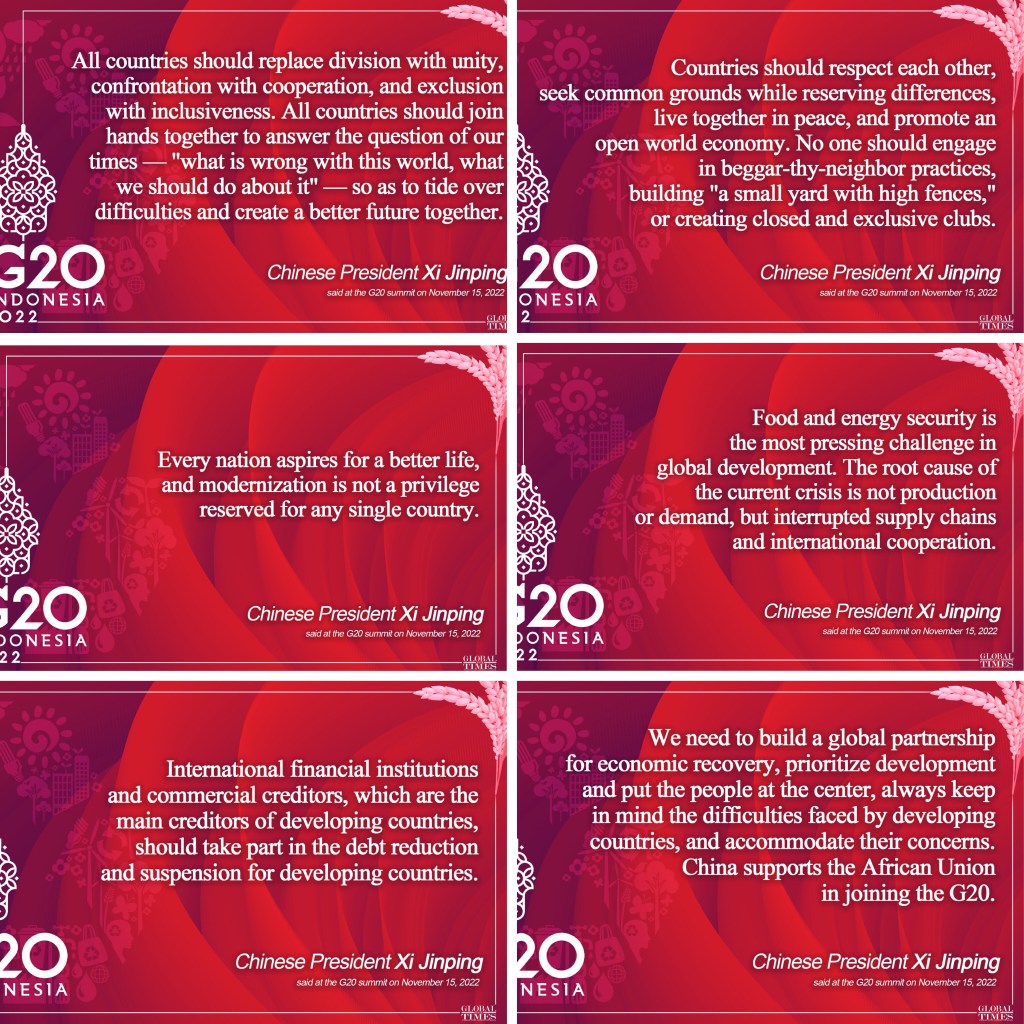
Video: Highlights from Xi’s speech at G20 Summit 習近平在G20峰會上的講話要點
https://rumble.com/v1v0tt2-highlights-from-xis-speech-at-g20-summit.html
https://m.facebook.com/story.php?story_fbid=834753824414611&id=100036400039778
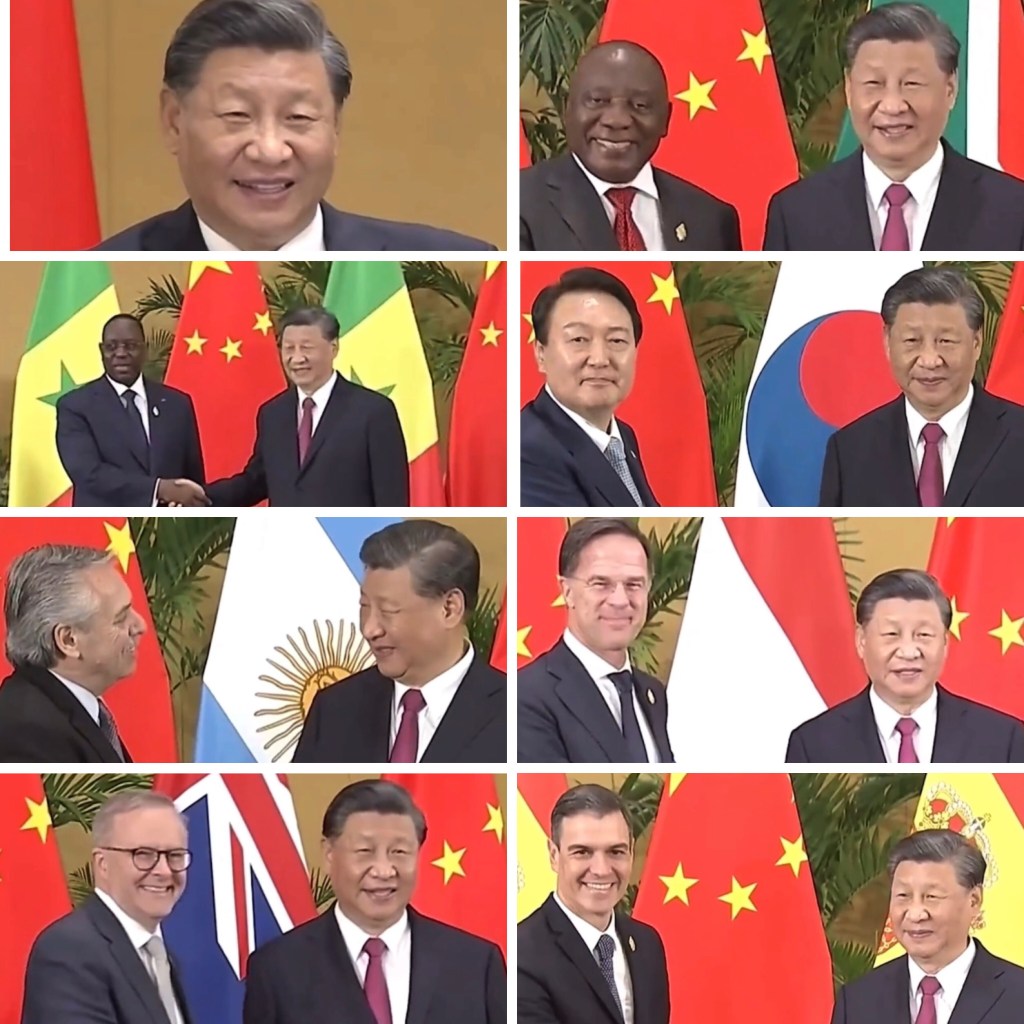
Video: A very confident President Xi Jinping 非常自信的習近平主席
https://rumble.com/v1v0msa-a-very-confident-president-xi-jinping.html
https://m.facebook.com/story.php?story_fbid=834728251083835&id=100036400039778
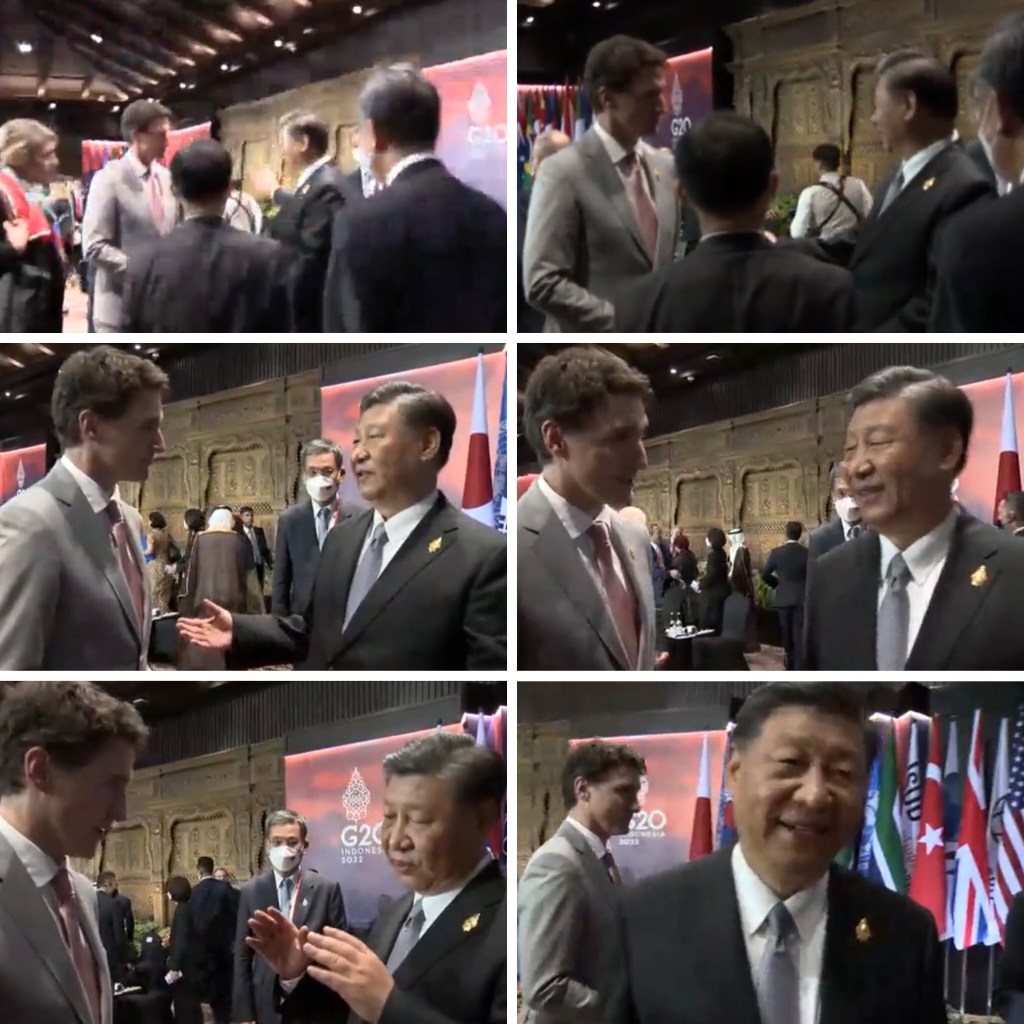
Video: Xi Jinping confronted Canadian Prime Minister at G20 and scolded him that he disclosed their private discussions to news media not appropriate. 習近平面斥加國總理披露交談內容:「這不合適啊!」
https://rumble.com/v1uzaec-xi-jinping-confronted-canadian-prime-minister.html
https://m.facebook.com/story.php?story_fbid=834563437766983&id=100036400039778
President Xi humiliates Trudeau as he is caught on camera tearing strips off Canadian PM that their conversation at G20 ‘has been leaked to the papers… it’s not appropriate’
By Rachael Bunyan For Mailonline
08:48 EST 16 Nov 2022
Chinese President Xi Jinping gave Canadian counterpart Justin Trudeau a dressing down at G20 Summit
Xi was visibly frustrated as he confronted Trudeau about how details of their meeting, held yesterday, had been leaked to the press by government sources
The leaders were caught on camera having a heated discussion on the sidelines
The two leaders were caught on camera having a heated discussion at the global summit in Bali today, with Xi tearing into the Canadian Prime Minister.
Xi appeared visibly frustrated as he confronted Trudeau about how details of an earlier meeting between them, which was held yesterday, had been leaked to the press by Canadian government sources.
Canadian sources had reported that Trudeau raised ‘serious concerns’ with Xi over suspected domestic interference by China during their first talks together in more than three years.
But Xi, trying to mask his anger with a pointed smile, was filmed by Canadian journalists telling an increasingly awkward-looking Trudeau: ‘Everything that we discussed yesterday has been leaked to the papers and that’s not appropriate.’
A stunned Trudeau, almost at a loss for words, just nodded as Xi continued his rant through a translator. The Chinese President looked pointedly at Trudeau and added: ‘And that’s not the way the conversation was conducted.’
Trudeau, knowing that details of his meeting with Xi had been leaked by his Canadian government sources, did not address the Chinese President’s concerns and instead gave a hapless response.
While Trudeau spoke, Xi looked frustrated and refrained from making eye contact with the Canadian Prime Minister.
Xi then smiled broadly and reached out and shook Trudeau’s hand to end the excruciating exchange.
Seemingly stunned by the onslaught, Trudeau wandered off alone while Xi smiled at the camera.
It comes after a Canadian government source said Trudeau raised ‘serious concerns’ over suspected domestic interference by China in his first talks with Xi on Tuesday in more than three years.
G20峰會期間,加拿大總理杜魯多與中國國家主席習近平15日簡短交談約十分鐘。有加國記者在社交媒體上載視頻,習近平今天(16日)在峰會期間又與杜魯多碰面,當面批評「把我們聊天的內容告訴報紙了,這不合適啊。」並且指出必須互相尊重進行溝通。
杜魯多破壞國際政治倫理和基本准則 – 萬里馮論政 – 馮煒光
國際政治倫理和基本准則是:不應隨便把和別國領導人的談話內容透露給傳媒。這會破壞領導人之間的互信,也令一些重要和敏感議題,難以繼續深入討論下去。*
可惜,年輕急躁,不諳國際政治搏弈的加拿大總理杜魯多便犯了這低級錯誤。加拿大方面竟然把11月15日杜魯多與國家主席習近平的10分鐘簡單談話內容透露給媒體。此事引起習近平的不快,於是便有了11月16日的面斥杜魯多一幕,而且是在加拿大記者現場攝錄下進行的。
由加拿大CTV電視網女記者Annie Bergeron-Oliver上載至網上的短片顯示,國家主席習近平和加拿大總理杜魯多在峰會休息期間碰面,習近平臉露不悅對杜魯多說:「把我們聊天的內容告訴報紙了,這不合適啊。而且我們也不是那樣進行的。」*
習近平續說:「如果有誠心,咱們就應以互相尊重的態度來進行很好的溝通。否則這個結果就不好說了。」
當杜魯多以英文回應說「希望日後能和習主席作自由和開放的坦誠對話時」,習回應了兩聲「創造條件」,便轉身離開了。相信習近平很不滿杜魯多的放風行為,把它定義為「沒有誠心作良好溝通」。
習主席不失大國領袖氣度,臉上沒有強烈的情緒,但他簡單幾句話,對杜魯多來說卻是萬鈞壓頂。
16日習近平簡短幾句「訓斥」,舉世都看到:杜魯多只是一個國際政治的幼稚園生,既不懂博弈之道,連外交基本倫理和准則也不懂。*
杜魯多急於在今次印尼的G20峰會中刷存在感,只要看看習近平這兩天在印尼與各國領袖的頻繁會晤,便可以見到唯一斯人獨憔悴的西方大國便是加拿大。
美國、澳州、法國領導人分別和習近平在印尼舉行會晤。本月初有德國總理到訪北京。亞州方面也有韓國、印尼等和習近平在印尼舉行領導人會晤。中國和日本也約好了在曼谷舉行領導人會晤。可以說除了新西蘭這個因為地理和國力而在國際政治上較為低調之外,加拿大是唯一不進入鎂光燈的西方國家。杜魯多的焦慮,不言而喻,其急欲刷存在感的心情也日見緊迫。於是便有了這樣不顧國際政治倫理和基本準則的「放料」。杜魯多的如意算盤是:讓加拿大選民看到,他腰骨夠硬,敢向中國說不,又不會因為孟晚舟事件而中斷了他和習近平的溝通渠道。但杜魯多今次完全失算了。
相信習近平15日願意和杜魯多簡短交談,是一個精心的安排。加拿大是西方大國之一,但因為加拿大在孟晚舟事件實在太「爛」,中國也沒有必要和加國舉行正式會晤,故有了 15日這個10分鐘的非正式交談。這等同告訴加拿大,中國很不爽;但基於國際政治,也不會拒絕接觸。但杜魯多實在不夠火候,夠的話也不會把孟晚舟事件處理得這麼差勁。於是杜魯多便在16日在加拿大記者面前栽了一個大跟斗。*
習近平很有風度,縱使很不悅,但在表達完他的不滿後,也主動和杜魯多握手,然後離開。但習近平最後兩句的「創造條件」,其實等同告訴杜魯多現在沒有條件進行中加領導會晤。看來杜魯多只能「再坐一會」。
有人說,西方民主就是選出一些只會作公開演講、只會作「秀」、只會開政治期票的候選人,但這些人是否真的懂治國?是否真的懂國際博弈?是否真的懂國際政治倫理?那便要看該國選民的運氣了﹗
Video: US key allies desperately wanting to meet with Xi Jinping at G20 meeting to help them get out of the damages done by supporting US proxy war against Russia in Ukraine 大國風向改變, G20峰會 美盟國紛紛與北京會談
https://rumble.com/v1uz8yy-xi-jinping-at-g20-meeting.html
https://m.facebook.com/story.php?story_fbid=834455407777786&id=100036400039778

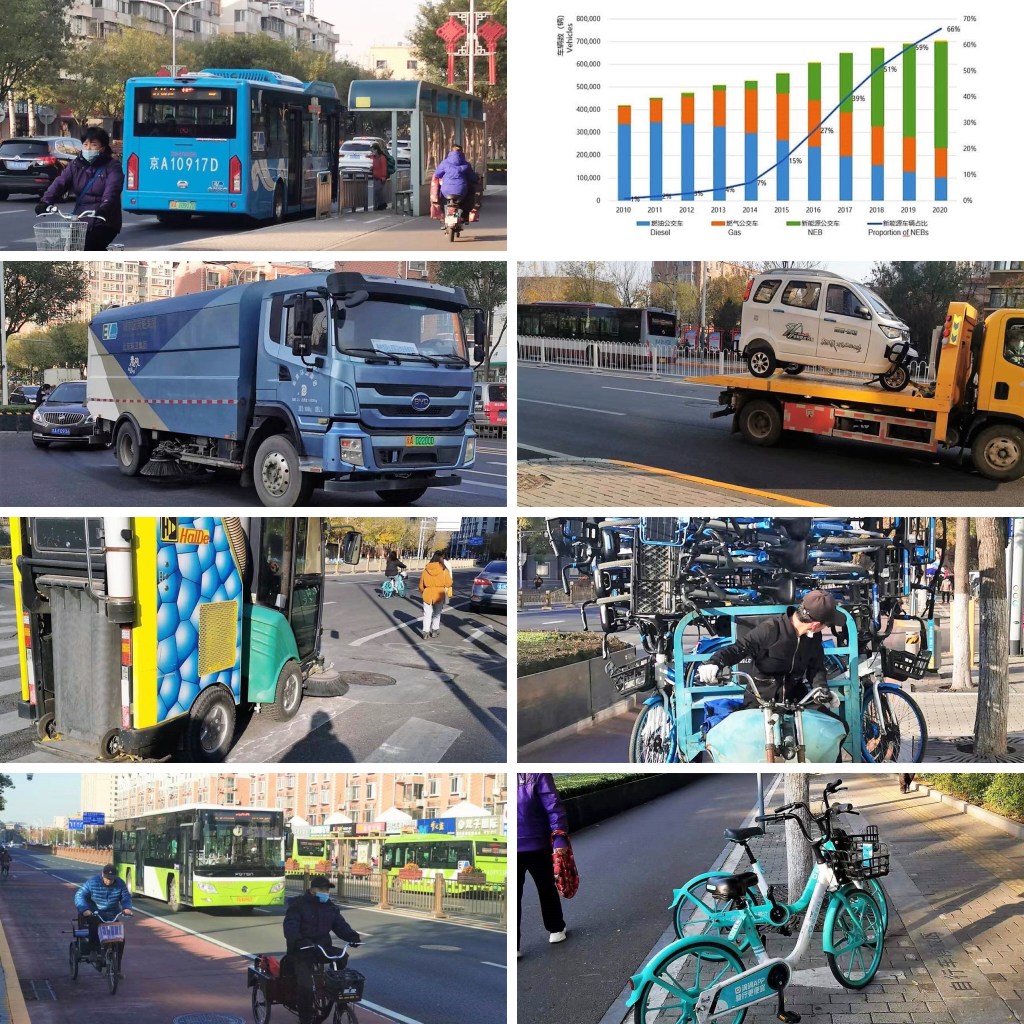
China Promises Made Promises Kept: 93% of world’s electric buses are driving in China, about 470,000 e-buses…
This is in line with China’s 2030 CO2 peaking and 2060 carbon neutrality programs, aiming to fully electrify its public bus fleet by 2035. At this stage 70% of China’s fleet has been electrified in about 10 years time with some cities already 100% such as #Shenzhen leading the way having 17,000 #ebuses on the roads.
China’s current electric bus fleet is estimated to save 270,000 barrels of diesel every day. This is over three times the volume saved by all the #ecars in the world.
In comparison, #Europe sees about 8,500 e-buses driving in their cities (2021) and in the #USA a little over 3,500 e-buses (2021).
But greening public transport and mobility is obviously not just about the #electrification of #buses and other public vehicles such as #taxis, waste and cleaning service vehicles or couriers. The large-scale electrification is just one part of the ambitions and challenges in the whole circle of this public transport #greeneconomy; including among others #batterycharger and #energy (#greenenergy) sources, #recycling (especially for batteries), public #infrastructure and a wider transformation to public and private #smartmobility and #greenmobility along with its regulations.
Read more in Sebastian Ibold 塞八仙 post about an extensive study in for the optimization of the public bus network for #Tianjin, a 14 million city in the north of #China and part of the Beijing-Tianjin-Hebei cluster or #JingJinJi Metropolitan Region with about 110 million people. A blueprint for other cities in China and beyond.
Red carpet welcoming Xi, no red carpet for Biden, a clear message who is welcome in Asia. Asia want to do business, not interested seeing the arm dealer! 紅地毯歡迎習近平,紅地毯拜登無份, 這是一個在亞洲受歡迎的人明確信息。亞洲想和中國做生意,沒興趣見軍火商!

Biden’s assurances to China change nothing. The US president only seems to be relenting toward Beijing because his party survived the midterm elections and he doesn’t need the bogeyman so badly for now By Timur Fomenko, a political analyst
US President Joe Biden (R) and China’s President Xi Jinping (L) meet on the sidelines of the G20 Summit in Nusa Dua on the Indonesian resort island of Bali on November 14, 2022.
US President Joe Biden met with Xi Jinping on the sidelines of the G20 summit in Bali on Monday.
It’s the first time the two leaders have met in person, with Xi having isolated himself significantly from international diplomacy for several years due to the Covid-19 pandemic.
The meeting struck an unusual tone against the flow of US-China relations. The past few months have seen tensions soar to unprecedented highs over the island of Taiwan. Now, Biden tells the world that he does not want a cold war and doesn’t think China will invade Taiwan.
Crisis averted? Don’t count on it.
Actions speak louder than words, and in the context of two great powers contending for global influence, and a US hell-bent on sustaining its hegemonic position, diplomatic small talk means little.
Neither a change in policy nor new agreements have come out of that meeting. The scenario remains the same: The United States sees the rise of China as the largest ever threat to its unparalleled geopolitical dominance, in the domains of military, technology, and diplomacy.
Chinese stock market awakens READ MORE Chinese stock market awakens
Under Biden, the US has consolidated its attempts to try and contain the rise of China, which started under Donald Trump. In this, the Biden presidency is arguably even more aggressive than its predecessor.
Not three months ago, Nancy Pelosi, the Democratic Speaker of the US House of Representatives and Biden’s chief ally, visited the island of Taiwan in an unprecedented provocation to Beijing. On at least three occasions did Joe Biden profess that the US would “defend” Taiwan in the event of an invasion, virtually signaling he was prepared to go to war against Beijing.
So what happened to that rhetoric? Is Biden’s meeting with Xi a sign that aggression is abating? The answer is the US midterms happened. United States politicians antagonize China for their own political gain and act tough before elections. The Trump administration did the same.
Biden is a lucky man. Despite eye-watering levels of inflation and a record-low approval rating, the Democrats performed better than expected because, simply put, the alternative is worse. This means, for now, Biden isn’t under pressure to be tough on China and can let things cool down at least temporarily.
But that doesn’t mean anything else is going to change. The US will continue to try to contain China and will continue to see the island of Taiwan as a keystone of its strategy. Washington will continue to “push against the lines” of the ‘One China’ policy by deepening its ties with the self-governed island in securing its de-facto independence, and Beijing will continue to view the US’ intentions with deep distrust.
Likewise, the US will continue to advance its military presence throughout the region by increasing its asset deployments and seeking to militarily encircle China’s periphery. It will continue to push comprehensive anti-China alliances such as the Quad and the AUKUS.
Xi says US and China must avoid ‘collision’ course
It will also continue in trying to suppress China’s rise in capabilities through maintaining its trade war tariffs and technology embargoes, likely expanding the latter. This process, known as “decoupling,” will continue; the only questions are “how fast” and “in what areas.”
So really, these more careful words from Biden change nothing.
As soon as it suits the US in terms of its domestic political interests, it will immediately begin ramping up tensions again. It will then, as it always does, accuse China of being the instigator of instability.
China will likewise stick to the goal of demanding eventual reunification. The US will then call China a threat to other countries and frame itself as a guardian and protector, in order to further its own containment agenda.
So has war over Taiwan been averted? The answer is no, not at all. A routine diplomatic meeting means nothing when the two countries’ agendas clash so much. Finding compromise is difficult.
The US always views its hegemony as a zero-sum game. There is no compromise to be had, because its policy is always orientated to utilizing maximum advantage.
One meeting cannot compensate for the total deficit of trust, and this tells us nothing about where US-China relations may ultimately be headed. What Biden tends to say and do are often two different things.
At most, this is short-term reassurance.
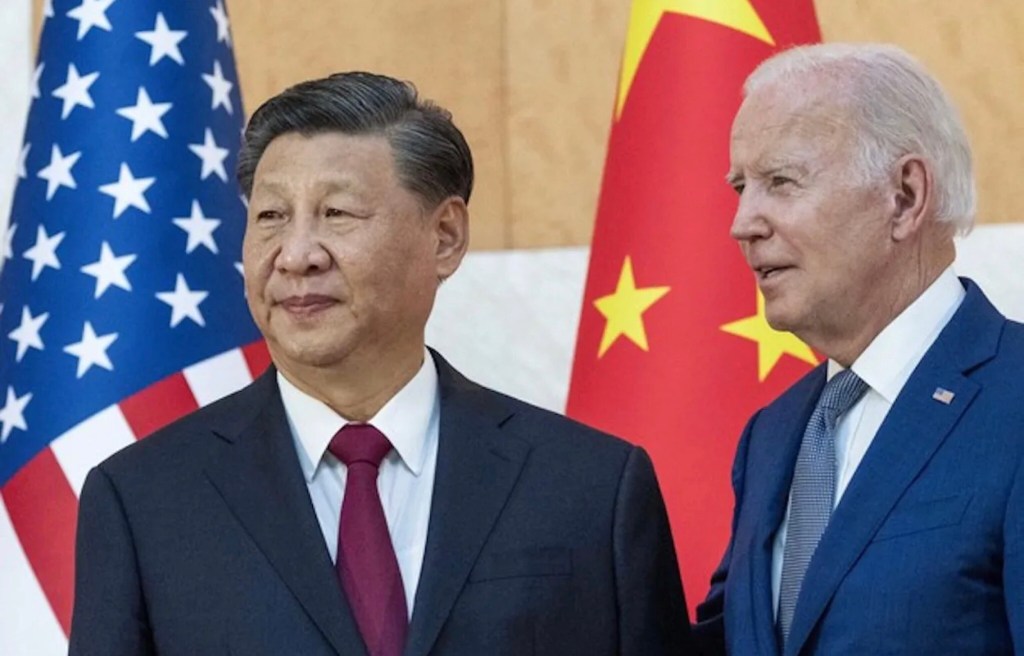
Beware the instagram takes of the Xi-Biden meeting. By KJ – SF Bay Area China Group 11-15-22
The consensus coming out of the press is that the Xi-Biden G20 meeting was positive and beneficial.
Among things noted:
It was long (3 hours and 12 minutes–hence possibly substantial),
It looked congenial (based on the pictures)
The official readouts from the respective sides did not diverge too much (as they have in the past, where US statements were practically mirandized or made you wonder if they were at the same meeting).
The US reaffirmed its 5 Noes (reaffirming, in particular, that it is not seeking to undermine China’s development or seek independence for Taiwan).
GT notes that the US requested the meeting and travelled to the Chinese residence to meet, itself a signal of the US accommodating China. https://www.globaltimes.cn/page/202211/1279524.shtml
The US made de-escalatory comments about NK (China is not responsible for NK’s policy), China is not about to invade Taiwan (as stated by top brass and others), the US commits to the one China policy. AT: https://asiatimes.com/2022/11/biden-xi-lower-the-temperature-in-hours-long-summit/
No nuclear war, and re-opening of military communication channels.
Color me cynical, I differ with these pollyannaish views. The instagrammable images should be analyzed deeper.
(See here, starting 15:30 mark https://sputniknews.com/20221115/biden-and-xi-meet-brics-to-grow-dems-clinch-senate-1104133208.html)
First the US hybrid war on China has three dimensions that are important to remember or consider:
COIN is the military doctrine of counterinsurgency that was developed at CNAS for the Afghan and Iraq wars. It is, to this moment, still the official currency across all the forces. It has been described as “Armed social work”. This expresses itself as bipolar behavior: soccer balls during the day, raiding people’s houses at night; Praise and warmth, followed by military actions and preparations. Abuse followed by flowers. It pendulates back and forth, Jekyll & Hyde-like between congeniality and brutality. It is a good-cop-bad-cop routine expanded to global interactions.
The US puts the spin on this in the case of China as “compete and cooperate”.
General.Mattis put it, however, much more concisely and candidly: “be polite….and be prepared to kill”.
Right now, this is the polite part, the flowers and candy part.
The “prepared to kill” is still very much in play (see below).
The other aspect of COIN is the PR battle. COIN is understood as a three-handed PR game, an effort to look and gain legitimacy among third parties. Right now China is doing well (despite US efforts to paint it as a “genocidal” oppressor), because it offers countries development, win-win cooperation, connections, and peace. The US currently offers degrowth, decoupling & sanctions,bloc-forming, and escalation to conflict. This is also affecting the imperial core, where the western European leadership is starting to face legitimacy crises. The US needs to regain some legitimacy, gain some PR territory.
The 3rd offset is the strategy of dispersion, an offset to precision and focused response. (It ties into hybrid war in general, the doctrine that the US is waging war in all “war-fighting domains”), i.e. everywhere, all the time.
Here, it means simply, “Look outside the immediate field of vision”. What’s happening outside the frame?
Here’s some of what I note:
TPA–the Taiwan policy act, designed to turn Taiwan Island into a US garrison and paracolony, on par with SK & Japan, is winging through congress. It will likely pass.
Semiconductor sanctions & CHIPs act, designed to decouple and destroy China’s foundational tech industry, and hence China’s industrial development. This has been referred to as going “nuclear” in the economic war.
EV sanctions
Belligerent–and now unending–wargames targeted at China (with NATO (including the Luftwaffe!), Aukus, Japan, Philippines, Korea).
Just before the meeting: Yoon Sukyeol announced two things:
a) that Korea was back on the reservation, in particular with GSOMIA (creating a Pacific “3 eyes” intelligence-sharing grouping against China)
b) the ROK army is doing military exercises in conjunction with JSDF, and with SK troops saluting the rising Sun.
c) SK has just declared its own “Indo-pacific” strategy, which surprise!, is cribbed directly from the US Indo-pacific strategy: I say cribbed, plagiarized, my colleagues suspects that the US is literally writing it for the SK government (which is so incompetent that it kills 156 people in an avoidable accident
The fact is that what the US says, and what it does, are completely opposed. It is not reliable as an interlocutor.
The US is committed, in its ideological DNA, to taking China down– as an Empire with unipolar hegemonic ambitions, it cannot and will not tolerate a challenger–doctrinally and ideologically.. Capital brooks no challenges, certainly not on the scale that China poses.
So why this meeting at this moment?
The Western European leadership, despite its language, is very uncomfortable with the pace and speed of US aggression against China. Notice Scholz’s recent trip to China. This is why Scholz said “decoupling is not an option”. They do not want to deindustrialize for the benefit of the US.
Some kind of relief is necessary*, and the G-20, in particular China will be asked for support–as they were during the 2008 meltdown. This was the reason the G-20 was formed in the first place. (The G-7, the western ruling elite (+Japan) were no longer capable of pulling the capitalist economy out of its death spiral).
This is a good analysis from PSL on this aspect:
https://www.liberationnews.org/psl-editorial-managed-competition-with-china-or-real-peace/
Biden is signaling his desire to maintain the United States’ posture of fundamental hostility to China, but at least rhetorically softening the U.S. position in a nod to other nations that are uncomfortable with the pace of escalation. China’s economy remains deeply integrated in the world market, and even major capitalist powers like France and Germany do not desire a complete breakdown in relations despite their underlying hostility to China’s socialist system. Given the existing balance of forces in world politics, the United States may calculate that a momentary easing of pressure could reduce the likelihood that the alliance between China and Russia will deepen.
The US has a consistent pattern. Make promises and break them–every single one of them. The Chinese are happy to meet and smile. But Wang Yi has said “the relationship is a whole”. No to a la Carte “cooperation”. Taiwan independence and the one China policy are “like fire and water”. They cannot coexist.
China is stating it wants a peaceful and stable world. It wants win-win cooperation, and they note the foundational crises of the world that make that essential.
They are watching the US very carefully. We are not out of the woods yet. Far from it.
(*Tangentially, China’s dynamic zero covid–although tough–has been shown to be the right choice. It now has an oral vaccine, which allows it to open up more.
On the other hand, the US currently is estimated to have 17 Million people with long Covid; collectively they could result in the loss of nearly 3 Trillion dollars of lost productivity. The US cannot sustain this without relief).
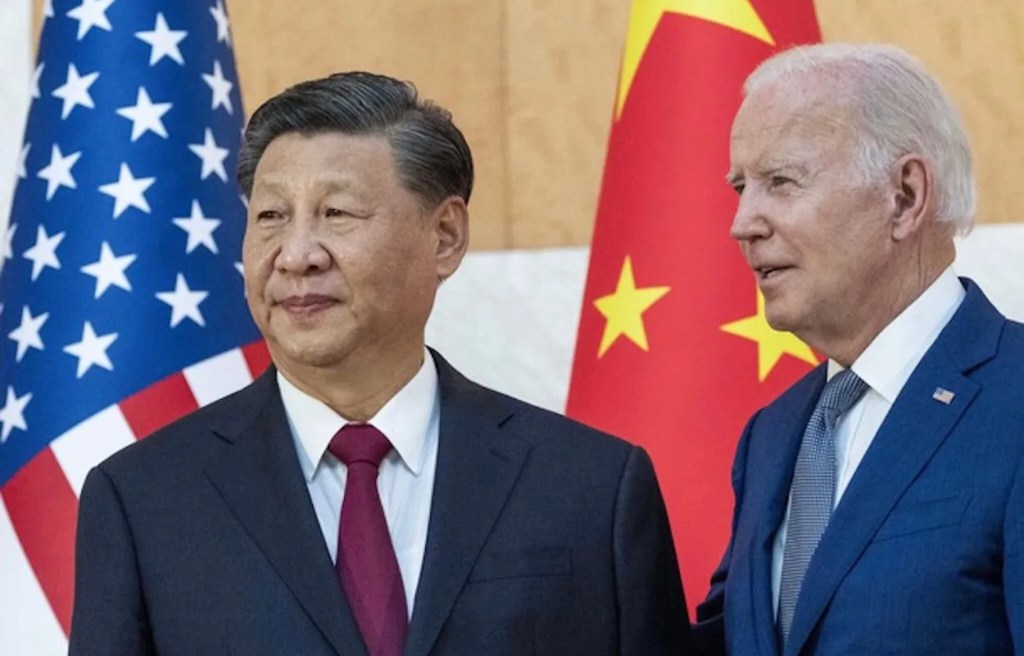
Taiwan US-China Experts Video: Biden’s meeting with Xi for show only, Foreign Leaders trusted Xi: Promises Made Promises Kept (World Leaders are standing in lines to meet Xi, fully booked till Jan 2023).
https://rumble.com/v1uon7w-bidens-meeting-with-xi-for-show-only.html
https://m.facebook.com/story.php?story_fbid=833605784529415&id=100036400039778
No one study political science considered Democracy is the only form of Government except US using it to demonize others.
In 1989, the World Bank controlled by US established WGI (Worldwide Governance Indicators) as follow:
1) People say in Government & Held Gov’t Official Accountable
2) Stability & Non-Violence
3) Effective & Getting Things Done (US is the worst)
4) Monitoring & Management Country’s Economy
5) Rules of Laws
6) Controlling Corruptions
US has practically failed in all 6 categories.
Democracy is not mentioned anywhere.
G20習拜過招!習近平:中國式民主符合中國民情|郭正亮:政治學不把”民主”當作”治理國家”唯一條件

 Business Blog