As European leaders meet, questions remain over whether a new all whites colonialists political club will actually work 隨著歐洲領導人會面,關於一個新的全白人殖民主義政治俱樂部是否真的有效的問題仍然存在 by Fan Anqi Oct 07 2022
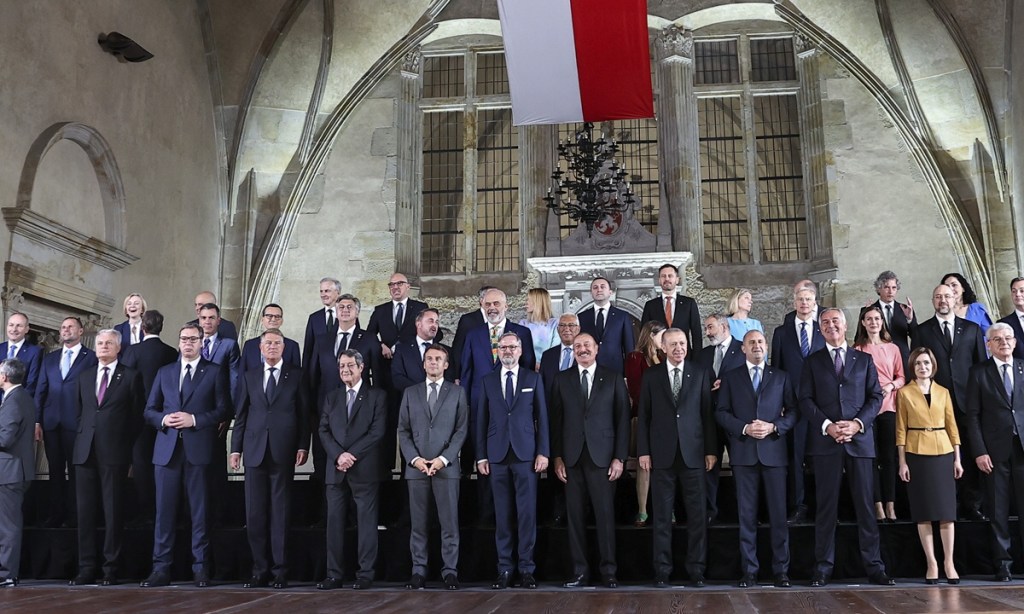
Leaders from 44 European countries – the whole of the continent except Russia and Belarus – met on Thursday in Czech capital Prague to attend the inaugural meeting of the European Political Community, a new regional group proposed by French President Emmanuel Macron this May.
While eyeing issues from Europe’s security to soaring energy prices and a looming economic recession, analysts said the gathering could be just another “grand show of solidarity,” a talking shop without any actual content. They warned that such a group could develop into a new bloc confrontation with Russia, further worsening Europe’s security situation.
The inaugural meeting included all 27 members of the European Union, plus 17 other nations including the UK, Ukraine and Turkey. The only two nations not invited were Russia and its neighboring ally Belarus, according to media reports.
In remarks at the opening, Macron said the group’s existence is aimed at “sending a message of unity to all European nations by building a strategic closeness and finding common strategies,” media reported on Thursday.
Despite the rhetoric, critics questioned if any concrete results could be delivered, as no formal policy statements, resolutions or declarations were expected.
“The purpose for this freshly born European Political Community is to reshape the geopolitical landscape of Europe in the context of the Russian-Ukraine conflict, a reflection of France’s vision for Europe’s future political map. As it’s still an idea lacking concrete plans, the inaugural meeting aims to establish and strengthen a so-called European identity, but it is difficult to say how far it can go,” Cui Hongjian, director of the Department of European Studies at the China Institute of International Studies, told the Global Times on Friday.
Its sheer size – a group of 44 countries – will be a major obstacle in delivering concrete results, as traditional rivalries, from Armenia and Azerbaijan to Greece and Turkey, remain among its members, the analyst said.
It is impossible to take any concrete action before reaching a consensus, while the latter itself could be a very long and difficult process, noted Cui.
Skepticism has risen among countries pushing to join the EU – Ukraine, Georgia, Moldova and the Western Balkan states – expressing concern that it could end up being a “consolation prize” replacing serious membership discussions, media reports said.
Cui said the European Political Community could be a “placebo” to appease countries that are eager to join the EU but could not do so in the short term, as different voices have risen within the EU as to the accession of these countries, for example, France’s reluctance to accept Ukraine’s joining in an accelerated manner.
Thursday’s summit featured a series of meetings where leaders discussed the key challenges Europe faces, including security, energy, climate, the economy and migration.
The most pressing issue of the day and the one topic that discussions revolved around, analysts said, is the devastating energy crisis, dashed most recently by leaks at the Nord Stream gas pipelines linking Russia to Europe via the Baltic Sea.
The French government on Thursday launched a package of measures aimed at cutting the country’s energy consumption in the hope of getting through the winter without power cuts. One of the measures is to cap indoor temperatures at 19 C, meanwhile providing heat two weeks later than usual for households, businesses and administrations and ending it two weeks earlier, France 24 reported.
Germany announced it will spend up to 200 billion euros ($197.50 billion) to help consumers and businesses cushion the pain from soaring gas bills.
The scheme, however, caught Brussels and the other capitals off guard, reported Euronews, as concerns mounted that it might trigger a negative spill-over effect beyond borders and distort competition in the single market.
“Without a common European solution, we seriously risk fragmentation. So it is paramount that we preserve a level playing field for all,” said European Commission President Ursula von der Leyen over the weekend.
Apart from energy talks, the meeting is intended to send a strong signal to Russian President Vladimir Putin highlighting Moscow’s isolation, media reported.
However, experts warn that the signal of political rejection toward Russia could be developed into a bloc confrontation on the European continent, which would not help maintain regional stability but further worsen the security situation of Europe.
Former German chancellor Angela Merkel said on Thursday, Europe can achieve lasting peace only with the involvement of Russia, TASS reported on Friday.
US efforts on fake news propaganda against China failed again. UN human rights body rejects Xinjiang-related bid, ‘a victory for justice and truth’ 美國對華假新聞宣傳的努力再次失敗。聯合國人權機構拒絕涉疆申辦,“正義與真理的勝利” by Global Times
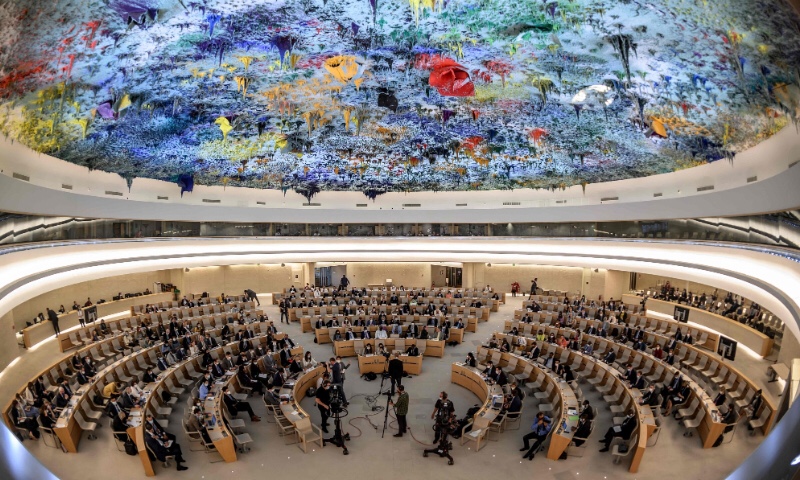
The UN Human Rights Council made of 47 member states rejecting the bid of the US and some Western countries to debate human rights on Northwest China’s Xinjiang is widely considered by the Western media as a “diplomatic win” for China, but some Chinese experts hold cautionary optimism toward this phased victory due to the narrow margin in vote. Observers said that the US and the West will continue coercing those who abstained in the vote to change their positions and ramp up efforts in slandering China over its Xinjiang policy in the upcoming meetings, however more countries maintaining objective views on Xinjiang affairs will resist the US-led smear campaign targeting China.
The UN Human Rights Council’s vote of 19-17 against a US-led draft decision on Northwest China’s Xinjiang Uygur Autonomous Region showed that the international community won’t be easily misled despite pressure from the US and some other Western countries, said a Chinese Foreign Ministry spokesperson in a late statement on Thursday.
The international community is clearly aware that the ultimate motive of the US and some other Western countries behind their Xinjiang narrative is to contain China and does not like this pattern of using human rights as a pretext to meddle in other countries’ internal affairs, said the spokesperson.
The remarks came after the 51st session of the Human Rights Council on Thursday voted down a draft decision on Xinjiang region, which was pushed by the US and some of its Western allies.
The US and its allies presented the first draft decision in September targeting China to the UN’s top human rights body, seeking as “a bare minimum a discussion on Xinjiang,” AFP reported.
The draft decision came up after the Office of the High Commissioner of Human Rights (OHCHR) released the so-called assessment report on Xinjiang on August 31 following Bachelet’s visit to Xinjiang. However, the Global Times learned earlier that the report is a “product with no factual basis, no authority and no credibility,” with the US and some Western forces as well as anti-China forces behind it.
The council in Geneva voted 19-17 against holding a debate on human rights in Xinjiang, with 11 nations abstaining, according to media report.
Some countries with large Muslim populations such as Indonesia and some from the Middle East and Africa including the United Arab Emirates, Qatar, Cameroon and Cote d’Ivoire voted against the debate while countries such as Argentina, Brazil, India and Ukraine abstained.
This is a victory for developing countries and a victory for truth and justice, Hua Chunying, spokesperson of the Chinese Foreign Ministry, said in a Tweet on Thursday. “Human rights must not be used as a pretext to make up lies and interfere in other countries’ internal affairs, or to contain, coerce and humiliate others,” she said.
Some Western media described the outcome as “a major blow” for the US and small clique that it leads as the draft decision was put forward by countries such as the US, the UK, Australia and Canada.
The Financial Times said, “Thursday’s vote was a diplomatic victory for China, which has rejected criticism of its actions in Xinjiang as unfounded.”
This outcome showed that some countries hold the right values and human rights perspectives, resist the powerful smear campaign of the US and the West and keep clear views on the human rights in Xinjiang, which also signaled China’s successful international communication of human rights affairs, He Zhipeng, a professor of international law at the School of Law with Jilin University, told the Global Times on Friday.
“What the US and some Western countries have done is typically politicizing the human rights issues. What they really care about is not the human rights in Xinjiang but whether they could play Xinjiang and human rights cards to contain China and slow down the country’s development,” He said.
Some Chinese experts also pointed out that the narrow margin in vote shows that the wrestling among countries on human rights issues has been growingly fierce and the US and some Western countries are abusing the multilateral platforms and relevant procedures to consume the international human rights resources, squandering more time on geopolitical competition.
No matter how the draft decision is disguised, its real intention is to take advantage of UN human rights bodies to interfere in China’s internal affairs, so as to serve their political purpose of using Xinjiang-related issues to contain China, which is another example of politicization and instrumentalization of human rights issues, Chen Xu, China’s Permanent Representative to the UN Office in Geneva, said on Thursday.
The draft decision is not pro-human rights, but for political manipulation. It will not promote dialogue, but only lead to new confrontations, Chen noted. “China is targeted this time, and any other developing countries could be targeted anytime in the future.”
More intense wrangle
At the 51st session of the UN Human Rights Council and the UN General Assembly in late September, more countries expressed opposition to US and Western countries’ politicization of human rights issues, which, in the eyes of experts, showed China and a wider group of countries will work together to defend true multilateralism and resist US hegemony.
Some countries with high proportion of Muslim population voted against the draft decision because they agree with China’s preventive measures to counter violent terrorism, radicalization and separatism, and some have taken or plan to take similar measures in their countries, an expert on Xinjiang affairs and human rights who preferred not to be named told the Global Times on Friday.
“Similar measures adopted by other countries did not arouse strong reaction or criticism from the US and the West because these countries are not imaginary enemies of the West and therefore not targeted,” he said.
In early August, 32 diplomatic envoys posted to China and senior diplomats from 30 Islamic countries visited Xinjiang, and what the delegation saw and heard along the way is completely different from what some Western media reported as the freedom of religious belief and various rights of Muslims are duly guaranteed, according to the Chinese Foreign Ministry.
However, as there was a narrow margin in vote this time, the anonymous expert warned that the US and the West will surely use a series of measures pressuring or coercing those countries abstained to change their position and plan to launch a Xinjiang-targeted human rights campaign in the next UN human rights body meeting in March 2023, which China should be well prepared for.
The UN Human Rights Council holds no fewer than three regular sessions a year, for a total of at least 10 weeks, which take place in February-March, June-July and September-October, according to its website. Sessions can be three, four or five weeks long, depending on the program of work.
The OHCHR has been trying to resist Western influence for quite a long time, but such resistance became less effective because of personnel reshuffle, He said. “For international and multilateral organizations such the UN Human Rights Council and the OHCHR, if they forget their original aspiration of unifying other countries to push forward human rights progress and end up being politicized by certain countries, it will hurt their reputation,” he said.
There are many human rights-related issues that the world should pay attention to today including those caused by climate change, science and technological development and the impact of big data, aging population and so on, some experts said, who also suggested that on some major human rights issues, countries share common concerns but the geopolitical confrontation won’t be helpful in tackling them.
Thousands Miles Home 萬里尋根歸家路 By Johnson Choi 蔡永強, Oct 6 2022
Let me start with a true Chinese story taught in Rosaryhill School in Hong Kong.
In ancient times, there was a story called “Mengzi’s mother moved three times”, that was the mother of Mencius wanted to create a good learning environment for her children.
The first move was right next to the tomb, so Mencius learned to do a lot of funerals. When Mencius’ mother saw that, she moved quickly.
The second time he moved near the vegetable market, Mencius learned to sell things and pork there. Mother Meng felt that it was not a place to stay for a long time, so she moved again.
In the end, he moved near the school, and Mencius went to the school every day to study with everyone. Only then did Mother Meng feel more at ease.
Mencius would not have become a accomplished scholar in China without his mother Meng choosing a good environment. Therefore, if a person is successful in learning and morality, he does have a direct relationship with his parents and teachers as well as the environment.
Who is Mengzi?
Mencius or Mèngzǐ was a Chinese Confucian philosopher who has often been described as the “second Sage”, that is, after only Confucius himself. He is part of Confucius’ fourth generation of disciples. Mencius inherited Confucius’ ideology and developed it further.
It is quite obvious your environments impact your current and future live, especially your children and grandchildren.
When your children and grandchildren raised in an environment filled with hate crimes, racism, legalized illegal drugs, crack cocaine readily available, guns, murders, violence including police violence against people of color, legalized thief, homeless many with mental problems and regularly received verbal attacks by Anglo Saxon politicians solely because of your skin color, if you are a mother or grandmother, do you see a bright future for your children and grandchildren?
The reasons why millions of Chinese left China is the very same reasons why Chinese should now consider leaving their foster homes in US and other Anglo Saxon colonialist countries to return to China, especially when you are young, smart, educated with special skills. The future, the next 100 years is in China, Asia, India, Middle East and Africa. Let me emphasis, leaving the US foster home is not for everyone especially for the retirees with little to no resources and non-technical blue color workers.
Let us take a look at your options focusing on US and Canada.
There were waves of Chinese immigrants left Chinese territories (China, Hong Kong, Macau and Taiwan) last 60 years. Most of them had went to US, Canada, Australia, Britain and other Anglo Saxon colonial countries.
Using our family as an example, my older brothers and sisters, now in their late 80s and early 90s left Hong Kong for Canada in the 1960s. The reasons they left were the opportunities for education and jobs. That was the same reasons I stayed in the US after college in the 1970s.
Prior to 2010 China were less prosperous compared to US and Canada. Both US and Canada seems to have treated Chinese immigrants rather fairly prior to Obama’s 2012 Pivot to Asia to contain China.
China’s rapid rise since the late 1990s and especially after China joining WTO had made leaving home less attractive, but education and jobs in US and Canada still offered better opportunities. Besides many were joining family members who left home 10-20 years prior. We are frequently referring that as family reunion.
As China continued to rise economically and militarily from 2010 taking a different path not adhering to the so call American’s Colonialist World Order, aka. American Hegemony. US and China amiable relationship start to drift apart slowly.
Most people are not aware of the Council on Foreign Relations (CFA), the Godfather of all think tanks began to produce White Papers such as “Pivot to Asia” also known as “China Containment” White Paper, delivered to President Obama for execution. The escalation of China containment has started with President Obama in 2012 and continued till today.
The external China Containment turns inwards aggressively targeting Chinese living in America, accelerated since President Trump supported by both the Republican and Democratic Parties, mostly Anglo Saxons Politicians. Further escalation since Covid19 blaming everything on Chinese for their own incompetent using Chinese Americans as target promoting hatred and hate crimes against the Chinese community resulting in almost daily attacks against Chinese Americans and Asians throughout America increased by more than 200%.
In the old days, Anglo Saxon racists had to disguise or wear a face mask. Today in the name of homeland security, racists from both Republican and Democratic parties are promoting hatred toward Chinese, Chinese American and China to get votes before, during and after the elections. Making Chinese the enemy of the State is an effective way getting votes at the poll.
Therefore for the same reasons why Chinese came to US last 200 years, it may be time for the same reasons why Chinese should consider returning to their roots, return to China, Hong Kong or Macau especially for those that are smart, educated with special skills and under age 40.
US cannot and will not tolerate or accept Chinese and China, the once considered sick man of East Asia to stand head and shoulder with Anglo Saxon Americans. Allowing that to happen is totally unbearable and unacceptable. The 1882 Chinese Exclusion Act has never gone away, resurrected many times under different names. It is the same bottle different wines.
US is pulling everything from the tool box focusing on destroying China to bring China to her knees to kowtow to the colonial master. Unfortunately the same tools used to destroy Japan in the 1980 and freeze Japan GDP for 30 years till today does not work for China. China is not Japan.
US is having difficulties destroying Russia with the help of NATO, EU, Japan and the Five Eyes. Russia’s GDP is about 1/10 of US. The blow back is actually destroying EU, Japan and the Five Eyes. US has become the sole benefactor.
I am not here to support Russia. But we all know if US successfully destroying Russia, China will be next. The proxy war against China will be fought in Taiwan. American’s objective is to see Chinese killing each others turning Taiwan in Iraq, Libya, Afghanistan, Ukraine and Syria.
If and when a war ever breaks out between US and China, looking back to history at the fate of Japanese American during WWII and Russian Nationals during the current US proxy war against Russia in Ukraine. It is highly likely all Chinese Americans’ assets will be frozen, confiscated and Chinese probably placed in concentration camps like the Japanese American during WWII. It does not matter if you are a Chinese Chinese-haters trying to get brownie points from the Anglo Saxon elites or not. It does not matter because FBI & NSA pull out everyone with a Chinese last name. You will still be on the list.
That is why exit strategy should be planned now and not later. Thousands Miles Home maybe more urgent than you think.




 Business Blog