-
Taiwan US-China expert video with English subtitles: A week’s worth of countermeasures: Is it China’s turn to deal with the EU this time?
Taiwan US-China expert video with English subtitles: A week’s worth of countermeasures: Is it China’s turn to deal with the EU this time? 台灣中美尊家視頻有英文字幕: 一周对策, 這回輪到中國來 收拾歐盟? 2025 1103
https://rumble.com/v716ir2-is-it-chinas-turn-to-deal-with-the-eu-this-time.html
https://www.tiktok.com/t/ZP8DDmrVV/
-
Taiwanese financial expert Dr. Tsai Cheng-yuan video with English subtitles: Fed’s December rate cut halted? Is the US economy solely reliant on AI?
Taiwanese financial expert Dr. Tsai Cheng-yuan video with English subtitles: Fed’s December rate cut halted? Is the US economy solely reliant on AI? 台灣財經尊家蔡正元博士視頻有英文字幕: Fed 12月降息喊卡?美經濟全靠AI苦撐?
https://rumble.com/v716i2a-feds-december-rate-cut-halted-is-the-us-economy-solely-reliant-on-ai.html
https://www.tiktok.com/t/ZP8DAEEeE/
-
American logistic expert video reports from China with Chinese subtitles: The US and EU countered China’s BRI in Africa’s copper belt. It fell apart in under a year.
American logistic expert video reports from China with Chinese subtitles: The US and EU countered China’s BRI in Africa’s copper belt. It fell apart in under a year. 美國物流專家從中國發回視頻: 報道,附中文字幕: 美欧在非洲铜带抗衡中国”一带一路”倡议,不料联盟未满一年便分崩离析.
https://rumble.com/v716hiw-the-us-and-eu-countered-chinas-bri-in-africas-copper-belt.-it-fell-apart-in.html
https://www.tiktok.com/t/ZP8DD2bwJ/Zambia sits upon some of the world’s richest copper ores which are highly prized by China’s factory sector and by Western companies.
The race is on to build a railroad to Zambia. The US and EU hoped to lay track through the DRC, which would connect Zambia to Lobito, a port on the Atlantic Ocean.
Chinese companies decided on multibillion-dollar upgrade to an existing railway from Tanzania, called the Tazara Line.
The Lobito Plan was doomed from the start. Financing for the project fell apart as the Trump Administration froze funds, and the war in Ukraine bled dry the EU’s budgets.
The Tazara Line, meanwhile, is already laying new track, and Chinese mining companies are signing deals across Zambia to bring new copper and cobalt production online.
赞比亚坐拥全球最丰富的铜矿资源,这些矿产既是中国制造业的重要原料,也深受西方企业青睐。
通往赞比亚的铁路争夺战已然打响。美欧原本计划铺设经刚果民主共和国的铁路,将赞比亚与大西洋沿岸港口洛比托相连。而中方企业则决定对既有坦赞铁路进行数十亿美元升级改造。
洛比托计划从伊始就注定失败。由于特朗普政府冻结资金,加之乌克兰战争耗尽欧盟预算,项目融资彻底崩盘。反观坦赞铁路,现已开展新轨道铺设工程,中国矿业公司正与赞比亚各地签署协议,即将启动新的铜钴生产项目。

-
Why can the Chinese space station only accommodate three people, while the International Space Station can host over ten? Is it really a matter of technological inferiority?
Why can the Chinese space station only accommodate three people, while the International Space Station can host over ten? Is it really a matter of technological inferiority? 為啥中國空間站只能上3個人,國際空間站卻能達到十幾人?到底是誰技不如人?
To put it plainly, the difference is that ours is like a private villa, while the International Space Station is more like a shared apartment. The Chinese space station was built by us, allowing us to maximize its use for our own purposes. In contrast, the International Space Station is shared among multiple countries, so they have to make do with crowding in.
First, let’s talk about the直观 differences in scale. The International Space Station was built through the collaboration of 16 countries, with a total mass of 420 to 450 tons, a pressurized volume of 916 to 1,005 cubic meters, a length of 109 meters, and a width of 73 meters. Its internal modules are diverse and varied.
For instance, the U.S. Destiny module, the Russian Zvezda service module—each country needs its own space to house its equipment. This requires reserving significant room for astronauts from various countries to take turns on duty.
In contrast, our space station has a total mass of 100 tons, a length of 55.6 meters, a pressurized volume of 340 cubic meters, and a habitable volume of 122 cubic meters. It consists of just three modules: the Tianhe core module, the Wentian lab module, and the Mengtian lab module. All were designed by us, with a compact layout and functions allocated as needed, leaving no extra space wasted.
The International Space Station is like a large, bustling but chaotic compound, while ours is like a well-decorated small apartment—sufficient for our needs. This isn’t a matter of technological backwardness but rather a difference in strategy. The International Space Station must balance the interests of multiple parties, with modules of varying standards, making maintenance cumbersome. Our space station, however, is uniformly planned, making it much more efficient.
The International Space Station once hosted a record of 13 people, but its usual capacity is seven. Our standard capacity is three, though it can temporarily accommodate six during crew rotations. The gap lies here—it’s not that we can’t fit more people, but there’s no need to cram them in.
The root of the crew configuration lies in usage requirements. The International Space Station typically hosts seven people because each country needs to send representatives to manage its own section. U.S. astronauts monitor equipment in the Destiny module, Russians repair the Zvezda module, and European and Japanese astronauts each have their own duties. Tasks are fragmented like a puzzle, and no one can be missing.
Our space station usually hosts three people, based on the actual volume of experiments. In December 2022, during the handover between Shenzhou-14 and Shenzhou-15, six people stayed for a few days, proving that the capacity is sufficient. However, there’s no need to keep it fully occupied year-round. Why? Because the 16 experiment racks follow uniform standards, and three people can divide the work: one managing life sciences, one handling materials research, and one maintaining systems, ensuring smooth collaboration.
The International Space Station’s equipment has poor compatibility, requiring crew members to分散精力 learning various operations, which reduces efficiency. Simply put, our space station is like our own land—we can farm it as we wish. The International Space Station is like a shared property, where everyone’s needs must be considered, so crowding is unavoidable.
The resupply capability directly reveals the differences in design philosophy. The International Space Station, with its larger crew, has higher consumption and relies on various countries taking turns to deliver supplies. Russia’s Progress cargo ship carries 2.5 tons per trip, making several flights a year. The U.S. cargo ships have a capacity of up to 3 tons, requiring multiple people to collaborate during unloading. The total operational cost is high, ranging from $3 to $4 billion annually, shared among partner countries.
Our Tianzhou cargo ship, on the other hand, can carry 6.5 tons per trip. By 2025, Tianzhou-9 will support three people with nine months of supplies and 1.4 tons of propellant. With lower launch frequency, it saves both money and effort. Key to this is our advanced environmental control and life support system. We can convert exhaled carbon dioxide into oxygen and purify urine and sweat into drinking water, with a utilization rate of over 90%, basically eliminating worries about basic supplies.
為啥中國空間站只能上3個人,國際空間站卻能達到十幾人?到底是誰技不如人?
說的直白一些,差別就是我們是私人別墅,而國際空間站就是群租房(公寓),中國空間站是我們自己造的,可以最大化讓自己人利用,而國際空間站就不行,是多個國家共用的,他們只能擠一擠。
先說體量上的直觀區別。國際空間站是16個國家合力搞出來的,總重420噸到450噸,壓艙體積916立方米到1005立方米,長度109米,寬度73米,內部模塊五花八門。
美國的命運艙、俄羅斯的星辰服務艙,每個國家都得佔一畝三分地,放自家設備。這就得預留大把空間給各國航天員輪流值班。
反觀咱們的空間站,總重100噸,長度55.6米,壓艙體積340立方米,可居住部分122立方米,就三個模塊:天和核心艙、問天實驗艙、夢天實驗艙,全是自己設計,布局緊湊,功能按需分配,沒那麼多閑地方浪費。
國際空間站像個大雜院,人多熱鬧但亂……,咱們像精裝修小戶型,夠用就好。這不是技術落後,而是策略不同。國際空間站得平衡多方利益,模塊標準不一,維護起來費勁,咱們統一規劃,效率高多了。
國際空間站歷史最高13人,但常態7人;咱們標準3人,短時能到6人。差距就在這兒,不是裝不下,是沒必要硬塞。
人數配置的根源在於使用需求。國際空間站常駐7人,因為各國得派代表管自家地盤,美國航天員盯命運艙設備,俄羅斯人修星辰模塊,歐洲和日本的也各司其職,任務碎得像拼圖,少誰都不行。
咱們空間站平時3人,基於實際實驗量,2022年12月神舟14和15交接時6人住了幾天,證明容量夠,但沒必要常年滿員。為什麼?因為16個實驗櫃統一標準,三人分工就行,一個管生命科學,一個搞材料研究,一個維護系統,協作順溜。
國際空間站設備兼容差,成員得分散精力學各種操作,效率打折。說白了,咱們是自家地,想怎麼種怎麼種,國際空間站是公攤房,得顧大家感受,擠點也沒轍。
補給能力直接暴露設計思路的分歧。國際空間站人多消耗猛,得靠各國輪番送貨,俄羅斯進步號貨船每次2.5噸,一年飛好幾趟;美國貨船上限3噸,卸貨時得多人協作。總運營成本高,每年30到40億美元,分攤給夥伴國。
咱們天舟貨船單次6.5噸,2025年天舟九號支持3人9個月物資外加1.4噸推進劑,發射頻次低,省錢省力。關鍵是環控生保系統先進,咱們能把呼出二氧化碳轉氧氣,尿液汗液凈化成飲用水,利用率90%以上,基本不愁基礎補給。

-
Video with English subtitles: Eight top Western investment figures visited China: Upon returning, they only uttered three words – “It’s over!”
Video with English subtitles: Eight top Western investment figures visited China: Upon returning, they only uttered three words – “It’s over!” 影片有中文字幕: 欧美8大投资大佬来中国参观:回去后只说了三个字——“完了!’
https://rumble.com/v715p56-eight-top-western-investment-figures-visited-china.html
https://www.tiktok.com/t/ZP8DA5hk2/What sparks fly when Western “common sense” collides with Chinese “reality”?
Recently, several top Western venture capital figures conducted an “immersive” study tour in China, and reportedly, they were collectively “overwhelmed” upon their return. In this video, we’ll discuss this interesting “culture shock” and see how our automation, industrial chain, and “China speed” have overturned their expectations.
This is a clash between perception and reality, and also a dramatic black comedy.
当西方的“常识”撞上中国的“现实”,会擦出怎样的火花?
最近,几位欧美顶级风投大佬来中国进行了一次“沉浸式”考察,结果回去后据说集体“破防”了。本期视频,我们就来聊聊这次有趣的“文化冲击”,看看我们的自动化、产业链和“中国速度”,是如何颠覆他们想象的。
这是一场关于认知与现实的碰撞,也是一出充满戏剧性的黑色幽默.

-
Video with English Subtitles: History will prove why we should “thank” Trump. Who is Trump’s real enemy? Not China! It’s the American Democratic Party!
Video with English Subtitles: History will prove why we should “thank” Trump. Who is Trump’s real enemy? Not China! It’s the American Democratic Party! 影片有英文字幕: 历史将会证明:我们为何要“感谢”川普?建国同志真正的敌人是谁? 不是中國! 是美國民主黨!
In this episode, we’ll talk about that man who commands attention, Trump.
Seven years of trade war drama, from maximum pressure to reconciliation, what really happened behind the scenes? Why do we say that ten years from now, we might even have to thank him? In this video, we won’t talk about dry news, only interesting logic. From the disappearance of the “surrender faction” to the power of the “rare earth card,” and where his real battlefield is… Get your snacks and drinks ready, let’s watch this exciting drama!
本期节目,我们来聊聊那位自带流量的男人, 建国同志。
七年贸易战风云,从极限施压到握手言和,这背后到底发生了什么?为什么说十年之后,我们可能还要感谢他?本期视频,咱们不谈枯燥的新闻,只聊有趣的逻辑。从“劝降派”的消失,到“稀土牌”的威力,再到他真正的战场究竟在哪里…准备好瓜子汽水,一起来看这出精彩大戏!

-
3.5 Hours to Space! Shenzhou-21 ‘Flash-Delivers’ Astronauts, Brings Four Mice to Make a Home in Orbit…
3.5 Hours to Space! Shenzhou-21 ‘Flash-Delivers’ Astronauts, Brings Four Mice to Make a Home in Orbit… Unlike the Hollywood Productions of Some Countries, This is Real! 3.5小時到太空!神舟二十一號“閃送”航天員,還帶四隻小鼠上天安家…與某些國家的好萊塢製作不同, 這是真實的!
3.5 Hours to Space! Shenzhou-21 ‘Flash-Delivers’ Astronauts, Brings Four Mice to Make a Home in Orbit… Unlike the Hollywood Productions of Some Countries, This is Real!
At the Jiuquan launch center in the early hours, the wind cut like a knife, yet no one felt the cold. Because up in the heavens, a home was waiting.
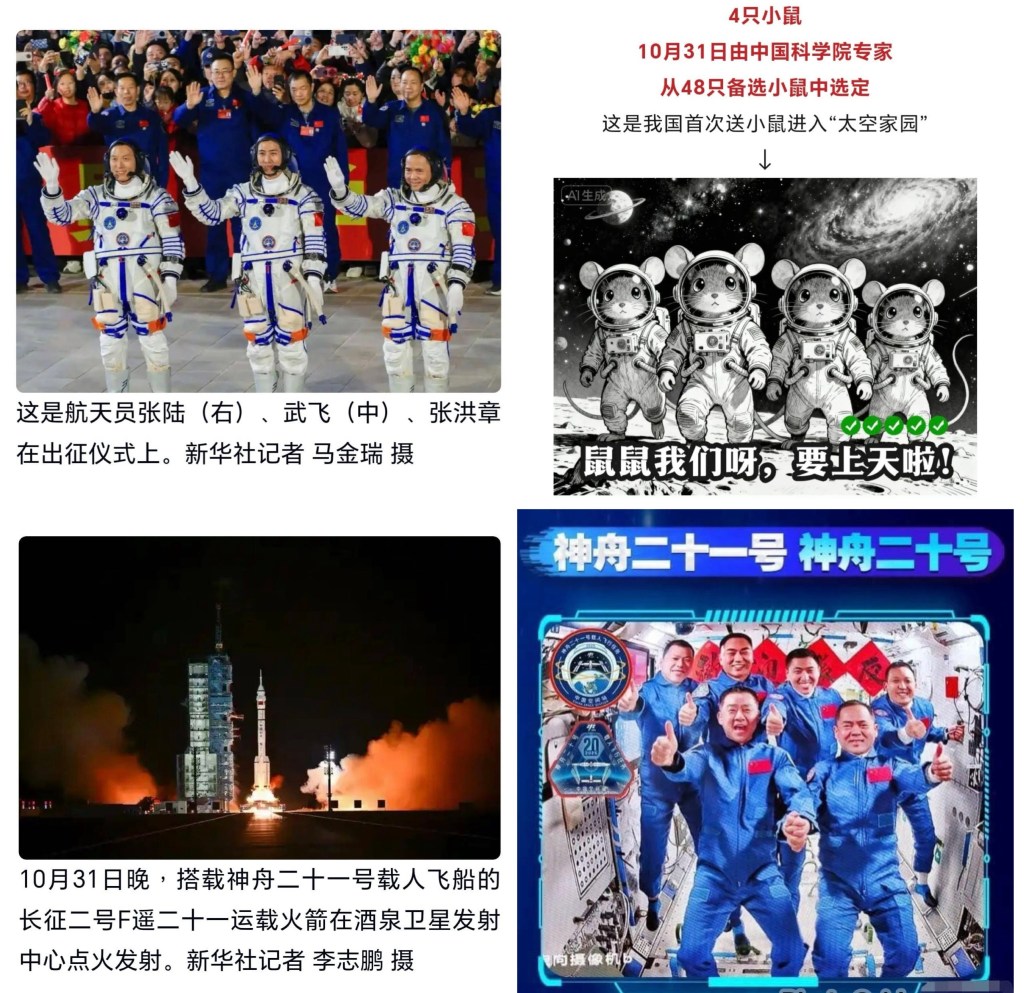
At 23:44 on October 31st, the command “Ignition!” pierced the night sky over the desert. The Long March 2F Yao-21 rocket, blazing with fire, thrust the Shenzhou-21 spacecraft straight into the clouds. Three astronauts were embarking on another journey, heading towards the ‘Heavenly Palace’ 400 kilometers away.
This wasn’t the first time, but it was faster than ever before: 3.5 hours from Earth to the space station – faster than taking the high-speed train from Beijing to Tianjin.
In the past, it took over six hours and orbiting Earth four times; now, it’s less than three orbits before they ‘arrive’. This isn’t just spaceflight; it’s practically ‘flash delivery’ to space.
Some joke that China’s space missions are now as routine as clocking in and out for work. The remark sounds playful, but it’s laced with both pride and the memory of a hard-won journey!
From Shenzhou-1 to Shenzhou-21, over fourteen years, we have turned the mythical feat of ‘ascending to the heavens’ into a routine operation that is plannable, repeatable, and increasingly efficient. This isn’t just a pile of technology; it’s precision carved out millimeter by millimeter, efficiency snatched second by second, paid for with countless heads of whitened hair, worn-out shoes, and balding scalps.
This mission also had some ‘furry’ passengers: four mice, two male and two female, hitched a ride to space. They aren’t pets; they are pioneers for science. How will their behavior, organs, and genes change in an environment of weightlessness, confinement, and radiation? The answers might just be the key to humanity’s long-term deep space presence in the future.
Centuries past spoke of ‘messenger pigeons’; today, we have ‘mice asking questions of the heavens’. From the tragic heroism of Wan Hu tying himself to a rocket-chair to today’s mice taking up residence in the space station, the Chinese obsession with the firmament has never been broken.
Even better, with the arrival of Shenzhou-21, the Heavenly Palace is getting lively. The ‘old residents’ of Shenzhou-20 haven’t left yet, the ‘express delivery’ of Tianzhou-10 just arrived, and Shenzhou-22 is already on its way. Three modules, three spacecraft, and six astronauts are about to have a true orbital ‘gathering’, capturing a real ‘space family portrait’.
This scene vividly echoes the line from The Wandering Earth 2: “The courage of humanity is the passport to the stars and the ocean.” Except, we don’t have to wait for the apocalypse; we are writing the future right now.
You might not know how much ‘meticulous embroidery-like work’ lies behind these 3.5 hours. The rocket’s control system uses a ‘dual ten-table optical inertial navigation system’, the tracking radars have been comprehensively upgraded, and even the optical equipment has optimized image processing – all to ensure the moment the spacecraft enters orbit, the phase difference from the space station is so small it’s practically ‘visible at a glance’.
Engineer Li Zhe put it lightly: “It has reduced the constraints on the launch window.” But how many sleepless nights bought the confidence behind that understated sentence?
From the first docking of Shenzhou-8 with Tiangong-1 in 2011 to Shenzhou-21’s current ‘space express delivery’, Chinese aerospace hasn’t taken detours; it has climbed a spiral staircase of progress. The docking mechanism itself has evolved from the initial ‘hard impact’ to an intelligent, ‘harmoniously balanced’ buffer system, much like the wisdom of Chinese conduct – round on the outside, square within, gentle yet firm.
Tonight, as we scroll through our phones under our blankets, someone is floating in the vacuum, feeding mice, calibrating equipment, and gazing at the blue arc of Earth. They aren’t superheroes; they’ve just moved their ‘home’ to the sky. And every star we look up at might just be reflecting in their portholes.
Shenzhou pierces the Nine Heavens once more, not to pluck stars, but to make a home.
People in the heavens, light on the ground.
This 3.5-hour journey is Chinese speed, but even more so, Chinese warmth
3.5小時到太空!神舟二十一號“閃送”航天員,還帶四隻小鼠上天安家…與某些國家的好萊塢製作不同, 這是真實的!
凌晨的酒泉,風颳得像刀子,可沒人覺得冷,因為天上,有家在等。
10月31日23點44分,一聲“點火”劃破大漠夜空。長征二號F遙二十一火箭噴出烈焰,托着神舟二十一號直插雲霄,三名航天員再次出征,奔赴400公裡外的“天宮”。
這不是第一次,卻比以往任何一次都更“快”:3.5小時,從地球到空間站,比你從北京坐高鐵到天津還快。
過去要繞地球四圈、等六個多小時,現在三圈不到,人就“到站”了。這哪是航天?簡直是太空“閃送”。
有人說,中國航天現在搞得跟上下班打卡似的。這話聽着調侃,實則心酸又驕傲!
從神舟一號到神舟二十一號,十四年,我們把“上天”這件神話般的事,干成了可計劃、可複製、可提速的日常操作。這不是技術堆砌,是無數人熬白的頭髮、磨破的鞋底、算禿的腦袋,一毫米一毫米摳出來的精度,一秒一秒搶出來的效率。
這次任務,還有個“毛茸茸”的乘客,四隻小鼠,兩公兩母,跟着上天。它們不是寵物,是科學的探路者。在失重、密閉、輻射的環境里,它們的行為、器官、基因會怎麼變?這些答案,或許就是未來人類長期駐留深空的鑰匙。
古人說“飛鴿傳書”,如今我們“飛鼠問天”。從萬戶綁火箭椅的悲壯,到今天小鼠住進空間站,中國人對蒼穹的執念,從未斷過。
更妙的是,神舟二十一號一到,天宮就熱鬧了。神舟二十號的“老住戶”還沒走,天舟十號的“快遞”剛到,神舟二十二號也已在路上,三艙三船,六名航天員即將在軌“會師”,拍一張真正的“太空全家福”。
這畫面,像極了《流浪地球2》里那句:“人類的勇氣,是星辰大海的通行證。”只不過,我們不用等到末日,此刻就在書寫未來。
你可能不知道,這3.5小時的背後,藏着多少“繡花功夫”。火箭控制系統用了“雙十表光學慣組”,測控雷達全面升級,連光學設備都優化了圖像處理,為的就是讓飛船入軌那一刻,離空間站的相位差小到幾乎“一眼就看見”。
李喆工程師說得輕巧:“減輕了對發射窗口的約束。”可這輕描淡寫的一句,是多少個不眠之夜換來的底氣?
從2011年神舟八號首次對接天宮一號,到如今神舟二十一號實現“太空速達”,中國航天走的不是彎路,是螺旋上升的階梯。對接機構也從當年的“硬碰硬”,進化成“剛柔並濟”的智能緩衝系統,像極了中國人處世的智慧,外圓內方,柔中帶剛。
今夜,當我們在被窩裡刷手機,有人正漂浮在真空之中,給小鼠餵食、調試設備、望向地球那顆藍色的弧線。他們不是超人,只是把“家”搬到了天上。而我們仰望的每一顆星,或許正映着他們的舷窗。
神舟再穿九霄雲,不為摘星,只為安家。天上有人,地上有光。這趟3.5小時的旅程,是中國速度,更是中國溫度!
-
Chinese graduates from overseas are no longer as highly sought after as they used to be
There are currently as many as 300,000 Chinese students studying in the United States, a stark contrast to the fewer than 1,000 American students studying in China. However, times have changed. Returnees from overseas are no longer as highly sought after as they used to be. 如今在美國的中國留學生高達30萬,形成鮮明對比的是…在中國的美國留學生不到一千人。不過,時過境遷。海歸如今越來越不吃香了.
Twenty years ago, a gilded foreign education could secure an annual salary of several hundred thousand yuan. Even a subpar master’s degree from abroad allowed one to stride confidently through the domestic job market. But now? Many returnees find that their salaries don’t even come close to those of local graduates from top-tier Chinese universities, with some earning as little as 7,000 yuan per month—barely enough to cover rent after careful budgeting.
Behind this shift is the market’s reevaluation of the “glamour” associated with overseas returnees. In the past, a foreign diploma was like a gold-standard credential, symbolizing broad horizons and exceptional abilities. But today, with the rise of domestic universities and an abundance of top-tier talent, employers prioritize practical skills over a foreign degree. I recall a friend with a master’s from a prestigious UK university who sent out hundreds of resumes upon returning, only to end up in a clerical role at a small company, earning less than he did from part-time jobs in London. He wryly remarked that the money spent on his overseas education could have bought half an apartment, yet now he struggles to pay rent.
Then there’s the shift in policy direction. In 2025, Beijing explicitly excluded overseas returnees from its targeted selection program, sending a clear signal: a foreign education is no longer an advantage. At the corporate level, figures like Dong Mingzhu have been equally blunt. She publicly stated that Gree does not welcome employees with overseas backgrounds, citing concerns about espionage risks. While her words may sound harsh, they reflect a growing trust deficit toward returnees in some domestic companies. Whether such risks are real is debatable, but this attitude has undoubtedly left many returnees feeling the chill.
Of course, not everyone is pessimistic. Some returnees have firmly established themselves through genuine competence, particularly in internationally-focused fields where language skills and cross-cultural experience remain valuable assets. The problem, however, is that such opportunities are scarce. Many returnees discover that their specialized knowledge doesn’t align with domestic market needs, leaving them with theoretical expertise but no way to break into their desired industries. One friend, who earned a Ph.D. in the U.S. in a cutting-edge field, found upon returning that Chinese companies preferred technicians who could hit the ground running over lab-bound researchers. He reluctantly switched to sales, spending his days running after clients and joking that he’d traded his doctoral cap for a hard hat.
Statistics further highlight the trend: the number of returnees has surged in recent years, intensifying competition. In 2022, over 800,000 overseas students returned to China, creating a supply-demand imbalance that has driven down salaries. Add to this the global economic downturn post-pandemic and a tightening domestic job market, and it’s clear that returnees can no longer rely on their foreign credentials for an edge. As some quip, returnees today are like discounted imported goods in a supermarket—seemingly high-end but repeatedly marked down.
Another underlying concern is the cultural adaptation gap. Many students who have spent years abroad adopt Westernized thinking and work habits, only to find that the domestic workplace prioritizes interpersonal relationships and teamwork. Some even struggle with basic norms, like deferring to superiors during meetings or offering suggestions too bluntly, leading colleagues to privately label them as self-centered. One friend faced marginalization just three months into his job and eventually resigned, telling me ruefully, “The skills I learned abroad just don’t work here.”
Does this mean studying abroad is meaningless? Not necessarily.
👉 Studying abroad can still broaden your horizons and foster independence, but it requires careful planning. When choosing a major, don’t just focus on rankings—consider whether it will be relevant back home. While studying, don’t just chase a high GPA; gain practical experience through internships to avoid returning clueless about the job market. I know a girl who studied industrial design in Germany and interned at a local company during her studies. Upon returning, she was immediately recruited by a major firm with a six-figure salary. She said studying abroad isn’t the end goal; what matters is whether you can convert what you’ve learned into tangible value.
👉 For those still debating whether to study abroad or feeling lost about their future as returnees, remember: the path you choose is yours alone, and its worth is for you to determine. The market has changed, policies have shifted, but one thing remains constant: competence will always outweigh credentials. Can the determination you honed writing papers abroad be channeled into understanding industry dynamics at home? Can the resilience you built in a foreign land give you the confidence to face lower salaries? The answers lie with you.
👉 Ultimately, the value of studying abroad may never have been about the diploma itself, but about whether you can find your place in an unfamiliar environment. Whether you’re a returnee or a local graduate, the workplace cares less about where you’ve been and more about what you bring to the table. If your salary falls short of expectations upon returning, push harder. If policies are unfavorable, pivot to another path. After all, life offers few shortcuts. Relying on external advantages is fleeting—self-reliance is the only true certainty.
如今在美國的中國留學生高達30萬,形成鮮明對比的是…在中國的美國留學生不到一千人。不過,時過境遷。海歸如今越來越不吃香了。
二十年前,鍍層洋金就能換來年薪幾十萬,哪怕是個水碩,也能在國內職場橫着走。可現在呢?不少人回國后發現,薪水連本地985畢業生的邊都摸不到,有的甚至月薪只有7000塊,租房都得精打細算。
這背後,是市場對海歸光環的重新審視。過去,海外文憑像一塊金字招牌,代表視野開闊、能力拔尖。可如今,國內高校崛起,頂尖人才層出不窮,企業在招聘時更看重實打實的技能,而不是一張外國畢業證。記得有位朋友,英國名校碩士,回國投了上百份簡歷,最後在一家小公司做文職,工資還沒他在倫敦打工時高。他苦笑着說,留學的錢夠買半套房了,現在卻連房租都快交不起。
更別提政策風向的變化。2025年,北京定向選調明確不再招收留學生,信號很清晰:海歸身份不再是加分項。而企業層面,像董明珠這樣直言不諱的也不少。她在公開場合表示,格力不歡迎有海外背景的員工,理由簡單粗暴怕有間諜風險。這話聽起來刺耳,但折射出部分國內企業對海歸的信任危機。是不是真有風險不好說,可這種態度,已經讓不少海歸感到寒意。
當然,也不是所有人都唱衰。有的海歸靠真本事站穩腳跟,尤其是在國際化業務領域,語言和跨文化經驗還是硬通貨。但問題是,這樣的機會並不多,更多人回國后發現,自己學的專業和國內需求脫節,空有一身理論,卻連入行的門都敲不開。有一位在美讀博的朋友,研究方向是尖端科技,回國后卻發現,國內企業更需要能立刻上手的技術員,而不是坐實驗室的學者。他無奈轉行做銷售,每天跑客戶,累得滿頭大汗,笑稱自己博士帽換成了安全帽。
再看看數據,近幾年回國海歸人數逐年攀升,競爭白熱化。2022年,歸國留學生超過80萬,供過於求下,薪資自然被壓低。更別提疫情后,全球經濟疲軟,國內就業市場也收緊,海歸再想靠身份吃紅利,幾乎是痴人說夢。有人調侃,現在的海歸,像是超市裡打折的進口貨,看着高端,價格卻一降再降。
還有一層隱憂,是文化適應的鴻溝。不少留學生在國外待久了,思維方式和工作習慣都西化,回國后卻發現,國內職場更講人情世故,講究團隊配合。他們中的一些人,甚至連開會時都不習慣先聽領導意見,提建議過於直白,結果被同事暗地裡吐槽太自我。有個朋友就因為這個,入職三個月就被邊緣化,最後只能辭職,臨走時跟我說,國外學的那套,在這兒根本玩不轉。
那是不是說留學沒意義了?倒也不至於。
👉留學依然能開眼界,鍛煉獨立性,但前提是得有清晰規劃。選專業時,不能光看排名,得想想回國后能不能落地;讀書時,也別光顧着刷GPA,多實習、多積累實戰經驗,才能不至於回國兩眼一抹黑。我認識一個在德國學工業設計的女孩,讀書時就跑去當地企業實習,回國后直接被一家大廠挖走,年薪百萬。她說,留學不是終點,關鍵是學的東西得能換成真金白銀。
👉至於那些還在猶豫要不要出國的學生,或者已經在國外但對未來迷茫的海歸,我想說,路是自己選的,值不值也得自己掂量。市場變了,政策變了,唯一不變的是,實力永遠比身份管用。你在國外熬夜寫論文的勁頭,回國后能不能用在摸清行業規則上?那些在異鄉咬牙堅持的日子,能不能變成你面對低薪時的底氣?答案,不用我說。
👉最後,留學的意義,或許從來不在那張文憑,而在於你能不能在陌生的環境里,找到自己的位置。不管是海歸還是土著,職場從來不看你從哪兒來,只看你能帶來什麼。回國后薪水不如預期,那就再拼一把;政策不友好,那就換個賽道。畢竟,生活哪有那麼多捷徑,靠山山倒,靠自己,才是硬道理!

-
Guo Zhengliang Video highlights with English subtitles: Nicholas Kristof is a two-time Pulitzer Prize-winning American journalist at NYT said US has lost the trade war to China
Guo Zhengliang Video highlights with English subtitles: Nicholas Kristof is a two-time Pulitzer Prize-winning American journalist at NYT said US has lost the trade war to China. 郭正亮 精選視頻: 曾兩度獲得普立茲獎的美國記者、紐約時報記者尼古拉斯·克里斯托夫表示,美國在對華貿易戰中已經輸掉了!
https://rumble.com/v713kac-nicholas-kristof-of-nyt-said-us-has-lost-the-trade-war-with-china.html
https://www.tiktok.com/t/ZP8DkjDWP/The US Trade War: China Recognizes Trump is Capable of Making Big Deals! Trump Suffers a Major defeat in the Trade War with China? 美國貿易戰, 中國認川普是可以做大買賣的美國總統! 失靈, 川普貿易戰大輸?
Here are the key details of the recent column by Nicholas Kristof in the The New York Times, titled “Trump Lost the Trade War to China” (Oct. 29, 2025). 
📌 Main thesis
Kristof argues that the United States under Donald Trump has lost its trade war with China. In his view:
• The trade war was bungled, leaving China (led by Xi Jinping) in a “significantly stronger position.” 
• The U.S. has not just lost the trade war, but also a chunk of our global credibility and influence for years to come. 
• The U.S.–China relationship, arguably the most important bilateral relationship in the world today, was mishandled. ✏️ Representative quotes
• “We Americans may have lost not just a trade war but a chunk of our global credibility and influence for years to come…” 
• “My new column argues that President Trump bungled his trade war with China, leaving Xi Jinping in a significantly stronger position.” 🧭 Why it matters
Kristof’s piece is significant because:
• It spells out a strategic assessment: that the trade war didn’t produce the leverage or outcome the U.S. expected.
• It connects economic policy (tariffs, trade war) to broader issues of geopolitical influence and credibility.
• It raises implications for U.S. foreign policy: if the U.S. loses influence in the world, that matters beyond economics.
• It serves as a critique of the U.S. approach to China under Trump, suggesting that the U.S. squandered an opportunity or mismanaged the strategy.🔍 Some caveats / things to check
• This is an opinion column, reflecting Kristof’s interpretation and judgment, not a neutral empirical study.
• The column draws broader conclusions (credibility, influence) that may be harder to quantify.
• The full text of the column may require NYT access / subscription.
• The broader question of whether the U.S. “lost” the trade war is complex—and other analysts may disagree with Kristof’s framing or conclusions.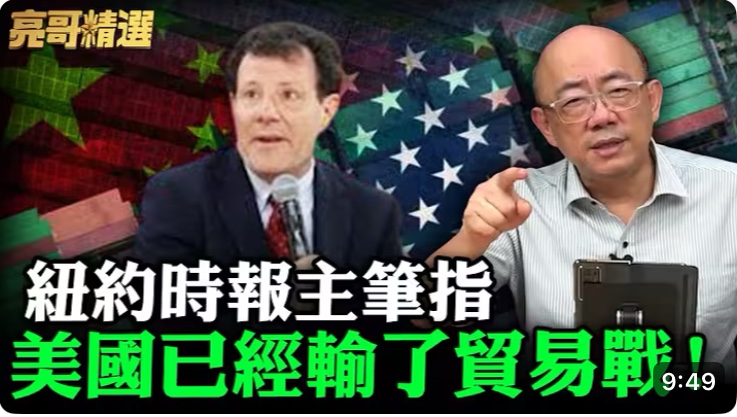
-
Video: The American-style deception has been exposed in China!
Video: The American-style deception has been exposed in China! Anti-China elements are disappointed! America’s “perfect harvesting” system for China has unexpectedly triggered three fatal seeds! It’s been exposed! 視頻: 美國式骗局在中國败露!恨國黨失望! 美国对中国的 “完美收割” 系统,意外触发了三个致命毒芽! 被暴光了!
https://rumble.com/v7134fo-the-american-style-deception-has-been-exposed-in-china.html
https://www.tiktok.com/t/ZP8DhboFu/
-
Subscribe
Subscribed
Have a WordPress.com account? Log in now.

