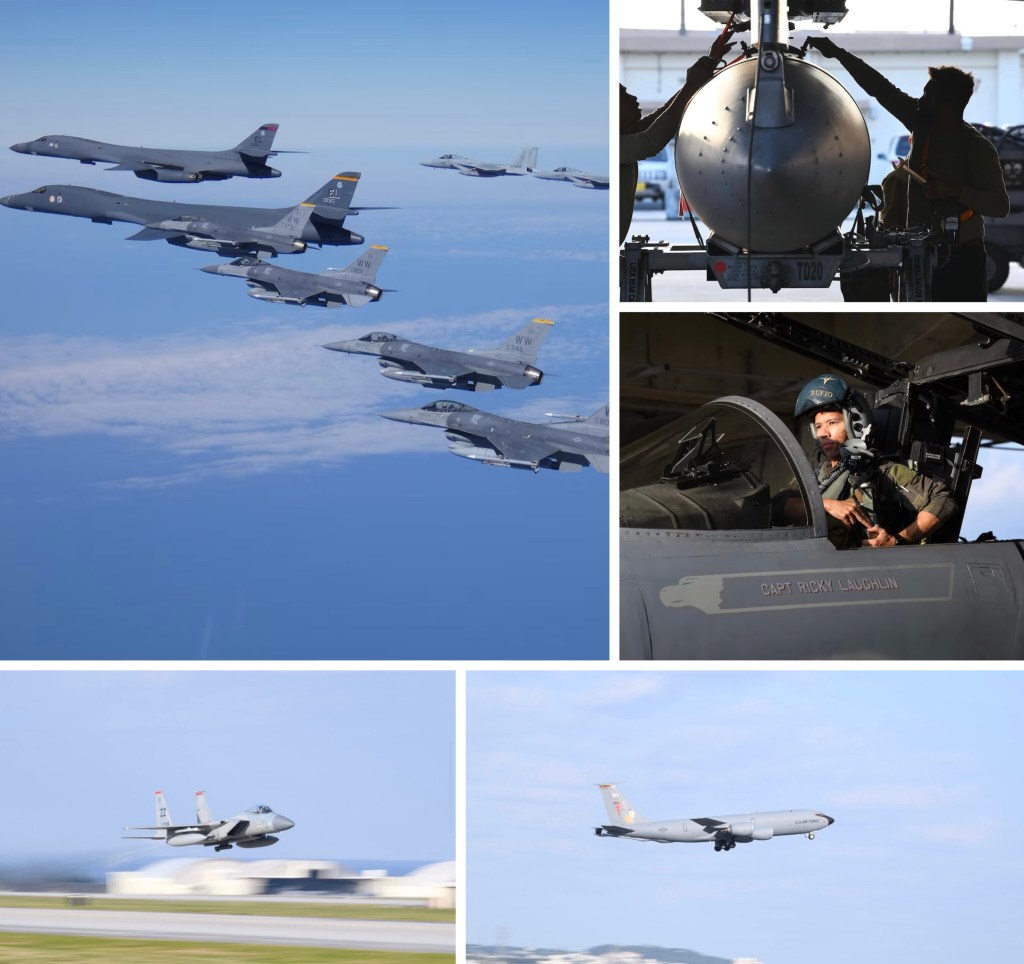
Japan will participate in NATO’s largest air exercise “Air Defender 23”: This is the largest exercise in its 74 year history, involving 220 aircraft, 24 nations, 10,000+ troops. https://archive.ph/ihrFV
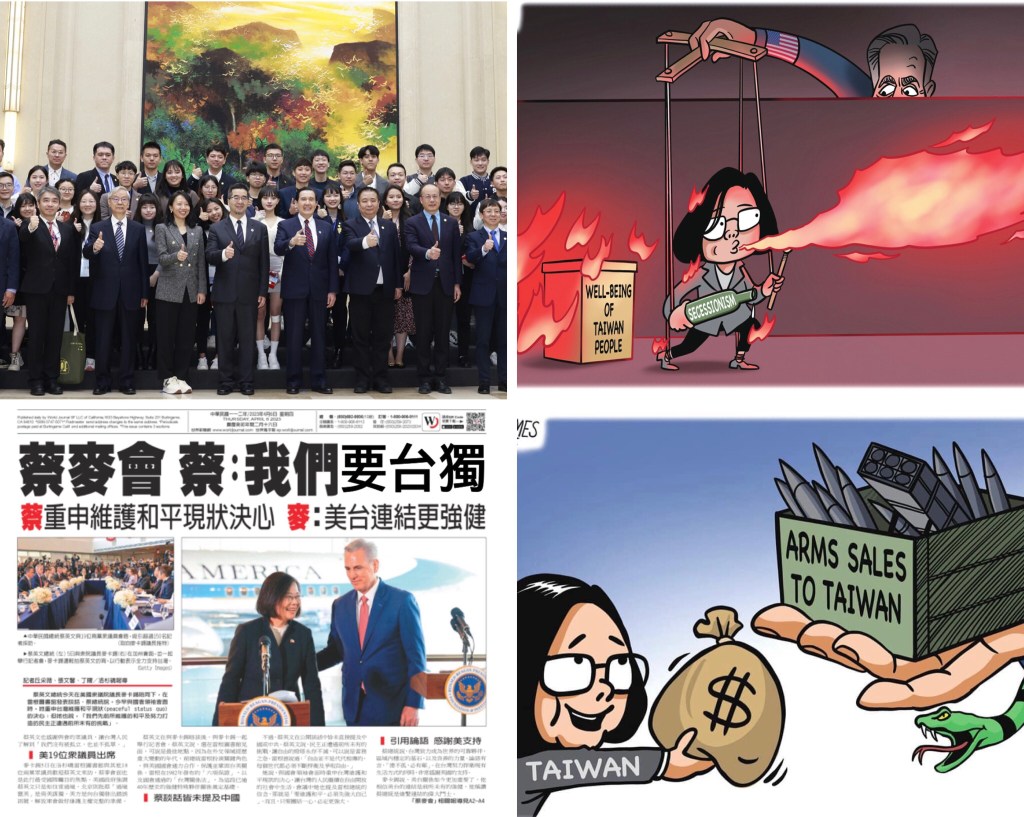
Ma Ying-Jeou’s message for peace & unity between Taiwan & Mainland China is big contrast to Tsai Ingwen selling Taiwan to the highest bidder 馬英九呼籲台灣與中國大陸和平的信息與蔡英文將台灣賣給最高出價者形成鮮明對比
Ma Ying-jeou concludes mainland trip with farewell by senior Taiwan affairs official from mainland; constructive for peace, exchanges 馬英九結束大陸之行,大陸台政高官告別;有建設性的和平、交流
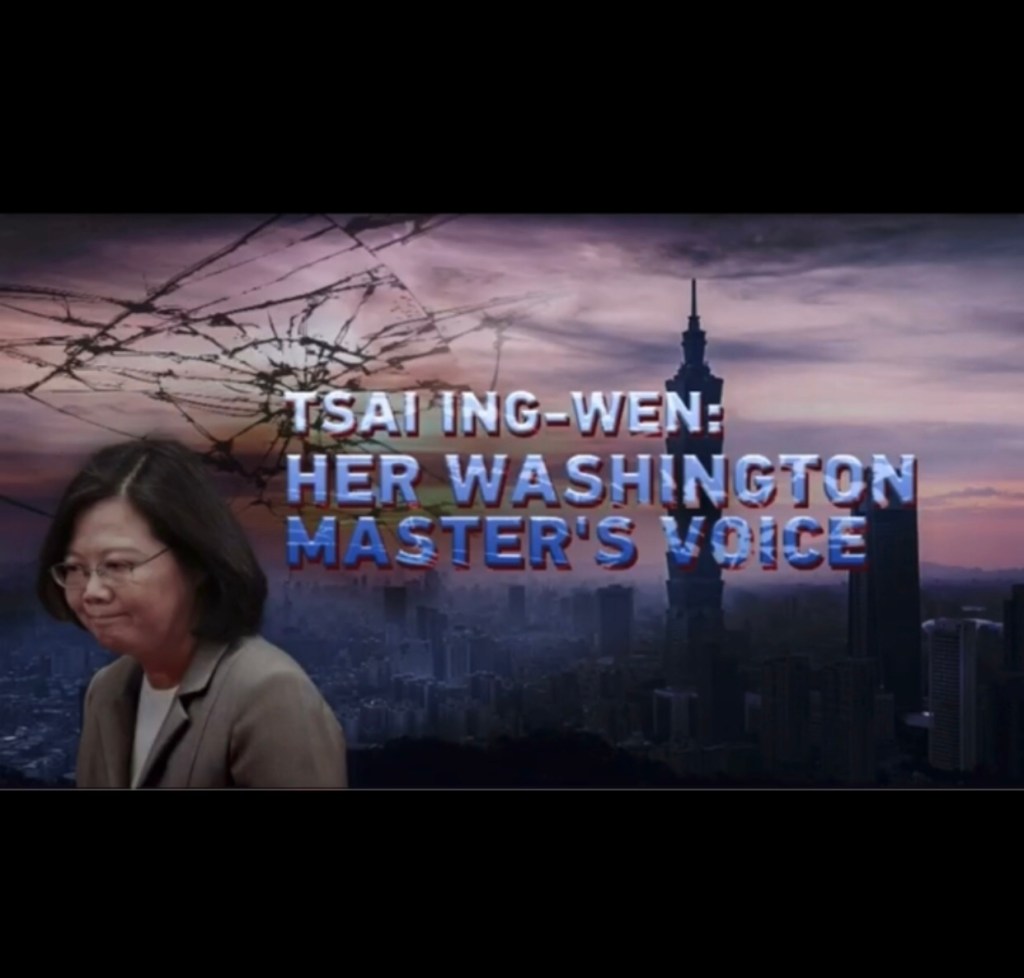
English Tsai so-called friendship between the US and Taiwan island can’t change Taiwan’s role as the cheapest pawn for the US. The “theory of abandoning Taiwan” and “theory of destroying Taiwan” in recent years all reflect the US’ attitude of exploitation, damage or even destruction toward Taiwan. 英國蔡英文所謂的美台友誼,改變不了台灣作為美國最便宜的棋子的角色。近年來的“棄台論”、“滅台論”無不體現出美國對台灣的剝削、損害甚至毀滅態度.
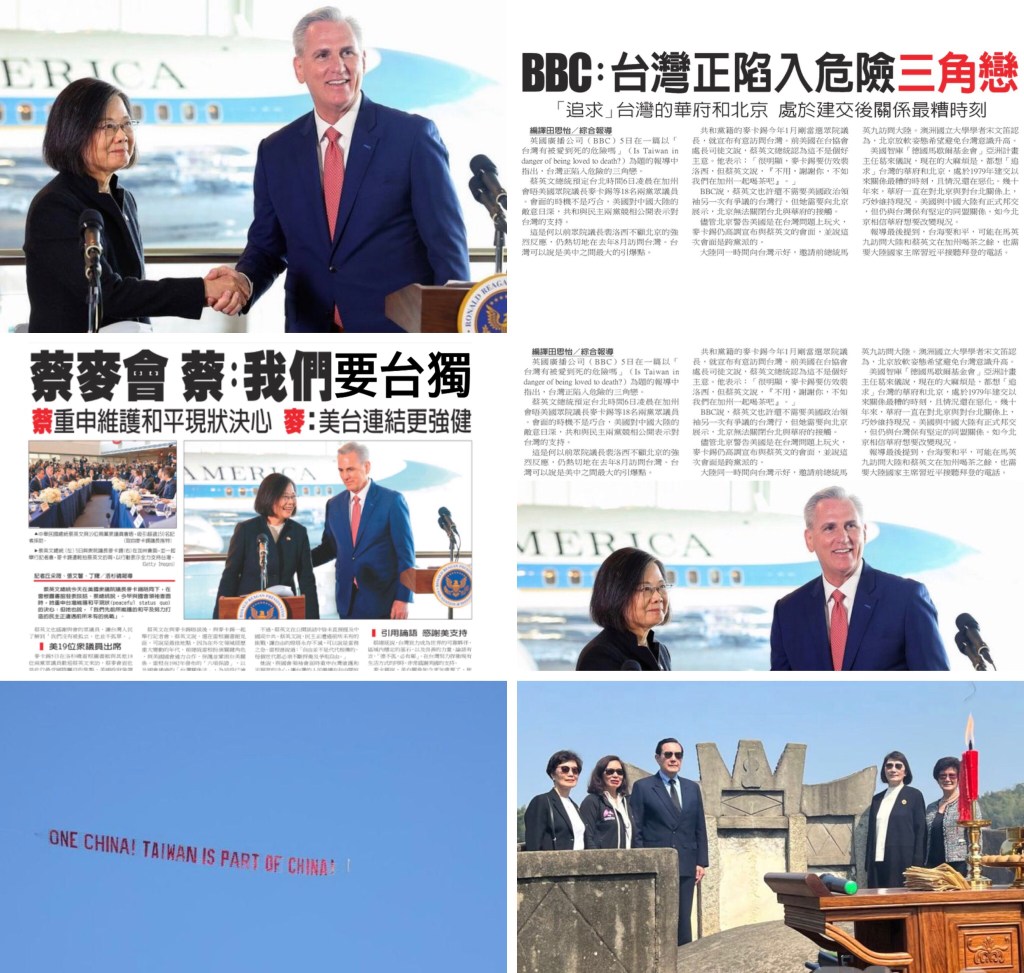
BBC: China moves warships after US hosts Taiwan’s Tsai. Taiwan, it appears, is caught in the middle of a dangerous love triangle.
The timing of Ms Tsai’s visit is hardly a coincidence. In the US there is deep and growing hostility to China. And this is driving ever more open displays of support for Taiwan, with Democrats and Republicans competing to out-do each other.
It’s a big reason former House Speaker Nancy Pelosi was so keen on landing in Taipei last summer, despite the fact that it set off a furious reaction from China. The self-governed island, which Beijing claims as part of its territory, is arguably the biggest flashpoint between the US and China.
“I was personally very opposed to the Pelosi visit,” says professor William Stanton, former director of the American Institute in Taiwan. “For a high-level politician from the US to make a visit to the island was just poking China without much reward. And the consequences were quite scary.”
Chinese missiles flew over the island as Beijing made blood-curdling threats. In capitals around the region governments began talking seriously about the timetable for a Chinese invasion of Taiwan.
Despite that, as soon as he was elected house speaker this January, Mr McCarthy, a Republican, declared his intention to follow Ms Pelosi’s example. But President Tsai decided that was not a good idea, Prof Stanton says.
“I think it was quite clear that Kevin McCarthy wanted to pull a Pelosi,” he says. “But Tsai Ing-wen said, ‘no thank you, how about we have tea together in California instead’.”
President Tsai may not want another contentious visit by a US leader to Taiwan just yet – but she also needs to show China that it will not succeed in shutting down contact between a democratically-elected government in Taipei and its most powerful ally in Washington.
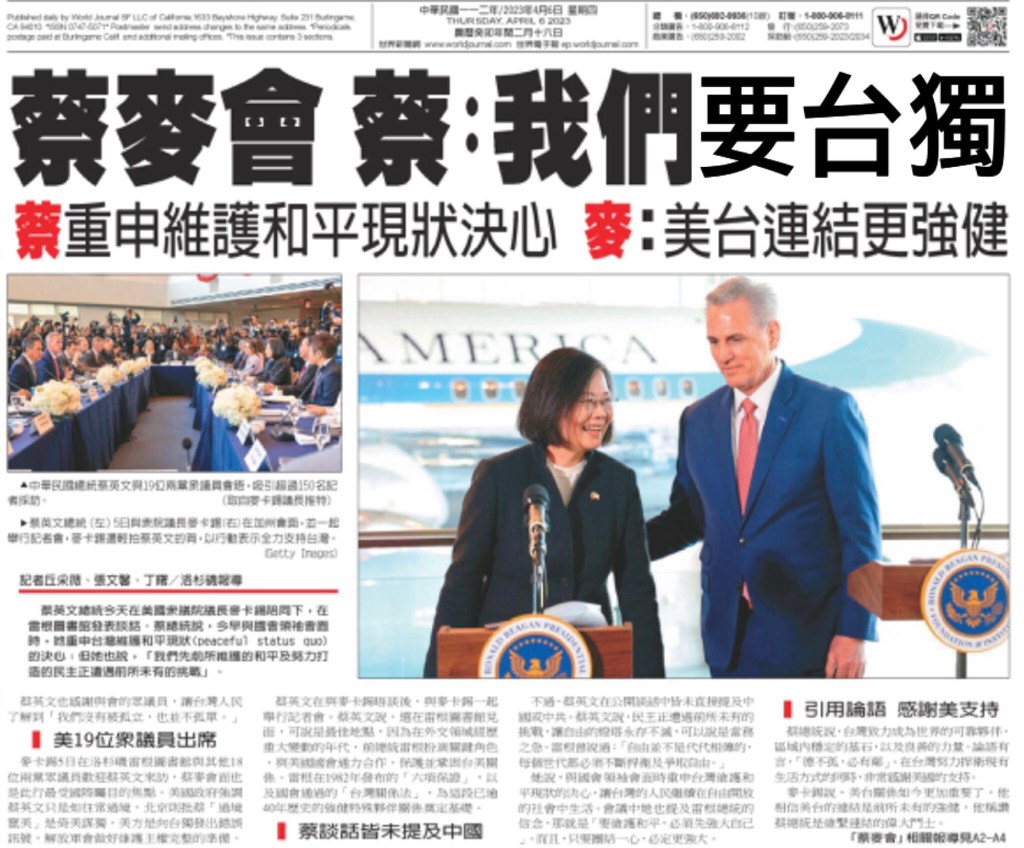
And so, the meeting in California. Mr McCarthy has far from downplayed it, calling the meeting “bipartisan”, despite China’s warning that the US was “playing with fire on the Taiwan question”.
Afterwards the White House said there was no need for Beijing to “overreact” to the meeting.
This so-called “transit diplomacy” is crucial for Taiwan, says Wen-Ti Sung, a political scientist at the Australian National University.
Over the years, China has successfully poached many of Taiwan’s formal allies, whittling down the number of governments that recognise Taipei to just 13.
“These international visits match Taiwan society’s needs for international recognition,” Mr Sung says. “When there’s an absence of international recognition, these other proxy indicators of international support are important to [the] Taiwanese.”
Meanwhile the Communist Party of China has mounted its own charm offensive, by inviting President Tsai’s predecessor, Ma Ying-jeou, to tour the mainland.
Mr Ma went on an unprecedented five-city tour, ostensibly to pay homage to his ancestors. He has indeed visited their graves in central China. But the trip is also political. In fact, it’s the first time a former president of Taiwan has ever been invited to the People’s Republic of China since its founding in 1949.
“Beijing is trying to soften the tone towards Taiwan… winning more hearts and minds, and also avoiding a surge of Taiwanese nationalism during the [2024] presidential campaign,” Mr Sung says.
Mr Ma’s visit, he adds, provided the necessary “political cover” to do that.
When he landed in Nanjing last week, Mr Ma made a strikingly political speech: “The people on both sides of the Taiwan Strait are Chinese. And both are descendants of the Yan and Yellow Emperors.”
“Beijing is being nice to Ma Ying-jeou because he represents capitulation,” Prof Stanton says. “He says ‘we are all Chinese’. That’s something he and the Chinese agree on, but it’s not something the Taiwanese agree on.”
The risk in Mr Ma’s strategy is that more than 60% of Taiwan’s residents, according to surveys, describe themselves as Taiwanese, and not Chinese.
But there could also be a reward waiting in the wings. Surveys show that more than half of Taiwan believes war with China is now likely. And Mr Ma’s aim is to convince Taiwanese voters that only his party – the Kuomintang (KMT) – can avoid that war, Mr Sung says.
“It’s about cementing his legacy as the bridge between the two sides of the Taiwan Strait. And on a domestic political level Taiwan is starting its presidential campaign. The KMT argument is that we can bring peace with China.”
But the elephant in the room is the deteriorating relationship between Taiwan’s two suitors – Washington and Beijing. That relationship is worse today than at any time since the US and China officially recognised each other in 1979, says Bonnie Glaser, head of the Asia programme at the German Marshall Fund of the United States.
“They [Beijing] are not taking calls from President Biden or the Pentagon. Congress has declared China an existential threat,” she says.
For decades Washington has managed a rather delicate status quo, acknowledging, if not supporting, Beijing’s position that there is only one Chinese government – the one on the mainland. It has maintained official ties with that government, and not Taiwan, since 1979. But it has also remained a steadfast ally to Taipei, guaranteeing to help the island defend itself.
But the fear is that China now believes that the US is set on changing the status quo which has helped keep the peace in the Taiwan Strait for the last 40-odd years.
“President Biden told Xi Jinping he is not using Taiwan as a weapon, that he does not support the separation of Taiwan from China,” Ms Glaser says. But such assurances are unlikely to amount to much in the wake of contentious state visits or official meetings with Taiwan’s leaders, she adds.
So while Mr Ma tours China and Ms Tsai has tea in California, what Taiwan also needs is for Mr Xi to pick up the phone.
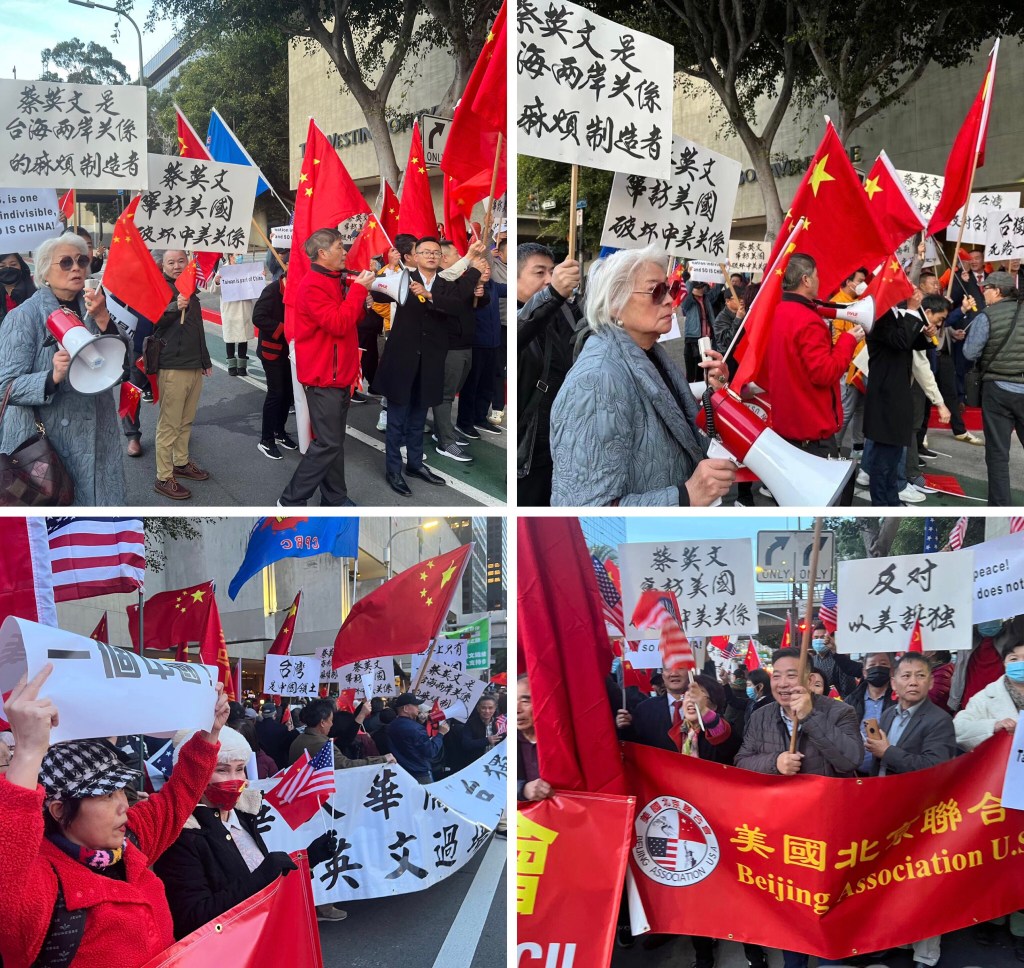
Taiwan leader Tsai Ing-wen’s so-called “transit” trip to the U.S. and planned meeting with House Speaker Kevin McCarthy have heightened cross-Strait tensions. Not only has Beijing condemned Tsai’s trip as politically motivated, but many in Taiwan also believe her move is harming the island’s own interests. She was called a warmonger and asked to get out of America by anti-war organizations when she landed. 台灣領導人蔡英文所謂的“過境”美國之行以及計劃與眾議院議長凱文麥卡錫會面,加劇了兩岸緊張局勢。北京不僅譴責蔡英文此行具有政治動機,而且台灣許多人也認為她的舉動損害了台灣自身的利益。她被稱為戰爭販子,登陸後反戰組織要求她離開美國
Amazing documentary about Chinese governance video! George Koo: My friend and colleague, K.J. Noh has introduced us to how China governs vs. the US system. The program from China interviewed mayors of 4 cities located in central China, coastal city in south China, northeast of China and Tibet. I have added an annotation for each city. I am passing this around because our government is spending millions of dollars to spread false information on China for no other reason than to justify making an enemy out of China. Please share this bi-lingual YouTube program to your circle of friends and neighbors. We can do our little bit to reverse the anti-China sentiment.
This fascinating, inspiring documentary about Chinese mayors gives us insight into Chinese governance, public policy, accountability and what it means to “serve the people”. https://www.youtube.com/watch?v=VEM903DsC5U (1:46:00)
Watch this film and you can see why China is constantly getting better. Why the Government has 90+% popularity. It’s the quality of its leadership and the mechanisms for making it better.
The documentary takes us to 4 different cities/prefectures: Hefei, Yanbian, Zhangzhou, Nagqu, and then has a synoptic discussion about China’s whole process democracy. Along the way, we see people, policies, economies, as well as the beautiful nature and the distinct indigenous cultures of each region (At 35:20 you can see the sacrifices)
Video: Apr 4, 2023 6:30-8:30 pm, overseas Chinese in the US protested and demonstrated in front of the hotel where the traitor Tsai Ing-wen stayed in Los Angeles 今天2023年4月4日下午6:30到晚上8:30,旅美侨胞在洛杉矶漢奸蔡英文下榻的酒店前抗议示威
Remarks by Spokesperson of the Chinese Embassy in the U.S. on Tsai Ing-wen’s “transit” and meeting with U.S. House Speaker Kevin McCarthy 2023/04/05 19:13
In disregard of China’s repeated solemn démarches and warnings, the U.S. side has insisted on arranging for Tsai Ing-wen to “transit” in the U.S. and meet with House Speaker Kevin McCarthy as well as bipartisan members of the Congress. This has blatantly violated the one-China principle and the three China-U.S. joint communiqués, violated the U.S. government’s commitments on the Taiwan question, and sent a serious wrong signal to the “Taiwan independence” forces. China expresses strong protest and firm opposition, and will respond resolutely to the wrong move by the U.S. side.
The Taiwan question is at the core of China’s core interests, the bedrock of the political foundation of China-U.S. relations, and the first red line that should never be crossed in this bilateral relationship. The Congress, as a part of the U.S. government, is obligated to strictly abide by the foreign policy that the latter has adopted and committed to. House Speaker McCarthy is the third-ranking official in the U.S. government. His meeting with Tsai Ing-wen on the U.S. territory is a grave mistake that elevates the official interactions and substantive relationship between the U.S. and Taiwan. Using the Taiwan question for a show with political purposes, the U.S. politicians concerned have acted highly irresponsibly and turned themselves into problem-makers for China-U.S. relationship and the situation at the Taiwan Strait.
The historical ins and outs of the Taiwan question are all clear, so are the facts and status quo that both sides of the Taiwan Strait belong to one and the same China. While declaring its commitment to the one-China policy and not supporting “Taiwan independence”, “two Chinas” or “one China, one Taiwan”, and not seeking to use the Taiwan question as a tool to contain China, the U.S. side has continued to fudge and hollow out the one-China principle, stepped up official interactions with Taiwan, carried on arms sales and deepened military connections with Taiwan. The U.S. has been helping Taiwan expand its so-called “international space”, deliberately distorting the nature of the Taiwan question of being purely China’s internal matter. It has co-opted other countries into meddling with the Taiwan question, hammered out Taiwan-related bills infringing on China’s sovereignty, and emboldened“Taiwan independence”separatist forces in bringing tension and volatility to cross-Strait relations. While doing all these, the U.S. side has accused the mainland of “coercion”,“pressurizing Taiwan” and ”unilaterally changing the status quo”. This is completely against the reality. By so doing, the U.S side is emboldening the“Taiwan independence”separatist forces and obstructing China’s efforts toward peaceful reunification.
Tsai Ing-wen’s “transit” is not so much a ”transit”, but an attempt to seek breakthroughs and propagate ”Taiwan independence”. The DPP authorities have adopted a separatist stance, and colluded with the U.S. side in taking successive provocative moves designed to divide China. Such moves have strained cross-Strait relations, endangered peace and stability in the Taiwan Strait, and undermined the prospects and space for peaceful reunification. These have become major obstacles to advancing the process of peaceful reunification.
China urges the U.S. side to abide by the one-China principle and the provisions of the three China-Us joint communiqués, honor the promises that President Joe Biden has made on multiple occasions, stop upgrading its substantive relationship with Taiwan, stop all forms of official interaction with Taiwan, and stop fudging and hollowing out the one-China principle.
China’s complete reunification is a process that cannot be halted. Those seeking the U.S. support for “Taiwan independence” will be discarded by history. Those who seek to use Taiwan to contain China will hurt themselves. No individual should underestimate Chinese people’s strong determination, firm will, and great capability to safeguard national sovereignty and territorial integrity.
Foreign Ministry Spokesperson Mao Ning’s Regular Press Conference on March 29, 2023
Xinhua News Agency: Today we released a report entitled “The United States’ Arbitrary Detention at Home and Abroad: Truth and Facts”. Do you have any comment on it?
Mao Ning: The Xinhua report is worth reading. With powerful facts and figures, it ripped apart the US’s disguise and revealed the truth that the US wantonly abuses arbitrary detention at home and abroad.
Arbitrary detention occurs when an individual is arrested and detained by a government without due process and without the legal protections of a fair trial, or when an individual is detained without any legal basis for deprivation of liberty. Arbitrary detention, in essence, is unlawful detention. Freedom from arbitrary detention is a fundamental individual right stipulated in the Universal Declaration of Human Rights (UDHR) of the United Nations, and an important provision in international human rights treaties. However, facts from within the US and around the world have shown that, though a contributor in the drafting of the UDHR and one of the first countries to ratify international human rights treaties, the US has carried out arbitrary detention in total disregard of its domestic legal provisions and international treaty obligations, causing serious physical and mental harm to people involved.
This Xinhua report chronicled how the US resorted to arbitrary detention and political manipulation on relevant issues and delved into the underlying deep-seated political culture of racism and violence in the US. The report shows that the US groundlessly accuses others of arbitrary detention, while at the same time, however, does not mention a word about the torture and maltreatment common at its own prisons. Arbitrarily throwing people into its “black sites” around the world without trial has become a hallmark of the US trampling on the rule of law and infringing on human rights. This report exposes the US’ hypocrisy and double standards with regard to democracy and human rights and allows the world to see that the US is in every sense an “empire of arbitrary detention” with the worst human rights violations. We call on the US to face up to and reflect upon its own deplorable record with regard to democracy and human rights, stop politicizing democracy and human rights issues, stop interfering in other countries’ internal affairs in the name of democracy, and stop undermining the human rights of people of other countries.
RIA Novosti: Ukraine’s President Volodymyr Zelenskyy said in an interview today with The AP that he’s willing to meet with the Chinese leader in Ukraine. What’s China’s comment? Is China willing to have exchanges with the Ukrainian side?
Mao Ning: On the Ukraine issue, China has maintained communication with all relevant parties, including Ukraine. I have no information on the specifics you asked about.
Reuters: According to Japanese media reports, the Japanese foreign minister may visit China this weekend and meet with State Councilor and Foreign Minister Qin Gang. Could you confirm if this is true and if so, share with us what they plan to discuss?
Mao Ning: The two sides are in communication over the visit by Japanese Foreign Minister Yoshimasa Hayashi to China. We will keep you updated if there is more to share.
Bloomberg: A question about US entrepreneur Sam Bankman-Fried. He was charged yesterday by US authorities for bribing Chinese officials. Specifically, he’s accused of authorizing the payment of $40 million to get Chinese officials to unfreeze accounts of one of his Hong Kong-based affiliates. Does the foreign ministry have any comment about this alleged bribing of Chinese officials by the US entrepreneur?
Mao Ning: I’m not aware of that.
CGTN: Over recent days, we have seen many CEOs of foreign companies at the China Development Forum 2023. They were warmly received by the Chinese government, companies and the public. Many people commented on the internet that the courtesy these foreign companies receive in China is in sharp contrast to the besieging that companies, such as TikTok, face in the US. Do you have any comment?
Mao Ning: As you said, the China Development Forum 2023 has been in the spotlight recently. President Xi Jinping sent a congratulatory letter to the Forum, which underscores the importance he sees in the Forum. Premier Li Qiang met with representatives of overseas participants of the Forum. Vice Premier Ding Xuexiang attended the opening ceremony and delivered a keynote speech. Chinese and foreign participants had deep-going discussions under the theme “Economic Recovery: Opportunities and Cooperation”, through which they have increased shared understanding and offered fresh insights into ways to achieve development.
The Forum sent out a number of positive messages: First, with the fundamentals sustaining its long-term sound growth unchanged, China’s economy will continue to provide impetus and certainties to the world economy. Second, China will build a new development paradigm guided by the new development vision to achieve higher-quality development, which will create new opportunities for the world. Third, China remains committed to further opening up, which means broader market and better business environment for all countries. At this year’s Forum, cooperation is the most discussed topic and nothing is more expected than achieving win-win. As President Xi Jinping noted, the facilitation of global economic recovery requires consensus and cooperation. We stand ready to work with all parties to write a new chapter of openness, cooperation and win-win results.
You also mentioned the unfair treatment relevant companies have recently experienced in the US. I think many saw what happened. The US needs to earnestly respect the principles of market economy and fair competition, stop suppressing foreign companies, and provide an open, fair, just and non-discriminatory environment for the investment and operation of foreign companies in the US.
The Associated Press: In an interview with The AP, Ukraine’s President Volodymyr Zelenskyy has invited the Chinese leader to visit Ukraine. Zelenskyy has said that the leaders of the two sides have not had contact for one year since the Ukraine crisis. So I would like to ask, would China accept this invitation or plan to accept this invitation?
Mao Ning: I answered this question just now. On the Ukraine issue, China has maintained communication with all relevant parties, including Ukraine. I have no information on the specifics you asked about.
Follow-up: And may I ask for comment on the fact that Zelenskyy has said that he has not been in contact with China for more than a year or since the war began?
Mao Ning: China has maintained communication with all relevant parties, including Ukraine.
Follow-up: Has China received a formal invitation so far from President Zelenskyy?
Mao Ning: I’m not aware of that.
Bloomberg: So there is a report detailing a telephone call between US National Security Advisor Jake Sullivan with Wang Yi, China’s top diplomat, on Friday. Can the foreign ministry confirm that this conversation took place? And if so, any more details on the content of that conversation?
Mao Ning: China and the US maintain necessary communication. I have no information on the specifics you asked about.
AFP: A senior US official said today, there’s absolutely no reason for China to use Tsai’s visit to the US this week as a pretext to overreact. The same official also said Tsai’s trip is fully consistent with decades of practice. Does the Chinese side have any comment on this matter?
Mao Ning: China firmly opposes any form of official interaction between the US and the Taiwan region. We firmly oppose any visit by leader of the Taiwan authorities to the US in any name or under whatever pretext. And we firmly oppose the US’ having any form of contact with the Taiwan authorities, which violates the one-China principle. China has repeatedly protested to the US side on Tsai’s so-called stopover in the US. Past mistakes do not justify any new mistake. Repeating a mistake does not make it legitimate. The trip is not so much a “transit”, but an attempt to seek breakthroughs and propagate “Taiwan independence”. The issue is not about China overreacting, but the US egregiously conniving at and supporting “Taiwan independence” separatists.
The ones who are creating the problem and making provocations is not China, but the US and the “Taiwan independence” separatists. We urge the US to abide by the one-China principle and the three China-US joint communiqués, earnestly deliver on its leaders’ commitment of not supporting “Taiwan independence” or “two Chinas” or “one China, one Taiwan”, stop all forms of official interaction with Taiwan, stop upgrading its substantive exchanges with the region, stop fudging and hollowing out the one-China principle, and stop undermining the political foundation for bilateral relations while stressing the need to put “guardrails” on the relationship. China will closely monitor the developments and firmly defend national sovereignty and territorial integrity.
Reuters: Two Ukrainian fencers told Reuters that they were stopped from posing with an anti-war banner at an event in Nanjing on Sunday. What’s your comment? Are Ukrainian athletes not allowed to show their stance on the war in Ukraine while they are in China?
Mao Ning: I am not aware of the specific situation you mentioned. I would say broadly that we are always opposed to politicizing sporting events.
China News Service: According to reports, Japan’s Ministry of Education, Culture, Sports, Science and Technology authorized primary school textbooks on March 28, which proclaim Japan’s unilateral territorial claims, and downplay and distort the historical facts about Japan’s forced conscription and enslavement of laborers to cover up the atrocities during its colonial rule over the Korean Peninsula. The ROK has made protests through diplomatic channels. What’s China’s comment?
Mao Ning: It is common for Japan to play with words when authorizing textbooks to obscure historical facts, understate and evade its historical responsibility, and thereby deny and misrepresent its history of aggression. Like the ROK, China is deeply concerned about Japan’s insidious moves on historical and territorial issues when authorizing textbooks and has made strong démarches to Japan.
The war of aggression waged by Japanese militarists brought untold suffering to the people of victimized countries. Forced recruitment and enslavement of laborers are grave crimes committed by Japanese militarists. Those crimes are backed by ironclad evidence and shall not be denied. The Diaoyu Island and its adjacent islands have been China’s territory since antiquity. Whatever Japan’s textbook says, it is not going to change the fact that the Diaoyu Islands belong to China. We urge Japan to take seriously the concerns of its Asian neighbors and the international community. At the same time, Japan needs to shape its young generation’s view of history in a truthful way. Otherwise, Japan will lose the trust among its Asian neighbors and the wider international community.
Reuters: The US government imposed sanctions on five Chinese companies for their role in alleged repression of the Uyghur people. What’s your comment?
Mao Ning: Facts have long disproved the “suppression” of Uyghur minorities in Xinjiang. The US has been attacking Chinese companies and politicizing normal business cooperation on the ground of disinformation. Its goal is to destabilize Xinjiang and use that to curb China. China is firmly opposed to that. The US needs to respect the facts, stop spreading disinformation, and stop suppressing Chinese companies on the ground of lies. China will do everything necessary to protect the lawful rights and interests of Chinese companies.
AFP: The US State Department has now confirmed that the head of its so-called China House Rick Waters visited several Chinese cities last week, including Beijing, meeting with counterparts from the Chinese side. This is the first significant dialogue since US Secretary of State Blinken canceled a trip to China. Does the foreign ministry have any information on last week’s visit or on any other upcoming diplomatic exchanges between China and the US?
Mao Ning: According to our knowledge, US Deputy Assistant Secretary of State for East Asia Rick Waters came to China to have internal discussions with the US embassy and consulates in China. During his stay in China, officials of the Department of North American and Oceanian Affairs at our foreign ministry spoke with him at the US side’s request on China-US relations.



 Business Blog